
Readings for the Fourteenth Sunday after Pentecost (Proper 17 – Track 1 – Year A)
Exodus 3:1-15
Psalm 105:1-6, 23-26, 45c
Romans 12:9-21
Matthew 16:21-28
This sermon was preached at Christ Episcopal Church in Eureka CA on August 30, 2026.
Today we continue reading through the Book of Exodus, the story of the movement of Jah people, the people of Jah or Yah or Yahweh, whose name is revealed in today’s reading. Last Sunday, baby Moses escaped death, thanks to the subversive vivaciousness of Shiphrah and Puah and especially his sister Miriam. Moses was then adopted and raised by Pharaoh’s daughter. As an adult aware of his Hebrew identity among Egyptians, Moses witnessed an Egyptian beating a fellow Hebrew and then killed the Egyptian and buried him in the sand. When Pharaoh learned of this, he tried to assassinate Moses, but Moses fled to Midian (a region in northern Egypt and modern-day Saudi Arabia). In Midian, Moses continued to fight bullies, including shepherds who were harassing women at a well. After Moses rescued the women from the shepherds, the women’s father, Jethro (Reuel), invited Moses over to his home, where he stayed and married Jethro’s daughter Zipporah, with whom he had a son. So, this is the context of our reading from the Old Testament today: Moses as a refugee from Egypt in Midian, tending the flock of Jethro. This is when he encounters the burning bush, through which the voice of Yah speaks and commissions him to liberate His people from Egypt.[1]
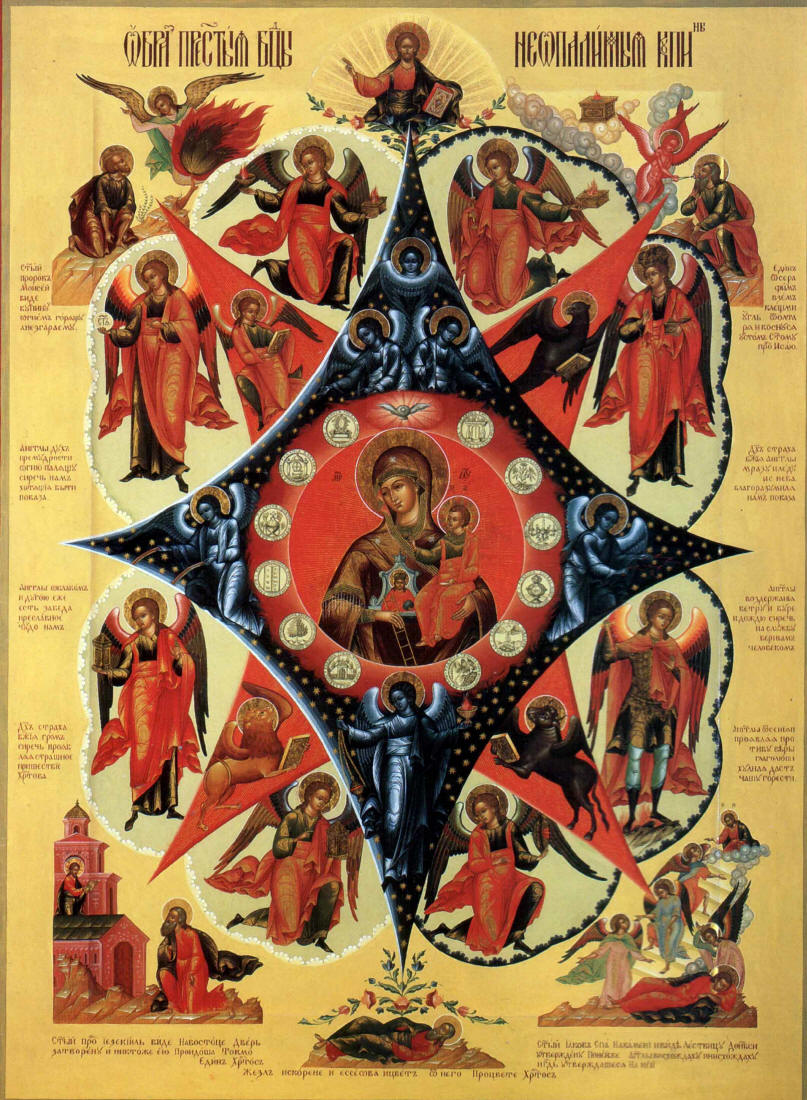
The mystery of the burning bush stirs up creative explanations (not unlike the identity of the angel who wrestled with Jacob). There is indeed a plant in the Middle East (called the Dictamnus albus) which releases high amounts of volatile flammable oils which can ignite into a flame on hot summer days, thus giving it the name “burning bush.”[2] Some suggest that Moses was exposed to psychoactive plants and was hallucinating. Or perhaps it was a subsurface volcanic vent that leaked natural gas feeding a flame that danced around a plant without reducing it to ash. If you go to the courtyard of St. Catherine’s Monastery at the foot of Mount Sinai today, you can visit a blackberry bush which our Eastern Orthodox siblings believe is located at the exact spot where Moses encountered the burning bush. In fact, our Eastern Orthodox siblings celebrate the Feast of the Unburnt Bush on September 4th (this Friday!) and they understand the unburnt bush to be a symbol of the Blessed Virgin Mary, who held God within her womb without being destroyed by the divine glory and who gave birth while still remaining a virgin.[3]
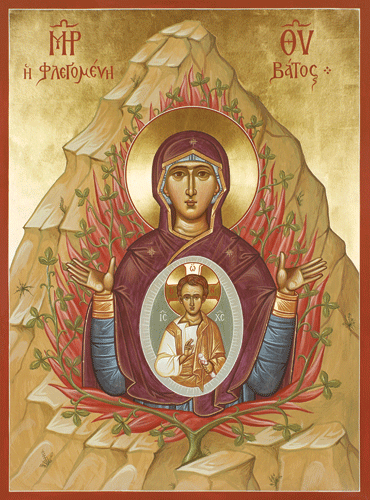
The medieval rabbi Rashi understood the burning bush as a symbol of God’s radical compassion for His people, who although not destroyed, nonetheless suffered under the fire of Egypt’s oppression. The burning bush is thus a manifestation of God’s burning empathy and compassion for God’s people.[4] Rashi’s interpretation resonates with the idea of the burning bush as a symbol of the Paschal Mystery, the Christ who takes on all the powers of death and yet is not destroyed by death. When God revealed His Name to Moses, He also revealed Himself as the One Who Is always burning with compassion for us and always ready to liberate us even if that requires His own immolation. Jesus understood this perfectly, which is why he informed his disciples that he himself would essentially be burned by imperial violence. He would be killed, but not utterly destroyed because the subversive vivaciousness of God would raise him back to life. This is the destiny of the Christ and his followers: to become a living sacrifice (a sacrifice that somehow still lives on) a burning bush (a bush that is burning but not consumed), who is always burning with compassion for God’s people yet never destroyed.
Last Sunday, St. Paul urged us to “present our bodies as a living sacrifice.” We are called to be the burning bush, burning with compassion yet never destroyed. Paul describes what this looks like in a practical, everyday way in our reading from Romans today when he says, “Let your love be genuine; hold fast to what is good; honor each other; be patient in suffering; persevere in prayer; extend hospitality to strangers; bless those who persecute you.” This is part of what it means to be a living sacrifice, burning with compassion. But how do we do all this while not burning out? Burning out from compassion fatigue or just fatigue in general?
The answer is found in God’s promise to Moses, “I will be with you.” The only way we can genuinely take up our cross and become a living sacrifice ourselves, burning with compassion and yet not burning out, is by regularly reconnecting with the God who is always burning with compassion for us, and always ready to liberate us. In a few moments, we will offer what we call “the Passover sacrifice,” which is the Paschal Mystery embodied in bread and wine: the living sacrifice of Christ, the Christ who burns for you so that you can continue burning with compassion for others while not burning out.
The Eastern Orthodox associate the burning bush with the burning coal that the seraphim picked up with tongs from the heavenly altar and placed on the lips of Isaiah. The burning coal not only cleansed and healed the prophet, but also empowered the prophet to burn with compassion for others while not burning out. In the Eucharist, this burning coal is offered to us. So, I invite you to approach the altar today with the same reverence that Moses had when he knelt before the burning bush and with the same awe that Isaiah felt when the angel placed the burning coal on his tongue; for this is the sacrament through which God promises to be with you (as he was with Moses); the sacrament that makes us a living sacrifice and an embodiment of the Paschal Mystery ourselves; that sets us on fire with compassion while not burning us out, that strengthens us to overcome evil with good, and to overwhelm the taste of death with the burning coal and the unburnt bush of God’s everlasting life. Amen.
[1] God essentially says, “Go down, Moses, way down in Egypt’s land; tell old Pharaoh to let my people go.”
[2] https://www.youtube.com/shorts/g62Li1_QDDY
[3] https://www.youtube.com/watch?v=scmZJa4QSOo
[4] This rabbinic interpretation is confirmed by the biblical narrative. In the verses immediately preceding our reading today, the narrator says, “God heard the groaning of his people and looked upon them with compassion.” (2:24 – 25). And God says to Moses, “I have observed the misery of my people who are in Egypt; I have heard their cry… Indeed, I know their sufferings.” The burning bush is a manifestation of God’s burning pathos and compassion for God’s people.


