
Inspired by Bishop Rob Wright’s weekly practice of writing a 150-word reflection on the upcoming Sunday’s lectionary readings, I’m going to try to write a reflection on the readings each week in 250 words or less…
Burning with Compassion
Pentecost 14 – Year A – Proper 17 (Track 1) – August 30, 2026
Exodus 3:1-15
Psalm 105:1-6, 23-26, 45c
Romans 12:9-21
Matthew 16:21-28
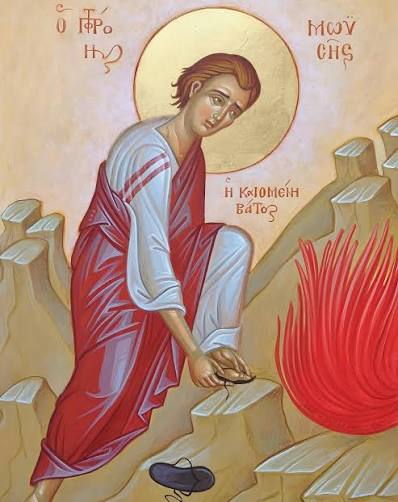
The medieval rabbi Rashi understood the burning bush as a symbol of God’s radical compassion for His people, who although not destroyed, nonetheless suffered under the fire of Egypt’s oppression. The burning bush is thus a manifestation of God’s burning empathy and compassion for God’s people. Rashi’s interpretation resonates with the idea of the burning bush as a symbol of the Paschal Mystery, the Christ who takes on all the powers of death and yet is not destroyed by them. When God revealed His Name to Moses, He also revealed Himself as the One Who Is always burning with compassion for us and always ready to liberate us even if that requires His own immolation. Jesus understood this perfectly, which is why he informed his disciples that he himself would essentially be burned by imperial violence. He would be killed, but not utterly destroyed because the subversive vivaciousness of God would raise him back to life. This is the destiny of the Christ and his followers: to become the living sacrifice, the burning bush, who is always burning with compassion for his people yet never destroyed.
The Eastern Orthodox associate the burning bush with the burning coal that the seraphim picked up with tongs from the heavenly altar and placed on the lips of Isaiah. The burning coal not only cleansed and healed the prophet, but also empowered the prophet to burn with compassion for others while not burning out. In the Eucharist, this burning coal is offered to us.


