
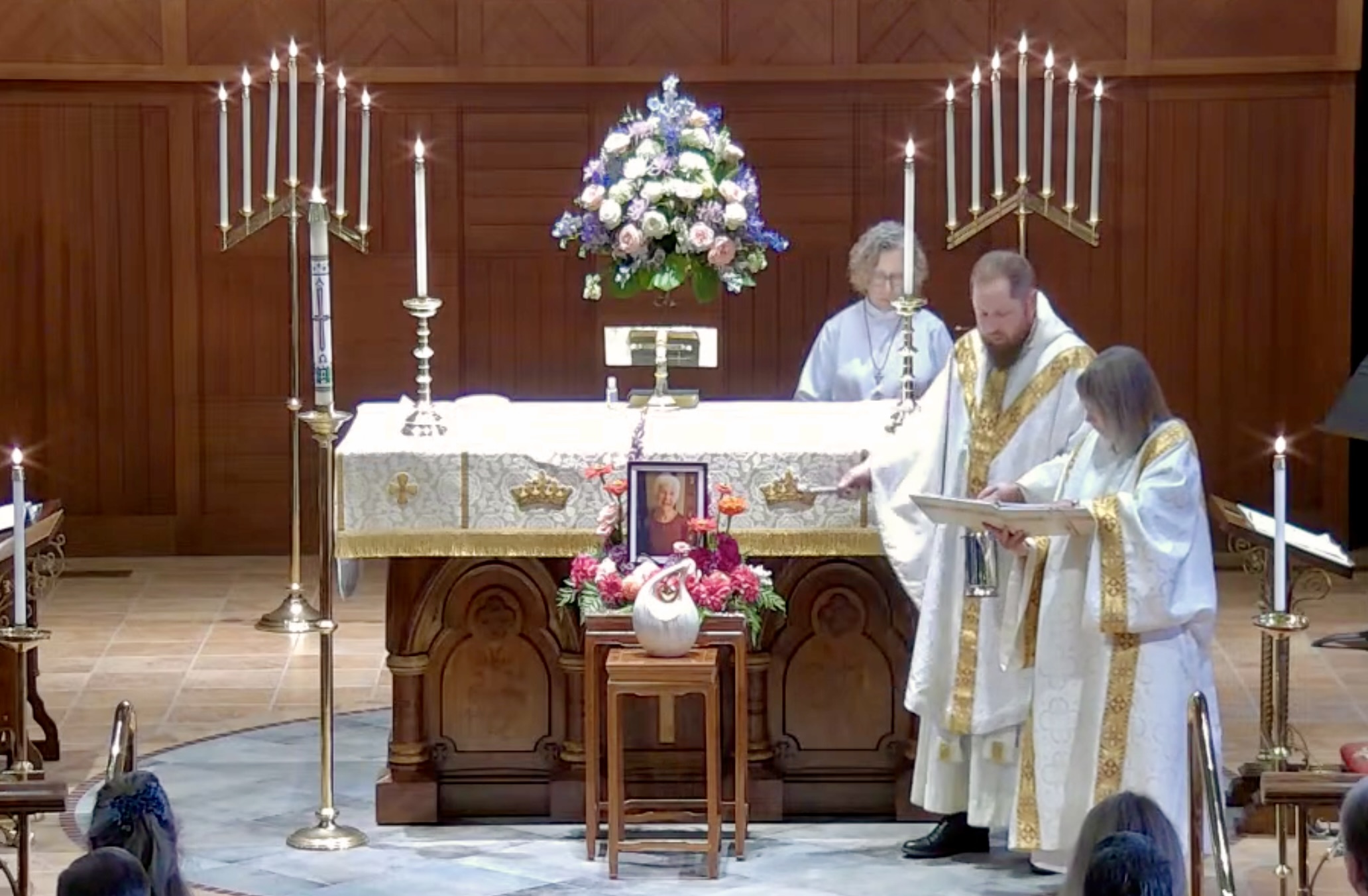
This homily was preached at the Burial Service for Shirley Davis (January 11, 1935 – April 21, 2026) on July 27, 2026 by Fr. Daniel London at Christ Episcopal Church in Eureka CA.
Readings for the Burial Service
- Lamentations 3:22-26; 31-33
- Psalm 23
- Revelation 21:2-7
- John 14:1-6
“Do not let your hearts be troubled. Believe in God; believe also in me. I go to prepare a place for you, that where I am you may also be.” (John 14:1 – 3)
This afternoon we gather to give thanks for the life of Shirley Davis, to grieve her passing, and to grasp ever more faithfully to the promise of the resurrection, a promise that Shirley held close to her heart. As I reflect on the songs and readings for this service, the same readings read at her husband’s memorial service eight years ago (almost exactly), I feel an invitation to connect with Shirley even now in the same way I connected with her when she was alive –whether it was while worshipping with her here with Jim or while she was hosting my wife and me at her home. I feel an invitation to connect with her now through that sixth sense: the heart sense.[1] I remember eight years ago, in the middle of Jim’s service, feeling overtaken by the radiance of Shirley’s heartfelt presence; and I said something I had not prepared, but felt needed to be said: “that among Jim’s many accomplishments and displays of wisdom, his best decision was marrying Shirley,” who is described in her obituary as “the beloved heart of her family” and, in the poem, as “the heart that shaped our whole world through.” I have personally felt embraced by Shirley and her extended family, who are a testimony to her steadfast love (“a steady love we felt so clear”) and who continue to share and expand the radiance of her generous and hospitable heart.
In the Gospel, Jesus says, “Do not let your hearts be troubled.” However, in the original Greek, the word for “heart” (cardia) is singular. The “you” is plural, but the “heart” is singular. So, do not let your “collective heart” be troubled because, in your collective heart, Shirley’s heart lives on. “To live in the hearts of those we love is never to die,” as Scottish poet Thomas Campbell puts in. This does not mean that we don’t grieve. Jesus himself expressed grief in tears when he wept at the grave of his dear friend Lazarus, whom he knew would rise again. So, we give ourselves full permission to grieve for as much and for as long as we need. There is no right way to grieve. The way you grieve is the (right) way; but because of the promise of the resurrection, we need not let our hearts and our collective heart be overwhelmed by the turbulence (tarasso) of our grief.
“Do not let your heart be troubled,” Jesus says, “Believe in God, believe also in me.” When we think about belief and when we are invited to say the words of the Apostles’ Creed, words that Shirley said at her baptism (surely), we would do well to remember the etymology of the Latin word for “belief”: credo, which is again connected to the word cardia: the heart. When we say, “we believe” it is not so much giving intellectual assent to doctrines as it is giving our heart(s) over to these divine mysteries, especially the mysteries at heart of our faith: the “resurrection of the body and the life everlasting.” These are the mysteries that Shirley held close to her heart in this life and mysteries that now fully embrace her.
I don’t want to make this about me, but I must say that it warms the cockles of my heart to learn that Shirley was born on the day that I was ordained to the priesthood, January 11th, and that she died on the day I was instituted here as the rector of Christ Church, April 21st. These days are not only significant to the heart of my identity, but they are also feast days of two great saints of the English spiritual tradition: St. Aelred of Rievaulx, the patron saint of spiritual friendship, and St. Anselm of Canterbury. St. Aelred happened to write about the presence of Christ and past loved ones living on in the collective heart of friends; and St. Anselm happened to write about how our belief in God is connected to the experience, not only of the mind, but of the heart. Indeed, Shirley’s birth and death and the heart-centered life she lived in between all proclaim the truth of the Gospel we heard: “Do not let your heart by troubled. Believe in God, believe also in me. I go to prepare a place for you, that where I am you may also be.” Amen.
[1] If this idea feels too abstract to you, I invite you to place your hand on your heart to access this sixth sense.


