
Readings for the Sixth Sunday of Easter (Year A)
This sermon was preached at Christ Episcopal Church in Eureka CA on May 10, 2026.
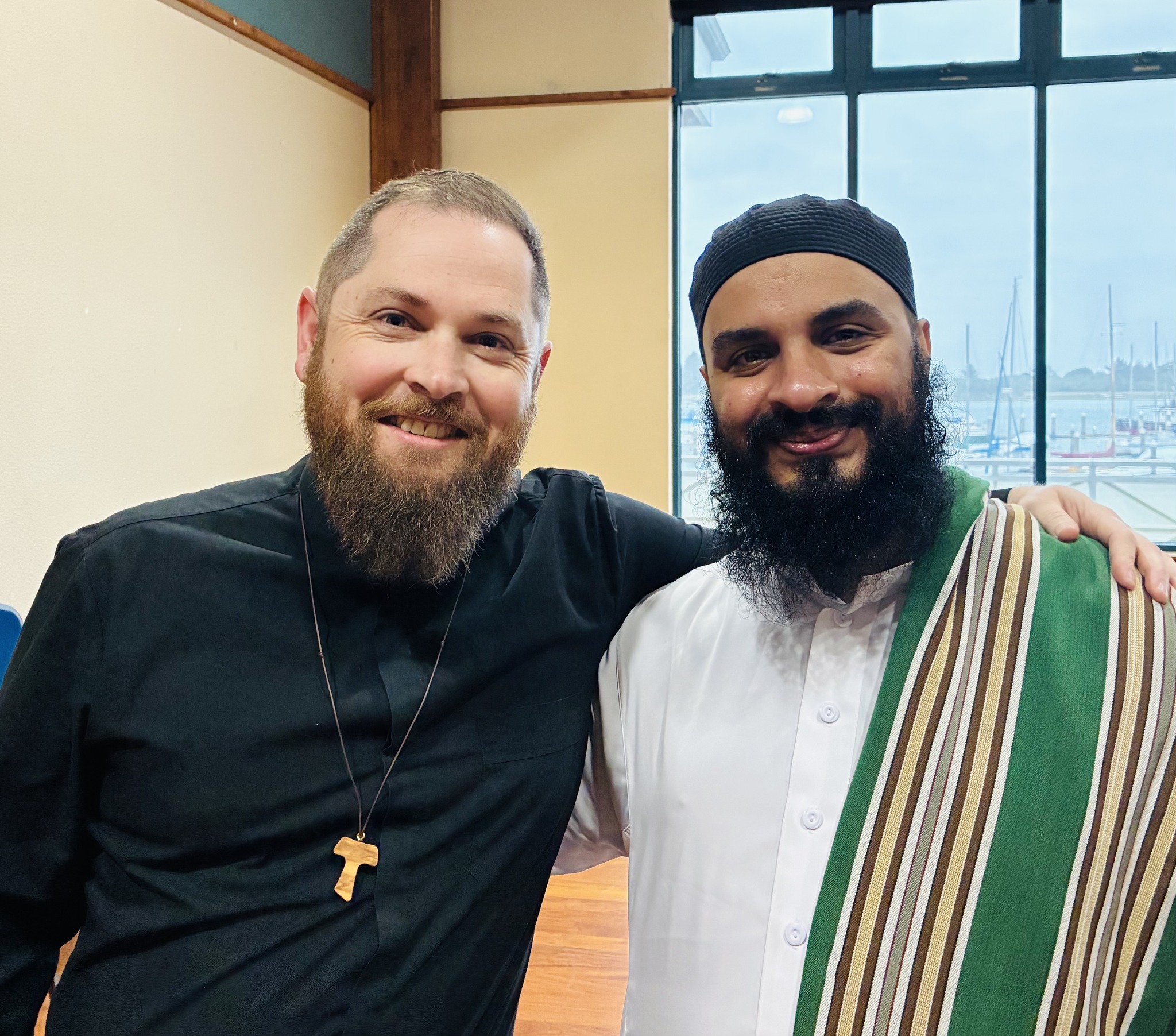
Happy Mother’s Day to you all! On this day when we celebrate motherhood in all its many forms and give thanks for our moms, I want to share with you a story about my friendship with an imam, not an “electronic mom” but an imam – i-m-a-m—which is a Muslim prayer leader. A week ago Thursday, I was invited to participate in a gathering with the local Muslim community here in Humboldt County, while an imam from the Bay Area (whom I had previously met) was briefly in town. The community met at the Wharfinger for some teaching, sharing, prayer, and pizza (from Babe’s Pizza). After we ate, the imam invited people to come to the microphone to share comments or ask questions. The first person he invited to speak happened to be the most obviously non-Muslim person in the room, a priest wearing a collar, clericals, and a large Tau cross. While I felt deeply honored by the invitation to speak, I was also a bit apprehensive since I had not prepared any remarks.
I thought of St. Paul who, in today’s reading from Acts, preaches to the Athenians and says to them, “I see how extremely religious you are in every way.” This would have been an appropriate comment for me to make since the Muslims had just concluded their elaborate evening prayer service (maghrib) which involves removing shoes, facing East towards Mecca, bowing, chanting, and prostrating several times, and making all of our rituals and “pew aerobics” here seem almost elementary in comparison.
I thought of St. Peter who, in our reading today, says, “Always be ready to make your defense to anyone who demands from you an accounting for the hope that is in you; yet do it with gentleness and reverence.” I could have respectfully laid out the historical evidence and philosophical arguments that support my faith in the Risen Christ, the Christ who is more than just another prophet, but who, we believe, is the incarnate Word of God.
I thought of emulating today’s Psalmist who says, “Come and listen, all you who fear God, and I will tell you what he has done for me.” I could have shared my personal testimony about how I came to receive salvation through accepting Christ as my Lord and Savior.
I then thought of St. Francis of Assisi, who was also granted an audience with a respected Muslim leader, the Sultan of Egypt Al-Malik al-Kamil, during the Fifth Crusade. Legends abound about this encounter between the saint and the sultan, including the story of Francis challenging the sultan’s religious advisors to a spiritual contest between the Muslim God and the Christian God. According to one biographer (St. Bonaventure), Francis proposed a trial by ordeal in which he and the Muslim leaders would walk through a bonfire; and whoever came out of the fire unharmed would be the one whose God is the true God.[1] I did not suggest doing this at the Wharfinger, thankfully. However, I also knew that such legends were not historical and that what really transpired between Francis and al-Kamil was likely far less theatrical but much more powerful and meaningful and inspiring.

Francis did indeed seek to convert the sultan to Christianity with the hope that such a conversion might lead to the end of the devastating violence of the Crusades. The sultan, who had already earned a reputation for being gracious to Christians and who was waiting for the leaders of the Crusade to accept his terms of peace, likely saw Francis as a kind of Christian Sufi. The Sufis represent the mystical branch of Islam and the sultan’s most highly respected religious advisor was a Sufi mystic named al-Farisi.[2] And the Sufis have a special love and admiration for Jesus, whom they call the “Perfect Sufi.” So, the sultan saw Francis as a devout follower of the Perfect Sufi and was therefore curious and even eager to listen attentively to him. Even more than that, he let Francis preach to his own Muslim troops!
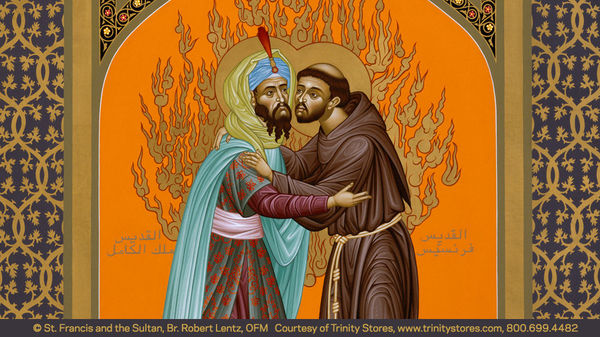
Although Francis failed to convert the sultan, he developed an authentic interfaith friendship and dialogue, centuries before that concept even existed. We also know, based on his later writings, that Francis was deeply impressed with the sultan’s commitment to prayer. Five times a day, the sultan and his entourage (and army) would stop whatever they were doing to pray by bowing, prostrating and chanting recitations from the Quran. Francis grew in his understanding of the Muslim faith and seemed to have undergone his own transformation.
So, when I was given the microphone, I decided to briefly share with the imam this story of the friendship between St. Francis and al-Kamil. While I was clear that I was not trying to compare myself to St. Francis, I thanked the imam for graciously giving this Christian an opportunity to not only speak formally to him but also to his Muslim community. I did not apologize for being Christian or water down my faith in order to make some facile or false conclusion that all religions are the same. Instead, I spoke of my deep and tender love for Jesus Christ and thanked the imam for helping me appreciate Jesus in a new way. The truth is that the imam looks a lot more like the historical Jesus than I do (or than any other Episcopalian I’ve met in Humboldt County.) And when the Muslims pray, their prayers sound a lot more like the prayers of the historical Jesus than any of the prayers that we pray. Although we might forget it, Jesus did not pray in English as we Anglicans do. Jesus prayed in Aramaic, which is closely related to Arabic, the language in which Muslims pray. When Jesus prayed to God, he prayed to Allah or Alaha or Elaha or Elohim. Whenever I spend time with Muslims, I hear Jesus telling me that they have much to teach me about him. So, I thanked them for helping me grow closer to Christ, who is, for me, the Way, the Truth and the Life, my path towards union with God. I also thanked the Muslim women because they have much to teach me about Jesus’s mother.
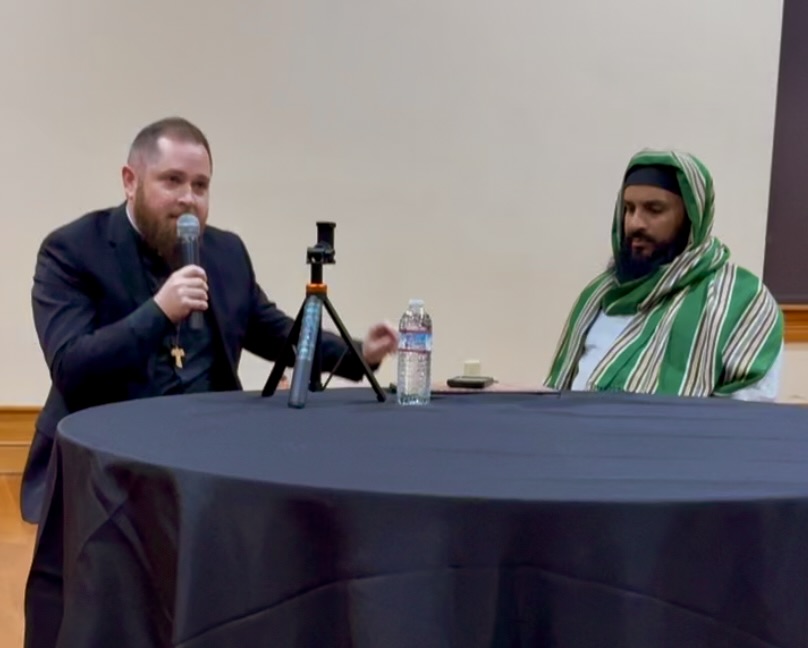
During that same evening, the imam spoke to the community in a way similar to Jesus, when he spoke to his disciples in the Upper Room Discourse, in chapters 13 to 17 of John’s Gospel, chapters that I read during our Maundy Thursday all-night vigil, chapters that focus on our sixth sense: the heart, chapters from which we read during Eastertide. In the Upper Room, Jesus speaks intimately, remains open to questions, and is sometimes interrupted. While the imam was speaking to us, he was interrupted a phone call, which he answered, speaking soft and low. And we all just …waited. And then when he hung up the phone, he said it was his mother; and his rule is that whenever his mother calls, even when he’s in the middle of teaching or preaching, he answers the phone. He then took it as an opportunity to teach and said that the way we treat our mothers (especially in old age) is the litmus test for righteousness. He said, “If you treat your mother poorly, you are automatically an arrogant loser.” The imam then chanted the surah (the chapter) from the Quran about Jesus and Mary and it was captivating! I cannot help but imagine the sultan of Egypt sharing this same surah with St. Francis. This chapter (19) tells the story of people insulting and condemning Mary for getting pregnant out of wedlock. Mary responds by simply pointing to her child Jesus, who defends her by saying, “I am truly a servant of Allah, destined to be a prophet and a blessing wherever I go. My purpose and your purpose is to pray, to give alms, and to be kind to my mother. Peace be upon us all through my birth, through my death, and through my resurrection.”On this Mother’s Day, may we emulate St. Francis and his willingness to learn from our Muslim siblings, who can help deepen our love for Christ. And may we emulate our Lord and Saviour Jesus Christ, who according to our Muslim siblings, was indeed a prophet and the Perfect Sufi who was committed to praying, giving alms, and being kind to his mother. Amen.
[1] Bonaventure, The Life of St. Francis, Ch. 9, translated by Ewert Cousins (San Francisco: HarperCollins, 2005),101 – 102.
[2] The name “Sufi” comes from the Arab word for wool since Sufis often wore wool robes, just like St. Francis. Also, like Francis, Sufis wore cords instead of belts.


