

Readings for the Feast of St. Mark the Evangelist
- Isaiah 52:7-10
- Psalm 2 or 2:7-10
- Ephesians 4:7-8,11-16
- Mark 10:17-27
- and Mark 14:51 – 52
This reflection was shared at the monthly gathering of Postulants, Associates and Oblates of the Community of the Transfiguration on April 24, 2026 in Eureka CA. This reflection was later published in The Transfiguration Quarterly Vol. 79 No. 2 (Summer 2026), 10 – 13.
In his final published journal titled The Road to Daybreak, Catholic priest Henri Nouwen writes the following reflection on the captivating story of the rich young ruler in Mark’s Gospel (Mark 10:17 – 27): “Jesus loved this young man and…desired to have him with him as a disciple. But the young man’s life was too complex; he had too many things to worry about, too many affairs to take care of, too many people to relate to. He couldn’t let go of his concerns, and thus, disappointed and downcast, he left Jesus.”[1]According to “The Promise of Simplicity” from Living the Oblate Promises, “Simplicity encourages receptivity to God’s gracious gift of letting go of attachments that can become stumbling blocks to us. It encourages clearing space for God to work in our lives. Whether the clutter…contains papers, mementos, books, old hurts and resentments, judgments of others, high tech toys, ‘my way’, unconsidered, un-prayed attitudes, or necessities from the last five all-consuming hobbies, the Promise of Simplicity is a challenge to ask God what can and needs to be released.”

What I find so fascinating about Mark’s story of the rich young man is the fact that he includes a detail that is not included in the Gospels of Matthew or Luke, Gospels that both recount this same story of the rich young man.[2] Mark, who is typically known for his sparseness and simplicity and for omitting details that often clutter the flow of the narrative, adds a key detail here.[3] In verse 21 of Chapter 10, he writes, “Jesus, looking at him, loved him.”[4] Have you ever been in someone’s presence and felt their love for you just by the way they looked at you? They didn’t have to say anything. They didn’t even say, “I love you.” They just look at you and love you. Imagine Jesus looking at you and loving you. What might prevent you from experiencing and receiving Jesus’s look of love? What needs to be released and de-cluttered from your life in order to become more receptive to the gaze of agape?
And why do you think Mark added this detail while others left it out?
Nouwen’s reflections on this passage continue: “Jesus was sad, the young man was sad, and today I feel sad because I wonder how different his life would have been had he been free enough to follow Jesus. He came, heard, but then left. We never hear of him again. Every year we remember Peter, John, and James, the three disciples Jesus loved so much. But this man whom Jesus also loved in a special way and also invited to become a witness to the good news, remains unknown. He never became a follower of Jesus and never made his mark on the history of the church as these other disciples did. If Francis of Assisi had remained in business [as a cloth merchant], he would certainly not be remembered so fondly today.”[5]
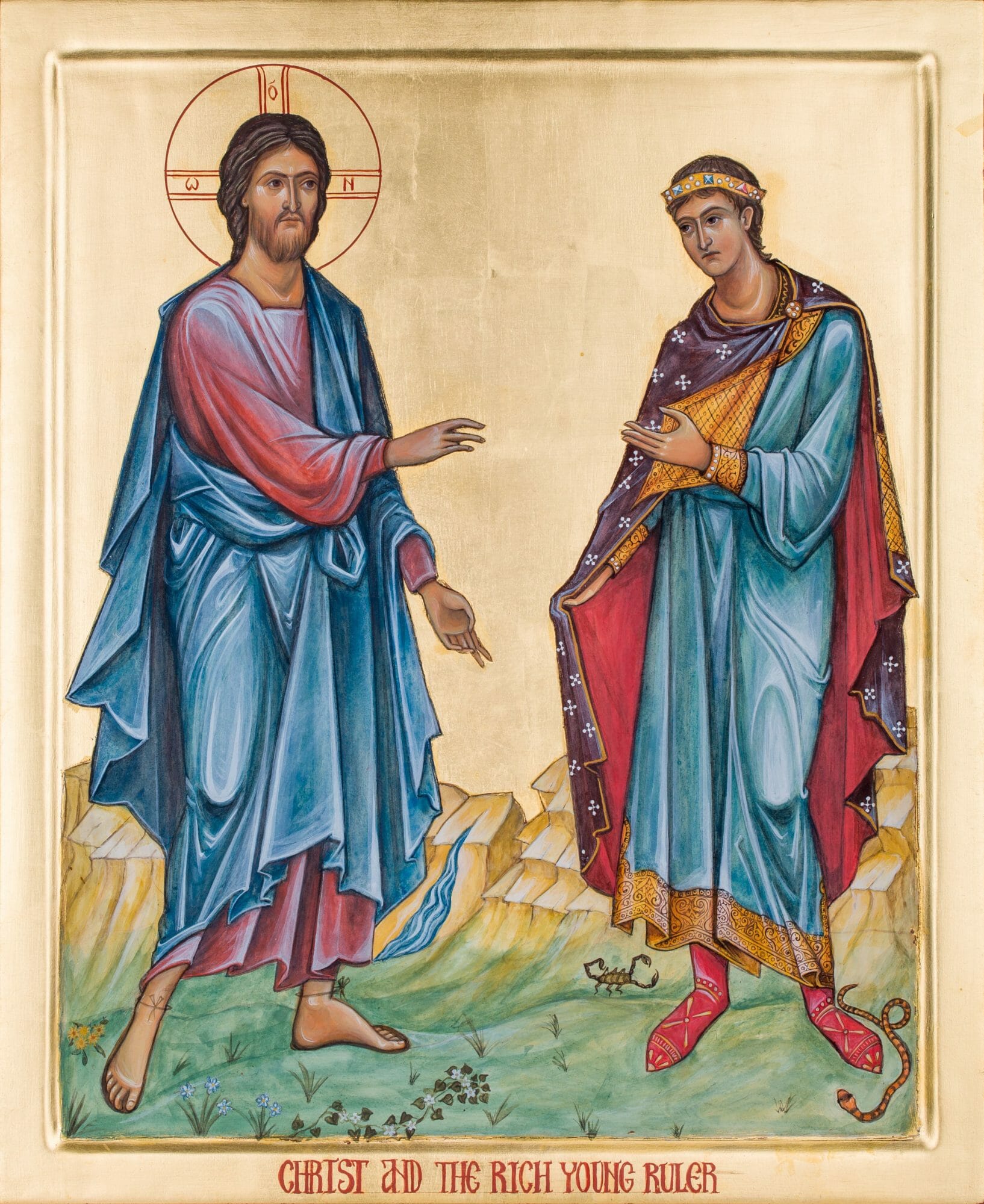
Is it true that this rich young ruler never made his mark on the history of the church as the other disciples did? Is the legacy of this rich young ruler simply a via negativa, a negative example, a kind of Francis of Assisi who never embraced poverty?
Or did this disciple leave his mark on church history by being a kind of proto-St. Francis?
Let’s look briefly at another section of Mark’s Gospel in which the “Evangelist of Simplicity” once again includes a unique (and, in this case, fairly bizarre) detail that the other Evangelists leave out:
“A certain young man was following [Jesus], wearing nothing but a linen cloth. They caught hold of him,but he left the linen cloth and ran off naked.” (Mark 14:51 – 52)

In Mark 14, we read about a young man (neaniskos)[6] who initially follows Jesus wearing nothing but a linen cloth, but when he is caught by the armed men, the linen cloth falls off and he runs away naked. While the early Church Fathers suggested that this unnamed disciple was either James[7] or John,[8] many biblical scholars today believe that the naked man was Mark himself who added this detail as a personal signature of sorts. Others also highlight the fact that the naked man was originally wearing a linen cloth, an expensive commodity during Jesus’s day and therefore largely worn by the wealthy elite. This detail leads some to suggest that the naked man is not only Mark but also the rich young ruler who eventually decided to sell all his belongings, except for his linen cloth. Remember that Mark is the only one who adds the detail about Jesus looking at the rich young ruler and loving him, a detail that makes sense if Mark himself is the one who is on the receiving end of Jesus’s loving gaze.
So, the rich young ruler does indeed leave his mark on church history by selling all his belongings and following Jesus with nothing but a linen cloth, which he eventually relinquishes as well; and then by ultimately penning the Gospel of Mark. In the end, the young man who previously clung to his possessions became the naked man of the Gospel, entirely free of all possessions, even his clothes, thus embodying the radical poverty of the Poverello, more than a thousand years before St. Francis stripped naked in Assisi. And the radical simplicity of this disciple then becomes expressed in the simplicity and sparseness of Mark’s Gospel, which omits extraneous details but includes perhaps the most important detail of all: that look of love from the eyes of Jesus which transformed him and inspired him to embrace a life of radical simplicity.
[1] Henri J. M. Nouwen, The Road to Daybreak: A Spiritual Journey (New York: Doubleday, 1988),15.
[2] Matthew 19:16 – 22; Luke 18:18-23. There is no account of the rich young ruler in John’s Gospel.
[3] Matthew has 28 chapters, Luke has 24, John has 21, and Mark only has 16 chapters.
[4] The word for love here is egapesen from the word “agape,” which is sometimes translated as “charity” or “divine love.”
[5] Nouwen, Road to Daybreak, 15 – 16.
[6] Matthew uses the word neaniskos (Greek for young man or youth or simply man under the age of 40) to describe the rich young ruler in Matthew 19:20
[7] Saint Epiphanius and Saint Jerome think that he was James the Lord’s brother and Eusebius of Caesarea also claims that James had worn a linen garment all his life until this moment.
[8] St. John Chrysostom, St. Ambrose, St. Gregory, and Baronius think the naked man was St. John the Apostle since he was the youngest of the apostles and was the only one who did not immediately desert Jesus and flee.


