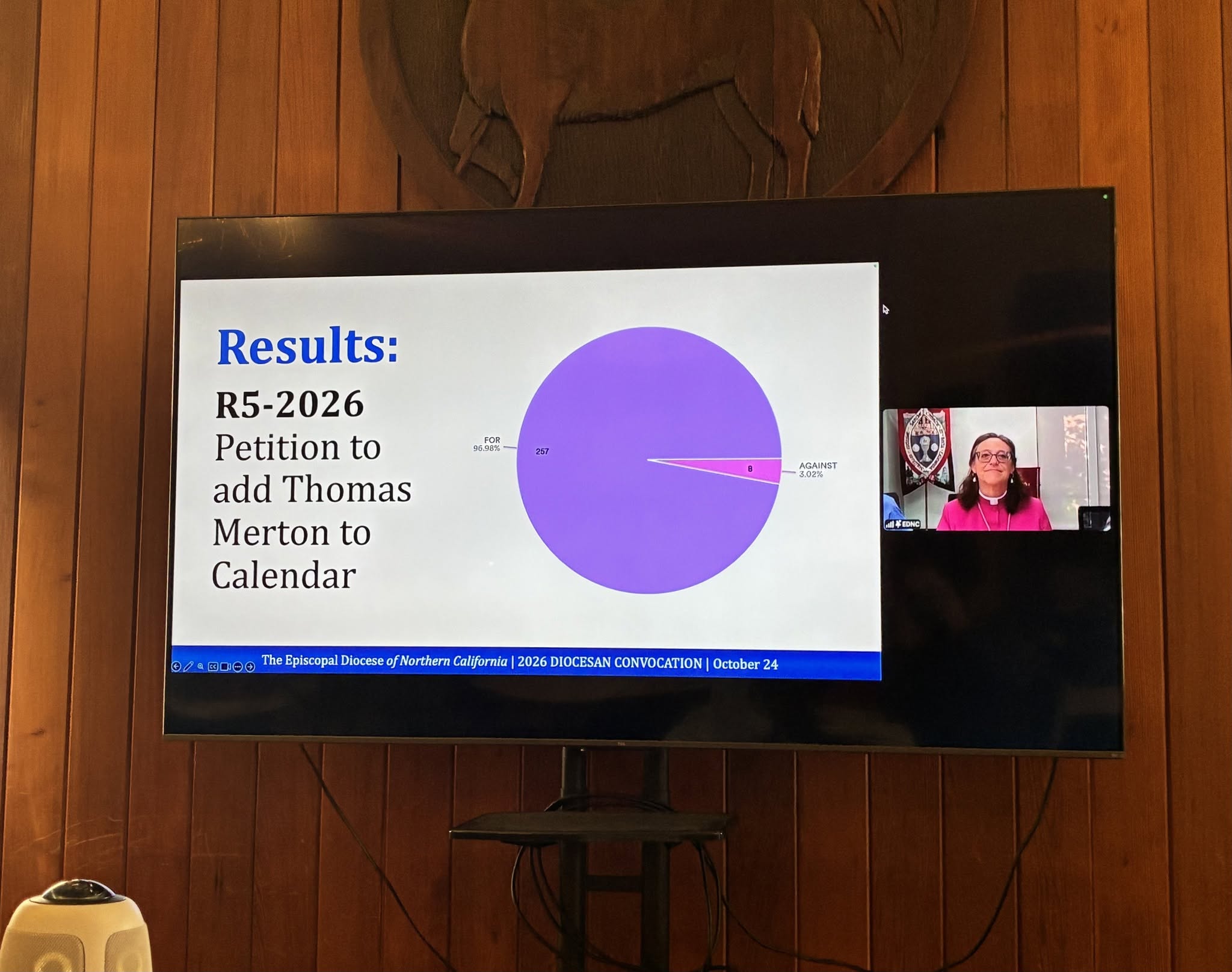
Readings for the Feast of All Saints’ Day
This sermon was preached at Christ Episcopal Church in Eureka CA on November 1, 2026.
Behold, what manner of love the Father has given unto us, that we should be called the sons and daughters of God (1 John 3:1)
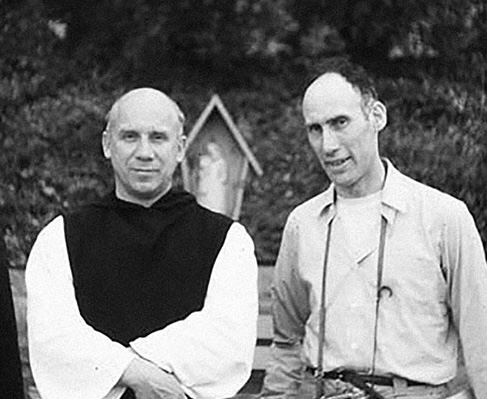
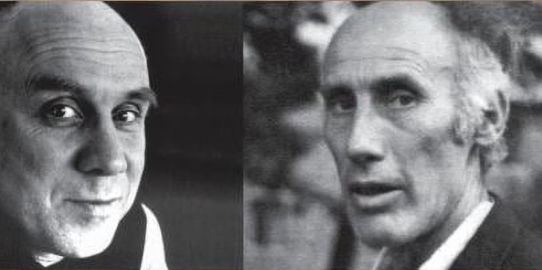
“What do you want to be?” These are the words that Thomas Merton’s Jewish friend Robert Lax asked him as they walked down Sixth Avenue in New York City. Ambling their way through the disruptive construction of the subway in the 1930s, this question caused constructive upheaval in Merton’s soul: “What do you want to be?” Merton’s first thought was, “I want to be Thomas Merton the well-known writer of all those book reviews in the back pages of the Times”; or “I want to be a Freshman English teacher.” But then he decided to address the question on a more spiritual plane, saying, “I don’t know; I guess what I want is to be a good Catholic.”
Robert Lax responded, “What do you mean, you want to be a good Catholic? What you should say is that you want to be a saint.”
This thought initially struck Merton as weird: “How do you expect me to become a saint?”
“By wanting to,” said Lax, simply.
“I can’t be a saint,” Merton protested, “I can’t be a saint.” And then his “mind darkened with a confusion of realities and unrealities: the knowledge of [his] own sins, and the false humility which makes [people] say that they cannot do the things that they must do, cannot reach the level that they must reach: the cowardice that says: ‘I am satisfied to save my soul, to keep out of mortal sin,’ but which means, by those words: ‘I do not want to give up my sins and my attachments.’
Robert Lax continued, “All that is necessary to be a saint is to want to be one. Don’t you believe that God will make you what He created you to be, if you will consent to let Him do it? All you have to do is desire it.”
While this initially seemed a bit absurd and overly simplistic to Merton, it became more and more clear to him that his Jewish friend was teaching him a powerful Christian truth. Merton wrote, “A long time ago, St. Thomas Aquinas had said the same thing—and it is something that is obvious to everybody who ever understood the Gospels.”[1]According to tradition, the great Dominican friar and theologian Thomas Aquinas was asked by his sister Theodora how someone might become a saint; and Aquinas answered with one Latin word: “velle,” which means “to want” or “desire.”[2] All that is necessary to be a saint is to want to be one. And, Merton thought, this is obvious to everybody who has ever understood the Gospels, the Gospels in which Jesus says, “Seek first the kingdom of God and His righteousness, and all these things will be given to you” (Matthew 6:33); “Ask, and it will be given to you; seek, and you will find; knock, and the door will be opened” (Matthew 7:7); and “Blessed are those who hunger and thirst for righteousness, for they will be filled” (Matthew 5:6).
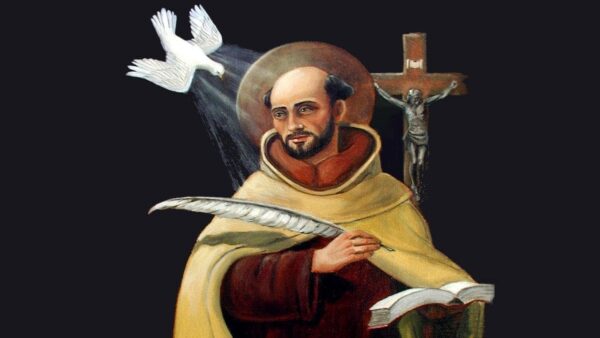
On this Feast of All Saints, I invite us to reflect on the same question that was asked of Merton: “What do you want to be?”[3] A good Episcopalian? Some of us might recoil a bit at the thought of wanting to be a saint – I can’t be a saint! – and perhaps that comes from a healthy humility. But it might also come from what Merton called a “false humility which makes [people] say that they cannot do the things that they must do, cannot reach the level that they must reach.” We might also recoil at the idea of wanting to be a saint because of the saccharine piety and unattainable perfection we often associate with sainthood. Thomas Merton’s friend and social activist Dorothy Day said, “Don’t call me a saint. I don’t want to be dismissed that easily.” She didn’t want to be “put on a pedestal, fitted to some pre-fab conception of holiness that would strip her of her humanity and, at the same time, dismiss the radical challenge of the gospel.”[4] However, for Thomas Merton, becoming a saint meant being stripped of everything but his humanity, his naked self. After his conversation with Robert Lax, Merton felt compelled to purchase the first volume of the Works of St. John of the Cross, the 16th century Spanish mystic who wrote about the Dark Night of the Soul, the experience of spiritual purification in which God strips away all the comforts of the false self. Merton said he was amazed and dazzled by the mystic’s words, but, he said, they “were all too simple for me to understand. They were too naked, too stripped of all duplicity and compromise for my complexity, perverted by many appetites.”[5]
Years later, Merton described the pale flowers of the dogwood outside his window and the little flowers that nobody notices on the edge of the road as saints, looking up into the face of God.[6] And he said, “For me to be a saint means to be myself…sanctity consists in being myself and for you sanctity consists in being your self and…in the last analysis, your sanctity will never be mine and mine will never be yours, except in the communism of charity and grace… Therefore the problem of sanctity and salvation is in fact the problem of finding out who I am and of discovering my true self.”[7]
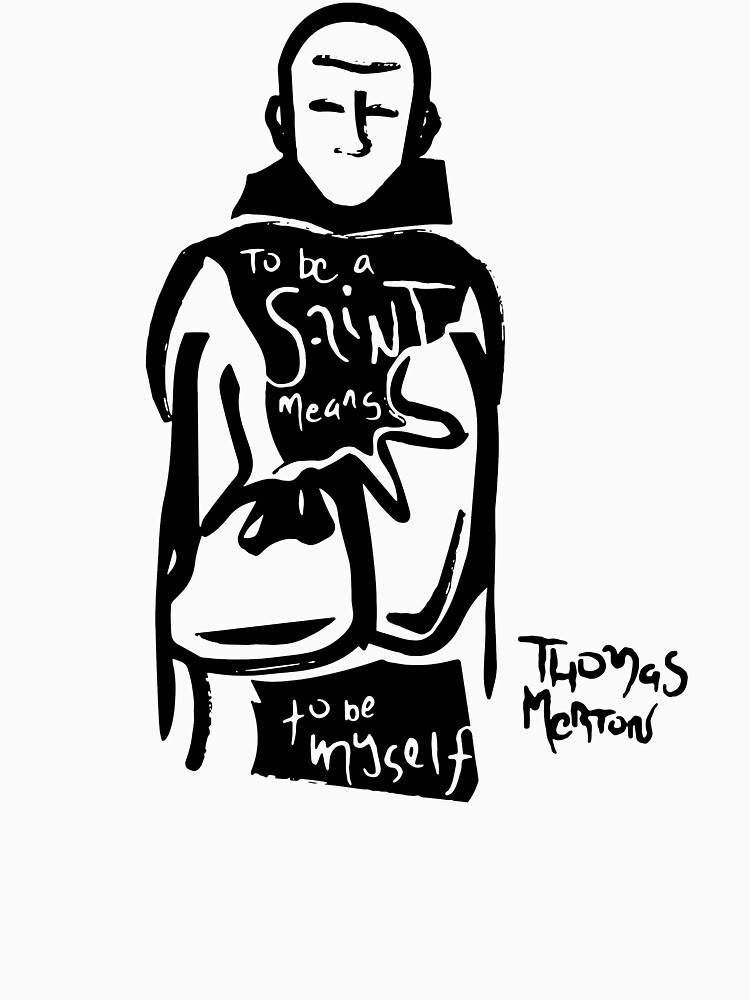
What do you want to be? Do you want to be your true self? If so, then all we need to do is to desire to be our true self and to consent to letting God remove all the masks of our false self. On this day after Halloween, after so many have removed masks and costumes, we are invited to consent to let God remove ours and strip our souls bare.
The Beatitudes in Matthew’s Gospel describe the qualities of those who desire to be their true selves, who hunger and thirst for righteousness and holy authenticity, and who have consented to let God remove all the barriers of falsehood and pretense. This process of sanctification and transformation into our true selves often involves a kind of poverty, tears, humility, vulnerability, mercy, purification, reconciliation, and persecution. Amidst all this, we can rejoice and be glad because we know that God is at work in us, as he was in the lives of the prophets and saints before us, guiding us home to our true selves.
What do you want to be? What we should say is that we want to be saints because, as Lutheran pastor Nadia Bolz-Weber says, “what we celebrate in the saints is not their piety or perfection but the fact that we believe in a God who gets redemptive and holy things done in this world through, of all things, human beings, all of whom are flawed.”[8] We should say we want to be saints because, according to Leonard Cohen, the saint does not dissolve the chaos, rather the saint rides the chaos with the balance of a cross-country skier, tracing “with the fidelity of a seismograph needle the state of the solid bloody landscape, [loving] the shapes of human beings, the fine and twisted shapes of the heart…[for the saints are] balancing monsters of love.”[9] We should say we want to be saints because the saints are truly themselves, inviting us to become truly ourselves, simply by desiring it and by giving our consent to our heavenly Father who has revealed to us our true identity as his beloved children. Amen.
[1] Thomas Merton, The Seven Storey Mountain (New York: Harvest, 1998), 261.
[2] John Placid Conway, Saint Thomas Aquinas, of the Order of Preachers (1225 – 1274): A Biographical Study of the Angelic Doctor (New York: Longmans, Green and Co., 1911), 88. The press for this book happened to be located on Fourth Avenue and 30th street in New York, not far from Merton’s conversation with Lax.
[3] It’s a question that Jesus himself asks of the disciples in the Gospel of John (John 1:38).
[4] James Martin SJ, “Don’t Call Me a Saint?” in America: The Jesuit Review (November 14, 2012) https://www.americamagazine.org/all-things/2012/11/14/dont-call-me-saint/
[5] Thomas Merton, The Seven Storey Mountain (New York: Harvest, 1998), 261.
[6] Thomas Merton, New Seeds of Contemplation (New York: New Directions, 1961), 30.
[7] Thomas Merton, New Seeds of Contemplation (New York: New Directions, 1961), 31.
[8] Nadia Bolz-Weber, Accidental Saints: Find God in All the Wrong People (New York: Convergent, 2015), 7.
[9] Leonard Cohen, Beautiful Losers (New York: Vintage, 1993), 95 – 96.