
Readings for the Sixteenth Sunday after Pentecost (Proper 19 – Track 1 – Year A)
Exodus 14:19-31
Exodus 15:1b-11,20-21 (Song of Moses & Miriam)
Romans 14:1-12
Matthew 18:21-35
This sermon was preached at Christ Episcopal Church in Eureka CA on September 13, 2026.
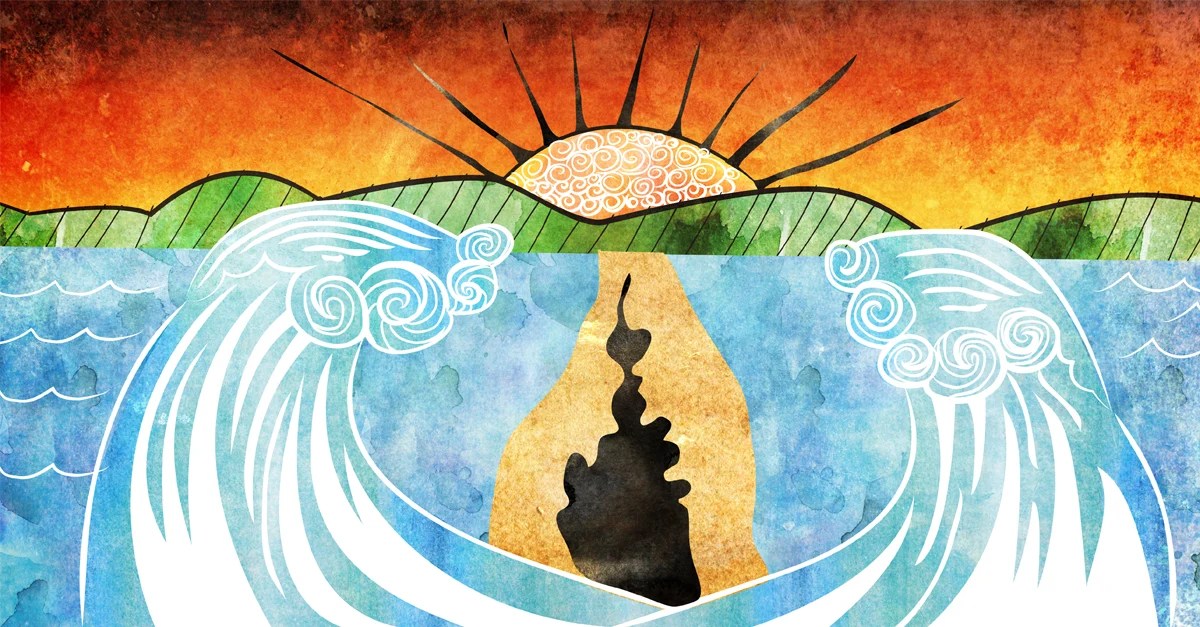
We continue our reading today through the book of Exodus, the story of the movement of God’s people, the story that invites us to reflect on the Paschal Mystery revealed in the Passover Lamb, the symbol of God’s creative vivaciousness, always subverting the powers of death. The Passover Lamb is God’s self-offering who nourishes us at this altar so that we can keep burning with compassion while not burning out, like the unburnt bush. The Passover Lamb nourishes us so that we can remain in the flow (shefa) of God’s subversive vivaciousness like those clever Hebrew midwives who undermined Pharaoh and his deadly decree: Shiphrah and Puah. As I said several weeks ago, the name Shiphrah is connected with the Hebrew word for divine flow: shefa, a word that is also connected with a Jewish musical instrument that is especially significant today. In the Jewish calendar, today is one of the two main High Holy Days: Rosh Hashanah, the Jewish New Year that celebrates the birthday of the creation of the universe as well as the creation of Adam and Eve. Very apt that it falls during our Season of Creation. Rosh Hashanah is celebrated with the sounding of the ram’s horn, known as the Shofar, through which the breath flows, shefa.
In Romans today, Paul says, “Some judge one day to be better than another, while others judge all days to be alike.” (Romans 14:5). Although we Christians don’t celebrate Rosh Hashanah, I want to honor this holy day and our Jewish siblings by introducing you to another lesser-known character of the Bible, who according to Scripture and especially Jewish legend, embodies a crucial aspect of the Paschal Mystery: the courage to face death with daring confidence in God’s vivacity.
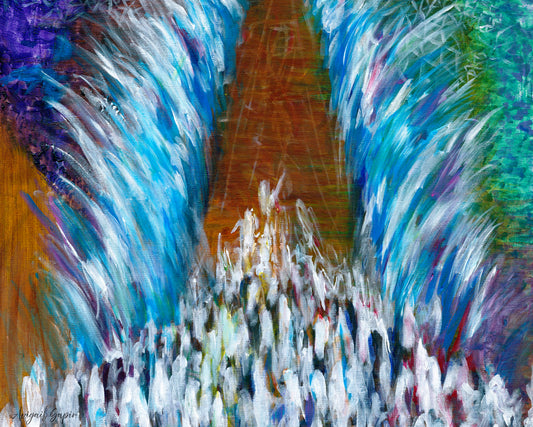
This lesser-known character appears only a handful of times in Scripture, in both the Old and New Testaments. While his name appears only once in Exodus, he was the leader of the tribe of Judah and, according to the book of Numbers, was the first to bring an offering to the altar at the inauguration of the Tabernacle.[1] His name is Nachshon and, according to Jewish Midrash, he was the first Israelite to wade in the waters of the Red Sea before the waters parted. On this Jewish High Holiday, we read the foundational Jewish story of the Israelites’ escape from Egypt in their miraculous crossing of the Red Sea. While the Israelites were complaining and Moses was crying out to God, Nachshon boldly stepped into the water and kept walking as the water came up to his knees, then his waist, then his shoulders, and then his neck. When the other Israelites saw him, they stopped their complaining and Moses stopped crying out to God.[2] When the waters completely covered Nachshon, Moses finally did what God had been telling him to do all along. He lifted his staff and the sea split so that all the children of Israel could move forward and cross the sea on dry ground. All thanks to the courageous action of Nachshon.[3]
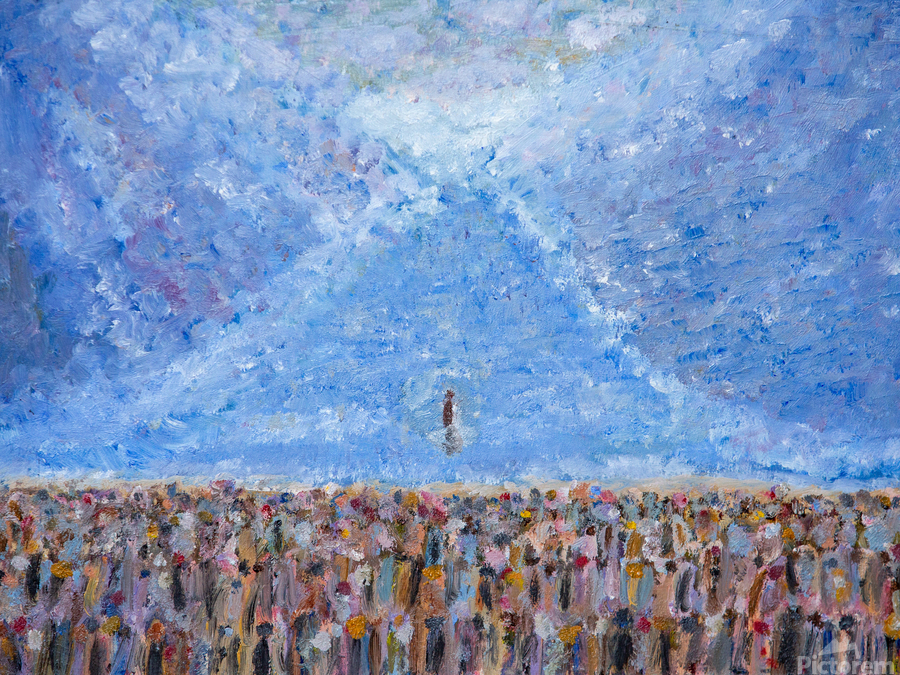
According to this Jewish legend, Nachshon was the first person to be baptized[4] and his act demonstrates the meaning of Holy Baptism. Nachshon understood that, in the words of the poet Robert Frost, “the best way out is always through.”[5] Often, the only authentic way out of pain, suffering, death and hell is through. As the defiant Anglican Winston Churchill said, “If you’re going through hell, keep going.” Holy Baptism is the sacrament by which we receive grace from the God who promises to be with us through our experiences of suffering and death, ego-death and physical death. When we are baptized, we enter into the Paschal Mystery of the Paschal Lamb, Jesus Christ, who according to our prayer book, “went not up to joy but first he suffered pain, and entered not into glory before he was crucified.” We pray these words every Friday[6] (and on Holy Monday)[7] when we also ask God to “mercifully grant that we, walking in the way of the cross,[8] may find it none other than the way of life and peace.” Like Nachshon, we are called to walk through the seemingly impossible challenges and obstacles so often set before us, trusting in the power and vivacity of the One who parted the Red Sea, who rolled the stone away from the tomb, and who conquered death itself. Nachshon had so much faith in God and God’s life-giving power that he was willing to drown; and that’s what baptism is: a drowning, a participation in the death of Christ so that we may also rise with him. This is how we enter into the Paschal Mystery sacramentally and practically, every day, by moving through those experiences we might prefer to avoid, moving through the grief, the frustration, the challenge, the conflict, the argument, the boredom, the loneliness, the diagnosis, which are sanctifying us, baptizing us, compelling us to let go of the false self. During this 25th anniversary of 9/11, we remember the first responders who went through hell to try to save peoples’ lives. That’s what Nachshon was doing, the first baptizand.
Nachshon ended up crossing safely over the Red Sea on dry land, even though he was thoroughly drenched. He ended up becoming the great great great grandfather of King David[9] and thus a great ancestor of Jesus of Nazareth. You can see his name listed in the genealogies of Jesus, in both the Gospels of Luke and Matthew.[10] And in Matthew’s Gospel, we read today about Nachshon’s descendant Yeshua telling stories about how we can emulate the courage of his ancestor Nachshon in our everyday relationships, by practicing forgiveness and generosity, virtues and behaviors that call us to continually let go of our ego and our greed. That’s what today’s Parable is about. Nachshon and his 34x great grandson Jesus call us to let go of our false selves, our over-inflated egos, and our fears of scarcity and to face the obstacles before us, to carry the crosses laid upon us, with a daring confidence in the subversive vivaciousness of God, and with the hope that, after Good Friday comes Easter Sunday,[11] and after we pass through the terrifying Red Sea, we will sing, like Miriam, to our God who always triumphs gloriously. Amen.
[1] Numbers 7:12, 17.
[2] The LORD said to Moses, “Why are you crying out to me? Tell the Israelites to move on.” Exodus 14:15
[3] Exodus 14:21, Mekhilta Beshallach 6, I 234. See The Classic Midrash: Tannaitic Commentaries on the Bible, trans. Reuven Hammer (Paulist Press: Mahwah NJ, 1995), 92.
[4] In 1 Corinthians 10:1 – 2, Paul writes, “I do not want you to be ignorant of the fact, brothers and sisters, that our ancestors were all baptized in the [Red] sea.”
[5] Robert Frost, “A Servant to the Servants,” 1915.
[6] BCP, 99.
[7] BCP, 220.
[8] Tomorrow is the Feast of the Holy Cross.
[9] Nachshon’s son was Salma whose son was Boaz whose son was Obed whose son was Jesse, father of David
[10] Matthew 1:4 and Luke 3:32
[11] We don’t go from Palm Sunday to Easter Sunday without first going through Good Friday.


