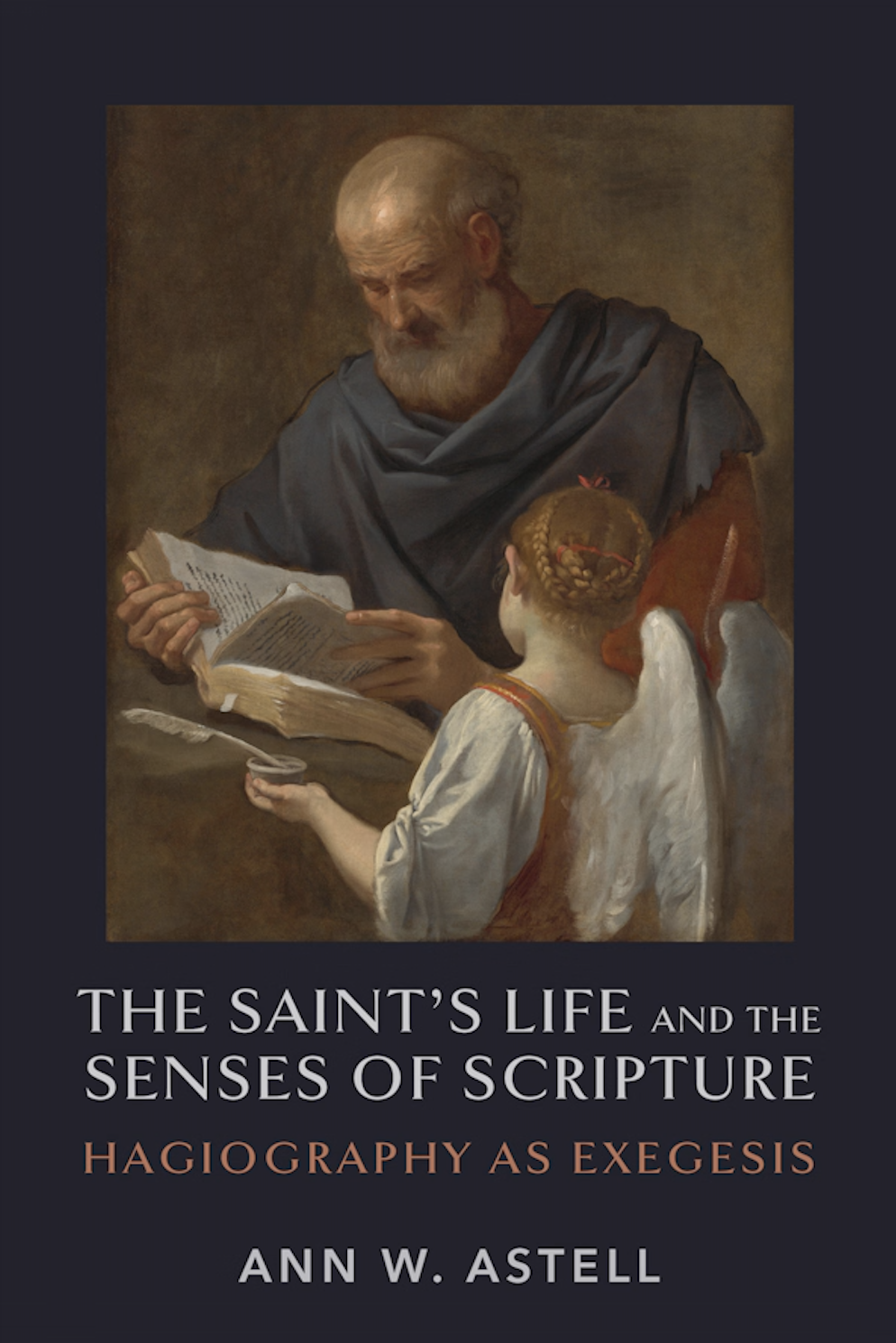
A book review of Ann Astell’s The Saint’s Life and the Senses of Scripture: Hagiography as Exegesis, written for Spiritus: A Journal of Christian Spirituality (Volume 26, Number 2, Fall 2026, Johns Hopkins University Press)
The Saint’s Life and the Senses of Scripture: Hagiography as Exegesis. By Ann W. Astell. University of Notre Dame, 2024. 380 pp. $70.00.
In liturgical churches, the Gospel procession includes two torchbearers whose flames not only symbolize the Light of Christ but also provide the light by which the biblical text can be illumined and read aloud. In The Saint’s Life and the Senses of Scripture: Hagiography as Exegesis, Ann Astell masterfully demonstrates how the saints’ lives, expressed in hagiography, function in a similar way: manifesting the Light of Christ through their own unique radiance while also elucidating the sacred scriptures. Just as torchbearers today may seem a relic of the past since we now enjoy the benefits of artificial light, the genre of hagiography has also become mostly relegated to a category of practical inutility due to the rise of modern biography and biblical criticism. The torchbearer analogy is inspired by Astell herself, who utilizes the image of a candle throughout her book, which begins with an epi-graph about Benedict’s life as “a candle,” a poetic link made by Gregory the Great, who along with Hugh of St. Victor, exhorts readers to use hagiography as a lens for interpreting and understanding scripture (2–3), not unlike the way Aggadot illumines the words of Torah (1). According to Astell, hagiographies function as a sophisticated form of biblical interpretation utilizing the fourfold sense of scripture—literal, allegorical, tropological, and anagogical—whereby the saints’ lives not only help interpret the biblical teachings but also embody them, thus expanding the scope of salvation history. [End Page 354]
In her first four chapters that comprise the first part of the book (“The Saint’s Life in the Age of Monasticism”), Astell shows how Felix of Croyland’s eighth-century Life of St. Guthlac underscores the prophetic and exorcistic power of the Psalms, while Aelred of Rievaulx’s twelfth-century Life of Ninian illumines the six days of creation through a series of six miracles, inspired by Augustine’s commentary on Genesis in his Confessions. In chapter 3, Bernard of Clairvaux’s oft-overlooked Life of Saint Malachy is employed as a “worthy companion piece” (62) to his homilies on the Song of Songs, revealing a “mysticism of pastoral care” (77) in which the bishop serves as bridegroom to his diocese. In the fourth and final chapter of the first part, Astell illustrates the emerging split between the literal/ historical sense of scripture and the spiritual senses by comparing Eadmer’s History of Anselm to his Life of Anselm, both of which engage the Lukan parable of the Great Banquet, literally and allegorically, respectively.
Part 2, titled “The Saint’s Life in the Scholastic Age,” begins with a chapter that cogently compares Thomas of Celano’s Vita prima of St. Francis with Bonaventure’s Legenda maior. Both hagiographies highlight the myriad ways that Francis foregrounds and embodies the biblical teachings of Christ, including the Beatitudes. However, for Bonaventure, who is writing in response to anti-mendi-cant critics like William of Saint-Amour, Francis embodies the biblical text itself as the divine finger engraves his message not on tablets of stone but on his very flesh, in the miracle of the stigmata. While Celano uses a monastic and meditative form to celebrate the miraculous grace of God in the life of the newly canonized poverello, Bonaventure’s work signifies a hagiographic shift, turning more focus upon the motivation, heroic virtues, and evangelical perfection of the saint. This emphasis on the saint’s heroic virtues persists in Raymond of Capua’s Life of Catherine of Siena, and Jacobus de Voragine’s “Legend of Mary Magdalene,” which are the subjects of chapters 6 and 7 that round out Part 2.
In Part 3 (“The Saint’s Life in Modernity”), Astell begins by exploring the “ends” of hagiography—its purposes and historical conclusions—through an analysis of three sixteenth-century texts that each, in their own way, express the decline of hagiography and the emergence of modern biography: Erasmus’s Life of Saint Jerome, Nicholas Harpsfield’s Life of Thomas More, and Thomas More’s self-written Epitaph. In the next chapter, she returns to the image of the candle, asking, “Is the ‘brief candle’ of the saint’s Life, once burnt out, able to be relit as a means for biblical illumination?” (236). As the genre of hagiography becomes associated with a biased distortion of historical facts and as biography becomes disassociated with the Bible, Astell considers three works of historical fiction that may relight the candle for biblical illumination: Fyodor Dostoevsky’s The Brothers Karamazov (1879–1880); Willa Cather’s Death Comes for the Archbishop (1927); and Franz Werfel’s Song of Bernadette (1941). Dostoevsky’s Alyosha experiences personal integration and biblical illumination in his memories of Father Zosima and interactions with Grushenka; Cather’s priest-heroes understand their missionary activity in the light of biblical parables; and Werfel’s illumination of scripture (particularly Revelation 12) is symbolized in the lit candles carried in procession to the grotto of Our Lady of Lourdes. This chapter invites reflection upon other works of historical fiction that may relight the candle, such as John Steinbeck’s East of Eden, which has been described as a 600-page commentary on the Hebrew word timshel (“thou mayest”), as elucidated by the character Lee. [End Page 355]
In the tenth and final chapter, Astell draws on the work of Hans Frei (The Eclipse of the Biblical Narrative) in reiterating the modern disassociation of the senses of Scripture. She writes, “Exactly in the seventeenth century—the same period in which Frei perceives the first ‘seeds of disintegration’ in biblical interpretation—the critical study of the Lives of the saints began” (253). This historical-critical study of the saints’ lives, pioneered partly by the seventeenth-century Bollandists and propelled by twentieth-century historians such as Peter Brown and Caroline Walker Bynum, has paralleled the rise and general dominance of the historical-critical approach to the Bible. “Modern historians who narrate the life of a medieval saint,” Astell explains, “resemble biblical scholars in search of the Historical Jesus” (254). She then highlights Augustine Thompson’s relatively recent Francis of Assisi: A New Biography as an example of an historian’s “minimalist, demythologized account of the founder of the Franciscans” (254). While Astell can certainly appreciate the tremendous contributions of historians, she seems to lament Thompson’s omission of theologically rich elements of Francis’s hagio-graphical life, such as the taming of the wolf of Gubbio. (As I was reading Astell’s book with my own Yorkie named “Gubbio” by my side, I was also translating Hermann Hesse’s German monograph on Francis of Assisi, which is based on Paul Sabatier’s Life of St. Francis, the first modern biography of the saint, which also sadly omits the taming of the wolf of Gubbio. Because of this modern omission, we are deprived of the author of Steppenwolf’s insights into the story of the Eugubino wolf.) The book concludes with a hope and call for a renewed biblical scholarship that combines historical criticism with a biblical reception history that incorporates hagiography; and with that, an even more earnest hope and call for a renewed hagiography.
Each chapter in the book stands alone as an insightful theological analysis of religious figures and texts and would enhance any undergraduate or graduate-level course on church history, medieval saints, and/or biblical reception. While readers who are less familiar with the many authors and texts referenced throughout the book may at times seem overwhelmed or lost, Astell’s lucid academic writing helps guide patient readers through the details of her analysis and the nuances of her argument. Though a clear conclusion and review at the end of each chapter would have been helpful, Astell’s introduction and final chapter provide a valuable outline to help readers follow the thread of the book’s overall argument and development. Readers who might initially be intimidated by the length of the book (380 pages) should rest assured that the last 105 pages are comprised of endnotes (74 pages) and bibliography (31 pages). Also, readers will likely be pleased with the addition of seven colored illustrations throughout the book, including a painting of the seven days of creation by contemporary artist Mary Zore (49) and an image of the Lourdes mural in the Basilica of the Sacred Heart at the University of Notre Dame (251), where Astell teaches. This mural features St. Bernadette holding a tall candle up toward the Blessed Virgin Mary, an image that suggests that “perhaps the ‘brief candle’ of hagiography in its capacity to illumine the scriptures . . . is burning still, after all” (250). Anyone interested in having their understanding of scripture and their own spiritual lives illumined by the bright candle of the saints would be wise to embrace this book as required reading. [End Page 356]