
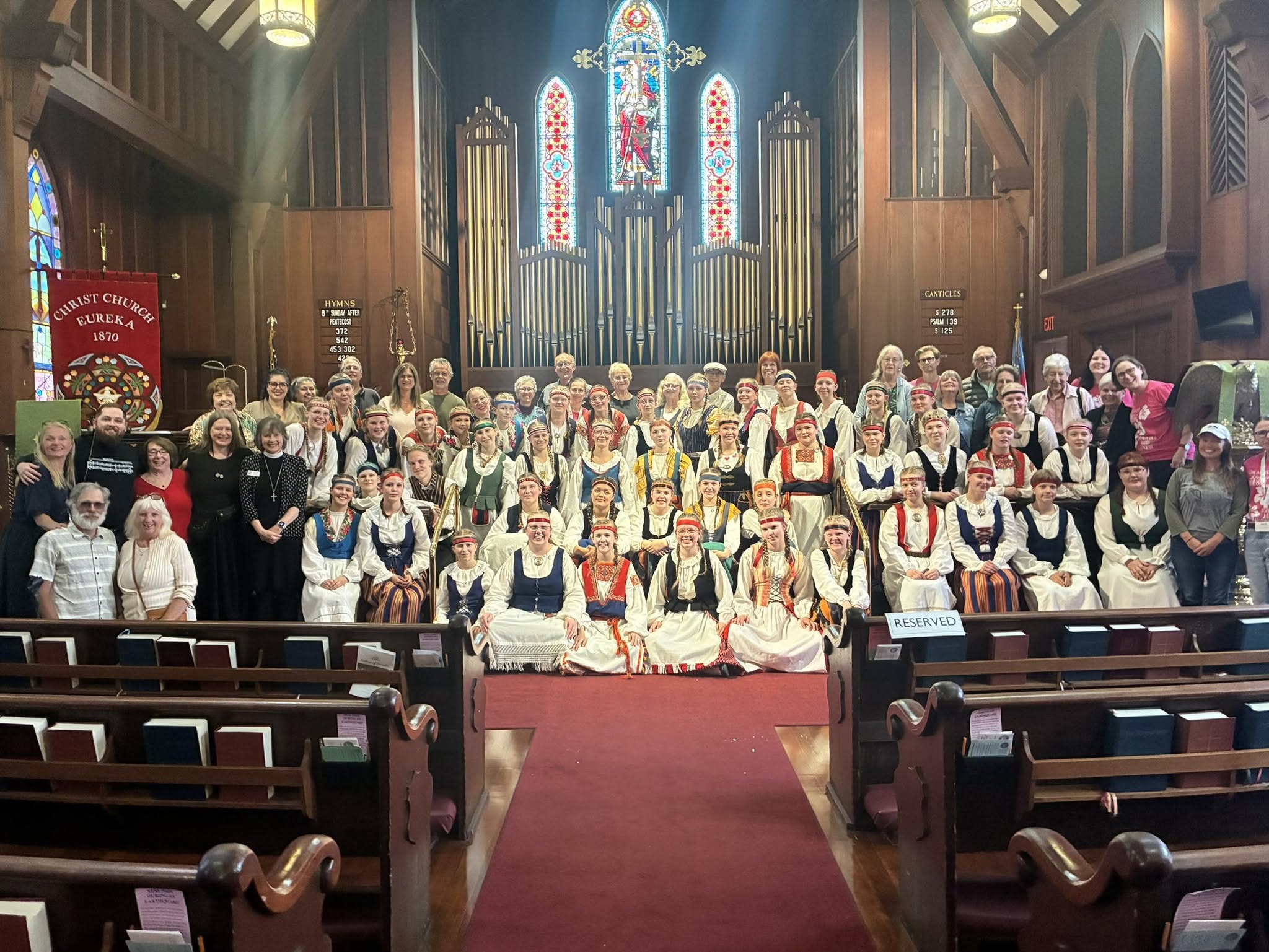
These remarks were shared by Fr. Daniel before the Finnish choir Vox Aurea performed the Echoes of Eureka opera, written and composed by Eric Tuan on July 20 and 21, 2026.
In the Spring of 2020, as this parish was celebrating our 150th anniversary, the Humboldt Historian magazine published an article titled “Christ Church: Steadfast and Growing since 1870,” written by parishioner and historian Catherine Mace. In that same issue, Katie Buesch published an article titled “‘The Eureka Plan’: Humboldt County’s Chinese Expulsions,” which describes a group of leading businessmen and citizens known as the Committee of Fifteen, who on February 6th 1885, notified the Chinese that they were no longer welcome in Eureka and needed to leave within 24 hours.[1] The Chinese were put on boats to San Francisco and then the Committee of Fifteen “encouraged every town in the county to expel their Chinese populations.”
With time, each town did, and by September 1886 Chinese residents had been driven out of Ferndale, Arcata and Rohnerville. In 1890, the publisher of Humboldt County’s business directory proudly claimed that Humboldt was the only county in California without a single Chinese person. The idea that Humboldt had no Asian residents at all became central to our county’s public image, even continuing after the national Chinese Exclusion Act was repealed in 1943. Humboldt’s Asian exclusion era finally ended in 1954, when Chinese immigrant and US Army veteran Ben Chin opened the first Chinese restaurant in Eureka since the 1885 expulsion. Katie Buesch concludes her article by saying, “The legacy of exclusion and expulsion [especially the February 1885 expulsion] still haunts us today, and it’s important that we acknowledge it.”[2]
A closer look at the history reveals how complicit this beloved church and its founders were in the Chinese expulsion. First, our church used to be located right across the street from Eureka’s Chinatown and our records suggest that we wanted little to nothing to do with that community.[3] And as Desmond Tutu says, “If you are neutral on situations of injustice, you have chosen the side of the oppressor.” Second, our beloved church founder and long-time Senior Warden Thomas Walsh served as the Mayor and Chair of the meeting that led to the expulsion of the Chinese.[4] When the landmark case Wing Hing v. City of Eureka was brought against Eureka for the city’s actions, the papers were served to Tom Walsh. While recognized as one of the nation’s first Chinese civil rights and reparations cases, it was eventually dismissed by the court after years of delays by the City of Eureka’s legal team. Eureka was one of the first western US towns that expelled its Chinese community members, but it was far from the last. Historians have found that more than 170 Chinese expulsions and attempted expulsions were committed in the western United States from 1885 through 1887.
Over the last several years, the leaders and parishioners of Christ Church have been doing the hard work of telling the truth about this part of our history, not to arouse guilt, but rather to learn from past sins and mistakes lest they be repeated again, and to practice truth-telling for the sake of healing and reconciliation. While none of us were alive during the Chinese expulsion and therefore not guilty of that horror, we are still called to be responsible. As theologian Catherine Keller explains, we “stand not guilty”for the…“preconditions [that] have shaped, privileged and deformed” us, but we “become guilty if [we] do not take responsibility for the effects of the past relations upon [us] now, as [we] affect the future.”[5] We at Christ Church have partnered with HAPI (Humboldt Asian and Pacific Islanders in Solidarity) in hosting a Lunar New Year celebration here and in supporting the fruitful ministry of a world-renowned philanthropist in Eureka who happens to be a Chinese immigrant, Betty Kwan Chinn, who recently met the pope. And we continue to support HAPI’s Eureka Chinatown Monument which is anticipated to be commemorated by the City of Eureka on October 11th of this year. We encourage you to support their community-strengthening endeavors as well.
This concert today is part of that truth-telling for the sake of healing and reconciliation. We tell the truth about this church because we know that loving a place does mean lying about it or hiding skeletons in the closets of its history. We tell the truth not to grandstand or to flagellate ourselves over the painful parts of our church’s history, but because we choose—out of love—to be responsible. We tell the truth because the teachings of Christ compel us to do so and to look outside ourselves and ask: are there grave injustices happening today about which we remain silent? How might future generations look back at Christ Church and Eureka during this time, our time? Will they be surprised by our silence and complicity or inspired by our courageous compassion? As you experience the “Echoes of Eureka” opera now, I wonder what questions will stir within you…
[1] Katie Buesch, “‘The Eureka Plan’: Humboldt County’s Chinese Expulsions” in Humboldt Historian, Vol. 68 no. 1 (Spring 2020), 13.
[2] Katie Buesch, “The Eureka Plan,” 15.
[3] “If you are neutral on situations of injustice, you have chosen the side of the oppressor.” Desmond Tutu, Oxford Essential Quotations as cited in Karen M. Price, The Gray Bird Sings: The Extraordinary Life of Betty Kwan Chinn (Arcata: The Press at Cal Poly Humboldt), 19.
[4] The Chinese consul in SF (Consul Bee) argued that “all of the Chinese expelled are not criminals. Many of them are peacable merchants, whose business has been broken up by their expulsion.” They built a case against the city’s actions in the case Wing Hing v. City of Eureka. Papers were served to Mayor Tom Walsh. “The case,” Buesch writes, “was dismissed under unclear circumstances, and other communities took note that expulsions could be repeated legally across the country without repercussions.” Katie Buesch, “The Eureka Plan,” 15. Ronald J. Perry, “’WIPE OUT THE PLAGUE SPOTS’: THE EXPULSION OF CHINESE FROM HUMBOLDT COUNTY” (Humboldt State University), 15.
[5] Catherine Keller, Face of the Deep: A Theology of Becoming (New York: Routledge, 2003), 80.

 DANIEL DeFOREST LONDON