
Readings for the Fourth Sunday after Pentecost (Proper 7 – Track 1 – Year A)
Genesis 21:8-21
Psalm 86:1-10, 16-17
Romans 6:1b-11
Matthew 10:24-39
This sermon was preached at Christ Episcopal Church in Eureka CA on June 21, 2026.
Happy Father’s Day! Ironically, Jesus’s message for us this Father’s Day is, “I have come to set a man against his father” (Matt 10:35). Apparently, Jesus has a lot to learn about strategies for church growth and family ministries; or perhaps we do…
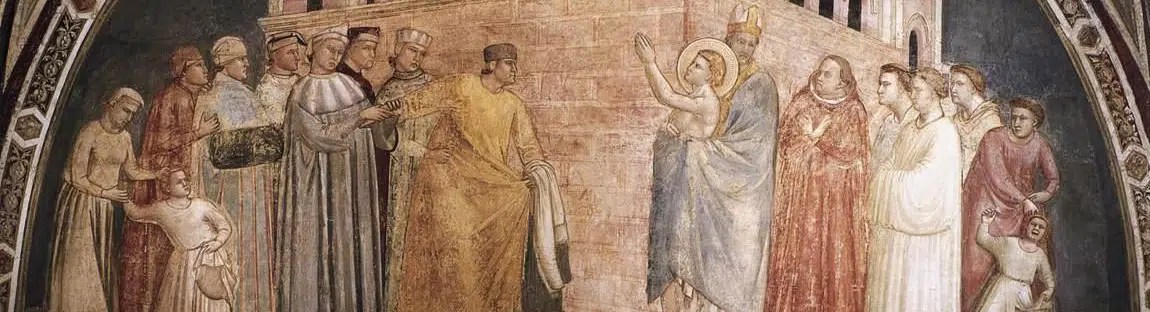
And if that’s not enough to dampen our enthusiasm for this holiday, we also have a story about a father sending his toddler out into the wilderness with little more than a canteen of water (Gen 21:14). These readings clearly urge us to prioritize our devotion to our heavenly Father over our earthly fathers, as wonderful as they may be. Indeed, these readings urge us to prioritize our devotion to our heavenly Father over our earthly fathers, like St. Francis who stripped himself free of his father’s expectations by literally stripping naked in the middle of Assisi and declaring to his father Pietro Bernadone, “I have previously called you father, but now I can truly say, ‘My Father who art in heaven.”[1]
Of course, we must also remember that God calls us to honor our earthly fathers. It’s the fifth commandment (Ex 20:12). The author of Ephesians reminds us that this is the first commandment with a promise attached to it: “Honor your father and mother so you will live well and have a long life on earth” (Ephesians 6:3). And elsewhere in Matthew’s Gospel, Jesus invites us to see the generosity of our earthly fathers as a glimpse into the vastness of divine generosity, saying, “If even wicked fathers give good things to their children, then how much more will our heavenly Father give good things to us who ask” (Matt 7:11). Jesus often uses this method of rabbinic argumentation, called kal v’homer (which means from “light” to “heavy” – a fortiori). The logic of this argument states that if a principle applies in a minor (“light) situation, then it must apply even more so in a major (“heavy”) situation. In Judaism, it’s often used regarding prohibitions: if something is prohibited on a minor feast day, then how much more is it prohibited on a major feast day. And in Jewish midrash, Moses argues with God at the burning bush, saying, “If the Israelites refuse to listen to me when I speak to them gently, then how much more will Pharaoh refuse to listen to me when I speak to him harshly?” However, Jesus often uses this method of kal v’homer to emphasize God’s paternal love!
The method is applied in today’s Gospel in which Jesus teaches that if our heavenly Father oversees the sparrow and not one falls to the ground apart from his will, then how much more does He surround us lovingly with the utmost care! How much more does the God who knows the number of hairs on our head care for each of us—care for you.
It is indeed a bit jarring to hear the Prince of Peace say that he did not come to bring peace, but a sword. In the Buddhist tradition, there’s a bodhisattva of wisdom named Manjushri, whose name means “gentle glory,” but he is always portrayed with a flaming sword in his right hand, ready to strike. The sword of Manjushri is a sword of compassion and nonviolence that cuts through ignorance and the source of suffering. It’s a paradox, but if we can understand the sword of Manjushri as a sword of compassion, then how much more should we understand the sword of Jesus as a sword of compassionate discernment that cuts through the sin that so often infects our relationships. The one whom we call the Prince of Peace teaches us that our journey with him does not automatically solve all our problems or resolve our troubled relationships. Sometimes, Jesus brings a sword of division into our most intimate relationships, a sword of discernment that compels us to check our priorities, to remind us that family is indeed important, but God is more important.

I find the Gospel’s reference to the sparrow personally moving since it is the song of the white–crowned sparrow here in Humboldt County that often reminds me of my own father. No one has had more influence on my spiritual journey than my father and yet there were also plenty of times when my commitment to my spiritual journey led me into times of tension with him. My walk with Jesus sometimes led me to clash with my father, who also loved Jesus. When my father passed away at the beginning of the COVID lockdown, I recorded a memorial service for him here, which included a eulogy that I gave in the backyard of the rectory. When I listen to the eulogy, there’s a sound that comes through just as clearly as my words; and it is the sound of the song of the white-crowned sparrow. Perhaps this was my father’s way of inviting me to deepen my trust in my heavenly father, now that he, my earthly father, was gone. Now when I see or hear the white-crowned sparrow, I’m reminded of the love of my earthly father as well as the love of my heavenly father, whose eye is on the sparrow. On this Father’s Day, I invite us all to not only honor and give thanks for earthly fathers, but more importantly, in the words of the classic Gospel hymn, I invite us to “rest on the goodness” of our Abba more than our beloved yet imperfect dads; and I invite us to sing (like the white-crowned sparrow) because we’re happy, to sing because we’re free, “for His eye is on the sparrow and I know he watches you and me.” Amen.

[1] Francis’s first biographer Thomas of Celano writes (in 1228–1229), “When he was in front of the bishop, he neither delayed nor hesitated, but immediately took off and threw down all his clothes and returned them to his father. He did not keep his trousers on, and he was completely stripped bare before everyone.” Thomas of Celano, “The Life of Saint Francis: The First Book,” Ch. VI, in Francis of Assisi: The Saint: Early Documents, ed. Regis J. Armstrong, J. A. Wayne Hellemann and William J. Short, 3 vols (New York: New City Press, 1999 – 2001), 1:193. In his poetic retelling of Francis’s life written around 1232 – 1239, Henri d’Avranches describes Francis as “leaving an earthly father / For his Father in heaven.” Henri d’Avranches, “The Versified Life of Saint Francis: The Third Book” in Francis of Assisi: The Saint, 1:450. According to The Legend of the Three Companions (1241 – 1247), Francis took off all his clothes in one of the bishop’s rooms and came out naked before the bishop, his father, and all the bystanders, and said, “Listen to me, all of you, and understand. Until now I have called Pietro di Bernardone my father. But, because I have proposed to serve God, I return to him the money on account of which he was so upset, and also all the clothing which is his, wanting to say from now on: ‘Our Father who are in heaven,’ and not ‘My father, Pietro di Bernardone.’” “The Legend of the Three Companions” Ch. VI, in Francis of Assisi: The Founder: Early Documents, d. Regis J. Armstrong, J. A. Wayne Hellemann and William J. Short, 3 vols (New York: New City Press, 1999 – 2001), 2: 80.


