
Readings for the Feast of the Christ Mass
This sermon was preached at Christ Episcopal Church Eureka for the Christmas Day service on Sunday December 25, 2025.
Merry Christmas! Merry Christmas on this first day of how many days of Christmas? Twelve! The reason we have twelve days of Christmas is to mark the span of time between the birth of Christ and the coming of the Magi, the wise men from the East, whose arrival we celebrate on January 6th, the Feast of the Epiphany! Some Christians (especially Anglicans) like to mark the twelve days of Christmas by celebrating the feasts of saints on each day. For instance, tomorrow is the feast day of St. Stephen, the first Christian martyr. The third day of Christmas (the day after tomorrow) is the feast of the saint who is traditionally considered to be the author of the Fourth Gospel, including the poetic prologue we just heard. The third day of Christmas is the feast of St. John the Evangelist. So today, on this great feast day of the Incarnation, I invite us to contemplate and consider the invitations of St. John the Evangelist, whose Gospel revolves around the mystery of the Incarnation, the God who became incarnate in Jesus Christ.

Some people have described the portrayal of Jesus in John as a detached “god who seems to glide across the face of the earth,” almost like a ghost. However, after studying John’s Gospel in depth for several years, I began to see how much the Gospel actually affirms the flesh. Although I wasn’t looking for it, I kept noticing how much John’s Jesus seems to take great delight in earthly pleasures. For instance, he inaugurates his ministry by miraculously bringing more wine to a wedding party (2:10). He offends his listeners with a very bodily and fleshy description of the bread of life (6:60-61). It is only in John that he makes mud out of dirt and saliva to heal a blind man (9:6). He receives a very expensive foot anointing from a female disciple (12:1-8). And he himself strips down to almost nothing as he washes his disciples’ feet (13:1-11). John’s Jesus is a human who enjoys and celebrates the flesh, understanding and using the five senses and sensuality as a vehicle for divine self-expression. One of my favorite Anglican commentators on John is the former Archbishop of Canterbury William Temple, who said “The Word made flesh” is the most important phrase in all of Christianity. He also said, “Christianity is the most materialistic of all great religions…. [‘materialistic’ not in the economic sense but ‘materialistic’ in its affirmation of matter]. Based as it is on the Incarnation, [Christianity] regards matter as destined to be the vehicle and instrument of spirit, and spirit as fully actual so far as it controls and directs matter.” God loves physical matter. He made it, he became it, and he wants us to experience him through it.
Friend and author Alexander John Shaia also observes these “elements of earthiness and sensuality” in John and believes that the Gospel invites its readers to appreciate the beauty and wonder of the matter that is all around us and the matter that is us. He says the Gospel invites us to notice the “buzzing of the bees and the rustling of the wind through the leaves…[to] become aware of the remarkable artistry in the veining of every leaf and bird feather…[to] sense the musculature beneath our own thin skin that miraculously holds us at 98.6 degrees in both snow and blistering sun…[to] wiggle our toes and stretch our arms and enjoy the sun or perhaps the taste of a raindrop on our tongue. This,” he says, “is God’s gift of sensuality awakening—becoming more sensitive and appreciative.” On this Christmas day as we celebrate the mystery of the Incarnation (the Word made flesh), John and his Gospel invite us to receive this gift of sensuality awakening, to practice appreciation of our bodies and to experience our flesh (and the earth!) as sacred vessels for divine life and expression.
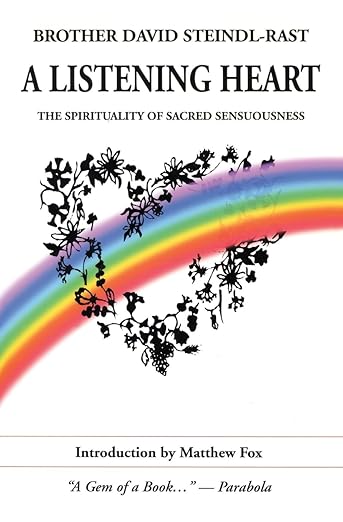
Last night I read a quote from the 99-year-old Benedictine monk Brother David Steindl-Rast about awakening our inner child. He says, “Nothing could be more important for our well-being on all levels than this awakening. Only our Inner Child can tingle with delight at simple pleasures like bare feet in wet grass, a slide into a swimming pool, or the smells of a picnic. We need to find that child hiding inside us, let it out, let it run about [without clothes], let it have fun.” The quote, however, continues: “In no other way can we recover the joy of all our senses…[and] this recovery is nothing less than the first step towards finding meaning in life. ‘How should tasting touching hearing seeing breathing…doubt unimaginable YOU?’ asks e. e. cummings. The child in us spontaneously makes a beeline to the Source of Meaning and sips sweetness with all its senses. The path to God starts at the gates of perception.”[1] Brother David then proceeds to elaborate on what he calls “sacred sensuousness” and “sensuous asceticism,” a spirituality that brings us down to earth, into our bodies and our bodily senses.
This sacred sensuousness permeates the Gospel of John, which begins by soaring like an eagle among the highest heights of heaven in its poetic prologue – which is why our Christian tradition has associated St. John the Evangelist with the symbol of the eagle. However, in verse 14 of the prologue, the eagle lands as the Evangelist proclaims that “the Word became flesh.” Throughout the Fourth Gospel, the Word Made Flesh invites us to be refreshed by the gift of our own flesh, our own temples of the Holy Spirit (1 Cor 6:19). As our reading from Hebrews says, Christ in human form is “the reflection of God’s glory and the exact imprint of God’s very being” (Hebrews 1:3). On this Christmas day, on this feast of the Incarnation, the Gospel of John invites us to appreciate the gift of our senses and the gift of these fleshy vehicles through which God chose to manifest his glory perfectly in Christ Jesus, vehicles through which we can say with the poet e. e. cummings, “I thank you God for most this amazing / day: for the leaping greenly spirits of trees / and a blue true dream of sky; and for everything which is natural which is infinite which is yes.”
[1] Brother David Steindl-Rast, A Listening Heart: The Spirituality of Sacred Sensuousness (New York: Crossroad, 1999), 27.

 DANIEL DeFOREST LONDON