
Readings for Easter Sunday (Year A)
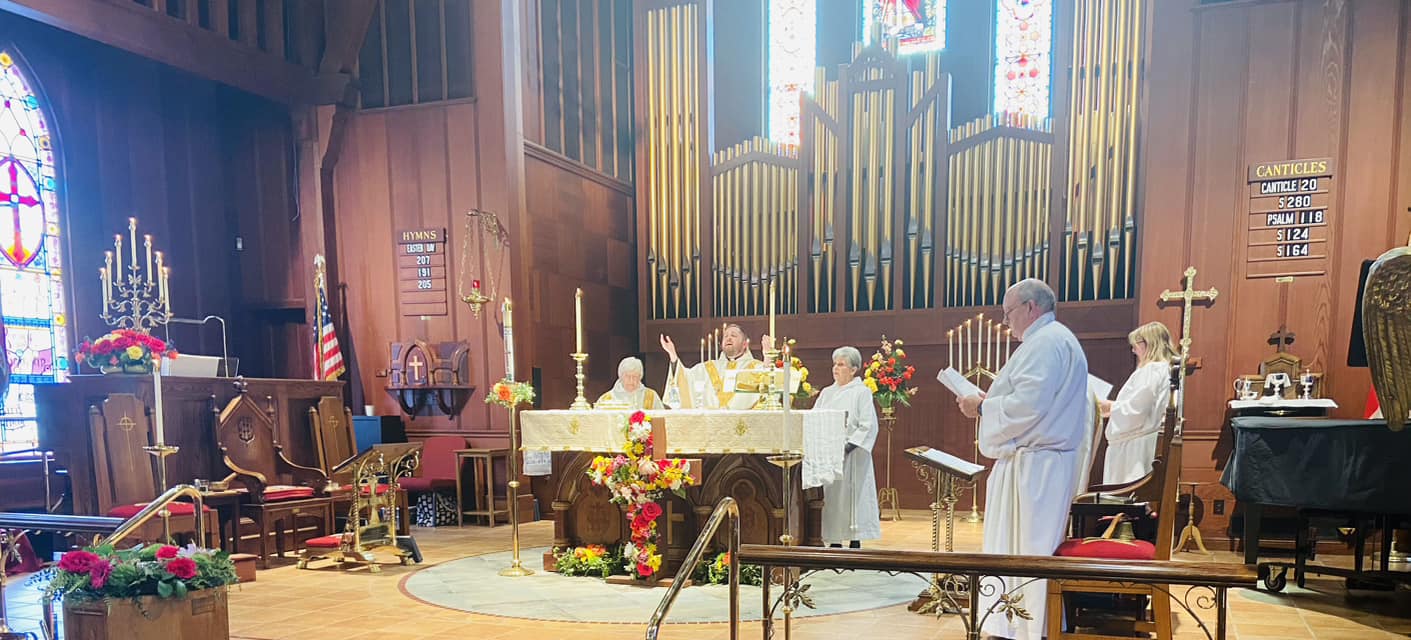
This sermon was preached at Christ Episcopal Church in Eureka CA on Easter Sunday April 9, 2023.
Happy Easter! Christ is risen! The Lord is risen indeed! ALLELUIA!
Throughout this Lenten season we’ve engaged our senses by listening to the wind with Nicodemus, by savoring the water with the Samaritan woman, by moving from merely looking to a deeper kind of seeing with the man born blind, and by smelling the aroma of new life beyond death with Mary, Martha, and Lazarus. And today, on this first of the 50 days of Easter, we engage with the oldest and most urgent sense: touch![1]
After recognizing Jesus in the garden, Mary Magdalene rushes to embrace him, but Jesus says, “Noli me tangere” – “Do not hold on to me.” However, the original Greek is actually me mou hapto, which means “do not touch me” (hapto is where we get the word haptic). Jesus is actually saying to Mary, “Do not even touch me.” I find these words perplexing, especially since, throughout the Gospel of John, Jesus invites us to use our bodily senses to understand and appreciate deeper spiritual realities, but here Jesus says, “Do not touch me.” What makes this even more perplexing is the fact that in this very same chapter in John (chapter 20), Jesus invites his disciple Thomas to put his finger on his hands and side. So why does he tell Thomas to touch him while saying to Mary, “Do not touch me”?
English poet and priest Gerard Manley Hopkins explored the connection between Easter and the power of touch in his poem The Wreck of the Deutschland, which begins with these evocative words: “Thou mastering me / God! giver of breath and bread; / World’s strand, sway of the sea; / Lord of living and dead; / Thou has bound bones & veins in me, fastened me flesh, / And after it almost unmade, what with dread, / Thy doing: and dost thou touch me afresh? / Over again I feel thy finger and find thee.” I don’t claim to understand the poetry of Hopkins with any level of depth or certainty, but I love how he concludes with this phrase: “Let him easter in us, be a dayspring to the dimness of us.” He makes Easter into a verb here. Let him easter in us. “Easter is not only an event, but it’s something that happens to us and in us.”[2] What does it mean for Christ to Easter in us? What does it mean for Christ to Easter in you?
In a few moments, we will baptize Isaac and Felix and by doing so, we will publicly claim their identity as beloved children of God, which they already are. God already knows and loves them, and I imagine, in some ways, they already know and love God. The sacrament of Baptism is the sacrament by which we bring someone into a formal and public and sensory and incarnational and haptic relationship with God. It’s almost like Isaac and Felix will be formally introduced to God and then shake God’s hand. And this is the most important gift they can receive in this life: a relationship with God, an incarnational relationship with God. Before I arrived here in person as your rector, I already knew some of you and some of you knew me, but our relationship took on an entirely new dimension when we shook each other’s hands and when we hugged. The sacraments are hugs and kisses from God so that our relationship with God takes on a dimension of intimacy and maturity. Baptism is a warm hug and a gentle kiss from the divine.
After receiving the divine embrace at baptism, we who have been baptized continue to remain in touch with God through the Holy Eucharist. When you love someone, you want to be with them. You want to spend time with them. Now a lot of people say, “I can worship God in the woods or on a boat or at the beach and you can. It’s true because God is omnipresent, God is everywhere in spirit. Alleluia! But the Son of God who became flesh is only present not just in spirit but in body in one place and that is here, in the communal celebration of the Eucharist. When you really love someone, you don’t want to be present just in spirit. You want to be present with them in the body, in their bodily presence. That’s what the Eucharist is: a celebration and experience of Christ’s bodily presence among us and a foretaste of our own bodily resurrection. This is how Christ Easters in us, through the sacraments of Baptism and Eucharist, nourishing us and empowering us to fulfill our baptismal vows, to strive for justice and peace among all people and respect the dignity of every human being.
So why does Jesus tell Thomas to touch him while telling Mary, “Do not touch me”? The answer can be found in Jesus’s subsequent words to Mary, when he says, “Go to my brothers” (20:17). With these words, Jesus is telling Mary that if she wants to touch Jesus’s body and be in his bodily presence, she is now invited to do so within the Eucharistic community of believers, which, after Easter, is understood to be the Body of Christ. In one sense, the Risen Christ has ascended to heaven and sits at the right hand of the Father; and in another very real sense, the Risen Christ remains here among us, whenever we gather in his Name. This is why it makes sense for Jesus to invite Thomas to touch his risen flesh in the very same chapter because Thomas is standing amidst the Eucharistic community of believers, the Body of Christ. The Gospel of John teaches that if we want to experience and touch the Risen Christ today, we can do so whenever we gather to celebrate the Eucharist as a body, as we do right now. Because we do not live in first-century Palestine, we cannot touch that same tangible body of Jesus that Mary Magdalene touched before he died, but we can touch the Body of Christ as it is made manifest to us today, here in the Eucharistic community.
During the COVID lockdown, it sometimes felt things were a little ‘touch and go’ for us as it became challenging for us to celebrate Eucharist in person, but now I trust we will thrive because if we love Jesus and want to grow in our relationship with him, we will make an effort to spend time in his bodily presence, today and every Sunday. So, stay in touch! Come back next Sunday; and let Christ Easter in you. Let him Easter in us. Amen. Alleluia!
[1] “Touch is the oldest sense, and the most urgent. If a saber-toothed tiger is touching a paw to your shoulder, you need to know right away. Any first-time touch, or change in touch (from gentle to stinging, say), sends the brain into a flurry of activity.” Diane Ackerman, A Natural History of the Senses (New York: Random House, 1990), 80.
[2] Tish Harrison Warren, “Why It Matters That Jesus Really Died” New York Times April 17, 2022. https://www.nytimes.com/2022/04/17/opinion/easter-resurrection-jesus.html

 DANIEL DeFOREST LONDON
The resurrection is not a static and an isolated event fixed in the past, but the unleashing of a power and force that takes the form of a death defying love. Resurrection is ever present, constantly accosting us, challenging us, stretching us, cracking us open and seeking to have its way with us in order that we might come to maturity in Christ. – Frank Griswold