
Readings for the First Sunday in Lent (Year C)
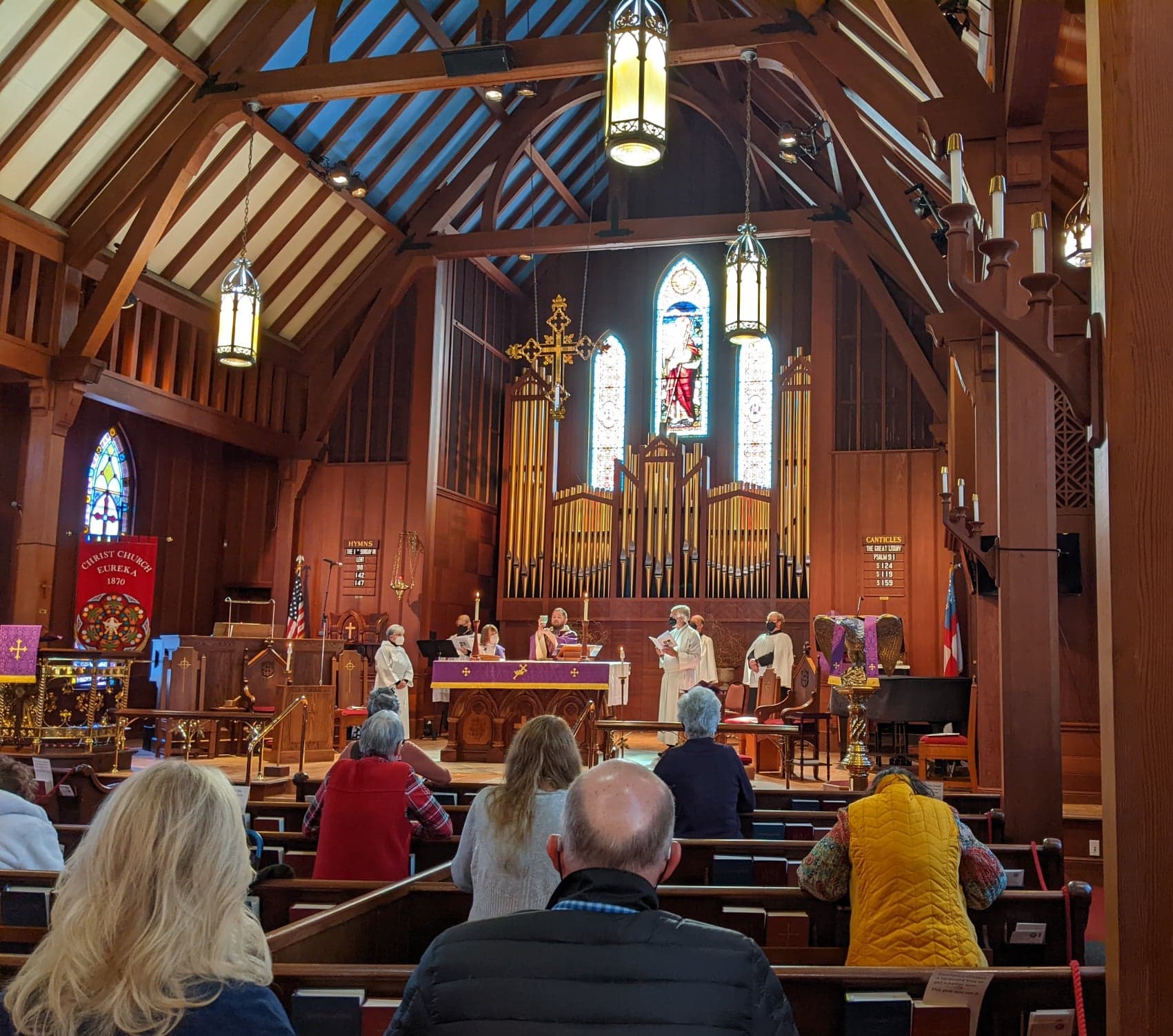
This sermon was preached at Christ Episcopal Church in Eureka CA on March 6, 2022.
The forty days of Lent have begun, even though today (Sunday) is not counted as one of those days. Remember Sundays are still feast days throughout the season of Lent, so if you’ve given up chocolate for Lent, you are free to have as much chocolate as you like today. Yesterday (the fourth day of Lent) I had the joy of gathering with forty people on zoom to engage in an ancient prayer practice that some say Jesus was using during his forty days in the desert. There is an ancient form of Jewish mysticism called “Merkabah Mysticism” that was supposedly practiced by the Hebrew prophets, including Jesus himself. Merkabah means “chariot” or “throne” and the tradition revolves around a prayer practice that helps bring people into the divine “throne” room, the loving presence of God. This is essentially the same prayer practice articulated by the 14th century anonymous author of The Cloud of Unknowing, of which we read distilled portions yesterday from 10 AM to 3 PM while punctuating our time with long periods of prayerful silence. It’s hard for me to imagine a better way to enter into the 40 days of Lent than by praying with 40 people the same kind of prayer that Jesus likely prayed during his 40 days in the wilderness. Two of the key aspects of this ancient prayer are 1) discovering our ultimate and foundational identity as God’s beloved children and 2) cultivating what the Cloud author calls “patient, humble love for God.” Patient, humble love for God. So receiving our belovedness and responding to God’s love with patient love in return. I see both of these dynamics at work in our Gospel reading this morning in which Luke describes Jesus being led by the Spirit into the wilderness, after his baptism. And what happened at his baptism? (We read this a couple months ago at the beginning of Easter when Mtr. Nancy was here). God spoke to Jesus and said, “You are my child, my Beloved, with you I am well pleased.” That is the divine voice of love that is spoken to each of us if we take the time to hear it and that is the divine voice of love that will transform our lives if we let it sink into the very depths of our being.

And that is what Jesus is doing when he goes off into the wilderness right after being baptized. He is letting that divine voice sink into the very depths of his being. And that’s what many of us were doing yesterday in praying the ancient prayer of the Cloud of Unknowing. However, whenever we humans try to let that voice sink in, we are often bombarded by other voices and thoughts and distractions. That’s why the Cloud author suggests using a sacred word like “God” or “Love” to help us to return to the voice of love. Many of the other distracting voices are, at least for me, condemning and accusatory. Sometimes it’s the voice of Martha who is worried and upset about many things when only one thing is needed. Sometimes the voices are accusing me of not being good enough or not doing it right or insisting that I should be doing something else more productive. Often those accusing voices that try to drown out the voice of love come from the Accuser himself, the Satan. Remember in Hebrew, “Ha Satan” means “The Accuser.” And although Jesus is divine by nature, he is also fully human which means he also must deal with the voice of the Satan.
The devil tempts Jesus by trying to make him doubt his own belovedness. He says, “If you are the Son of God, then prove it.” If God really loves you, he will provide you bread or save you from death or give you all the kingdoms of the world. Jesus must confront these same voices of doubt and accusation and temptation. And the devil uses Scripture to make Jesus doubt God’s love. Whenever someone uses the Bible to make someone else question or doubt their belovedness in God’s eyes, they are using the devil’s tactic.
The devil quotes from one of my favorite psalms, psalm 91, which inspired the beautiful anthem we’ll sing “On Eagle’s Wings.” It’s also the psalm that I prayed over my father as he was undergoing a bone marrow transplant a few years before he died. It’s also the psalm I prayed over Fr. Doug a few hours before he died. The psalm is all about being bound to God in love and abiding in his ever-loving embrace. But the devil uses it as a tool to try to make Jesus doubt God’s love. Like us, Jesus confronts these voices of doubt and accusation and temptation.
And we know these are really temptations for Jesus because he eventually does perform the very same miracles that the devil is tempting him to perform. Later on, Jesus miraculously makes bread (to feed thousands of people), he escapes death in his resurrection, and then he is given all authority in heaven and on earth (Matthew 28:18). Of course, this doesn’t mean that he’s eventually succumbed to the devil’s temptation. It means that Jesus fulfilled his deepest desires in God’s time and in God’s way, rather than in the devil’s way. The devil offered him the fast-food approach of instant gratification, which is tempting indeed. That approach is what drives the McDonaldization of the Church.
God’s way, on the other hand, requires “patient, humble love.” The timing was right for Jesus to miraculously make bread when there was more than just his mouth to feed. And the timing was right for Jesus to escape the clutches of death only after he had endured the suffering of the cross and the grave.
There’s that Morning Prayer Collect for Fridays that I always pray with the deacons “Almighty God, whose most dear Son went not up to joy but first he suffered pain, and entered not into glory before he was crucified: Mercifully grant that we, walking in the way of the cross, may find it none other than the way of life and peace; through Jesus Christ our Lord. Amen.” The way of the Cross is the way of patient, humble love.
The call to practice patience might be the most important and overlooked message of today’s Gospel about the temptation of Christ in the wilderness. The call to practice patience might also be one of the most important messages of the entire Lenten season. It’s exactly why we don’t just hop from Epiphany to Easter, like over-eager Easter bunnies. We first walk the via dolorosa of the Lenten season: the way of the Cross which is the way of patient, humble love, a way that is sometimes marked with difficulty, pain, self-denial, and boredom.
The call to practice patience is a message for us right now, as so many of us feel tempted to just be over and done with COVID. I know that a part of me wants us to stop wearing masks and to stop requiring vaccinations and social distancing and yada yada yada. But rushing to the other side without practicing patient humble, love seems to be the devil’s approach. The way of the Cross requires patience and openness and receptivity to the concerns of the most vulnerable among us. It requires listening to the multitude of counselors that compose our vestry and regathering task force. “In an abundance of counselors there is safety.” (Proverbs 11:14). Things might get done more quickly with dictators, but that is clearly not the way of the Cross.
Last night, Merry and I enjoyed an event that we had been planning since 2019. Because of COVID, we had to practice patience. Patient, humble love. And it was worth the wait. Last night, singer/songwriter Bobby Jo Valentine performed an intimate concert of hopeful folk and pop music right here. The hope and joy were so potent that we lifted the moratorium on that word that we don’t say during Lent. Because it was part of my birthday weekend and I love the song, Bobby Jo Valentine sang Leonard Cohen’s masterpiece. He also sang a song all about the spirit of patience, with whom he argued and had a reckoning and eventually through whom he learned the lesson that “Good Things Take Time,” the title of the song. He introduced the song by saying, “I have found that when chasing or developing or growing a dream or a vision or a way to be in the world that’s better or a space in my heart that’s healing or an opening of my soul that’s been shut for a long time, I have found that those things take a while. And if you rush it, you end up with a half-baked loaf of bread.” Towards the end of the song, when he has learned to integrate patience more fully, he says, “I watch some friends take the elevator while I climb these stairs late into the night, and I wish them well, I really hope they make it / But from what I see, most elevators break / And meanwhile, my legs are getting stronger from this climb / most good things take time.”
In the wilderness, the devil offers Christ the elevator but he chooses the stairs. May we do the same this Lent so that our legs grow stronger from the climb, and so that we, rooted in our identity as God’s beloved children, can continue practicing and embodying and inspiring “patient, humble love.”

 DANIEL DeFOREST LONDON