
Readings for the Seventh Sunday after the Epiphany (Year C)
This sermon was preached at Christ Episcopal Church in Eureka CA on February 20, 2022.
Last Sunday, we heard the opening words of the Sermon on the Plain, a sermon that Jesus preached after staying up all night in prayer and after calling his twelve disciples, on a mountainside. Unlike the Sermon on the Mount in Matthew, where Jesus is preaching from on high (like Moses on Mt. Sinai), Luke has Jesus descending from a mountain, sitting on a level plain, and looking up at his disciples, who likely surrounded him in a circle. Luke often portrays Jesus as being among the people, especially the lowly and marginalized, so this position reinforces Luke’s Christology, Luke’s understanding of Christ as being among the people, rather than as a detached voice pontificating from on high. Jesus was not using a pulpit here. He was descending from the mountain to be among the people, which is partly why our deacons proclaim the Gospel not from a lectern or pulpit but rather among the congregation.
Also, as I said last Sunday, Jesus and his disciples were embodying a tree with Jesus as the root and base of the tree and the apostles as the branches reaching out. Jesus enacted his teaching from John 15, in which he says, “I am the tree (vine) and you are the branches.” Now we remember that there was a large crowd of followers and a great number of people from all over Judea and from the coast region of Tyre and Sidon who had come to hear Jesus (Luke 6:17-18). So how do all these people hear Jesus who is sitting down on a level plain, looking up at his disciples? Monty Python’s Life of Brian plays with this question a bit by having listeners in the distance struggle in hearing Jesus to the point where they think he’s saying, “Blessed are the cheesemakers” rather than “Blessed are the peacemakers.” And that was with Jesus standing on a mountain top! So how could people hear him clearly while he was sitting down on a level plain without a microphone?
Years ago, when I attended rallies and outdoor gatherings in Oakland, I learned about a means of communication called “the human microphone” or “the people’s microphone.” People would gather around a person who was designated to speak and then repeat what the speaker said, thus amplifying the speaker’s voice without the need for amplification equipment. The speaker would usually begin by saying, “Mic check” and then the people around the speaker would respond “Mic check!” and sometimes another group of people farther away would repeat “Mic check!”
The speaker would then speak in relatively short and simple phrases, which would then be repeated throughout the crowed. Some suggest that Jesus and his apostles may have used a similar means of amplification. When we read these words of Jesus in the Aramaic (which is the language in which he originally preached), we see that his phrases are expressed in a way that is intentionally easy to hear and remember. He used mnemonic devices in his Aramaic teachings. We lose some of that in the Greek and English, but still, we can imagine Jesus saying, “Blessed are you who are poor,” to his disciples, who then proceed to tell the larger crowd, “Blessed are you who are poor!”
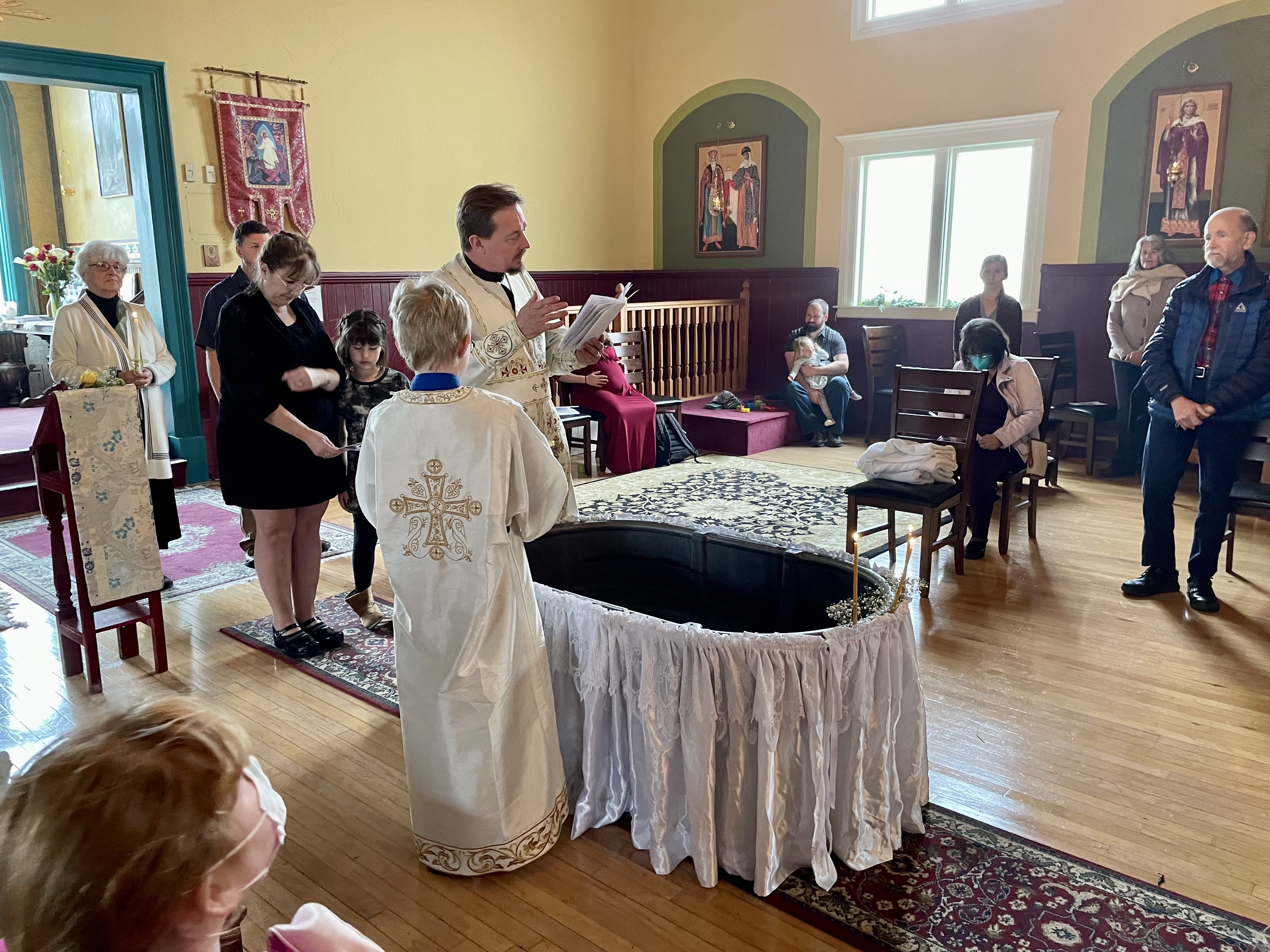
Yesterday, I attended a Baptism at St. Innocent Orthodox Church here in Eureka and I noticed how frequently many of the calls and responses which we say only once were repeated three times. And their liturgies are based on formulas far more ancient than ours, perhaps even rooted in ancient forms of the people’s microphone. I also noticed how often their prayers referred to the Cross not as a Cross but as the Tree (“The Lord upon the Tree did triumph”). And before reading Scriptures, especially the Gospel, they would say, “Let us attend.” Let us be attentive to the words of Christ. Let us listen with our whole selves because these words, especially the words we just heard this morning, are very likely the actual words spoken by Jesus to his disciples who repeated them to the larger crowd, who then repeated them to us today.
After the Blessings and Woes, Jesus begins his sermon by saying, “I speak to you that listen.” Let us attend! Jesus is asking his disciple to listen attentively to his words so that they can function collectively as his human microphone to the crowd. The disciples need to listen carefully to every word because they will be repeating those same words to those who are so eager to hear. What a powerful image of discipleship, that speaks to us today! Listening attentively to the words of Christ not just to let them transform us, but in order to share them with others. That’s what we do here: we gather together around Christ who speaks to us so that we can speak to the world, to all those who hunger and thirst for justice and wisdom.
Just as Joseph in our reading from Genesis asked his brothers to come closer to him, to listen attentively to him as he revealed the powerful truth about his divinely inspired response to their hostility and violence so too does Jesus bring his disciples close to him so that they can learn how we are all called to respond to other peoples’ hostility and violence. Joseph’s brothers then go out as the fathers of the twelve tribes of Israel to change the world through God’s blessings. Likewise, Jesus’s twelve apostles are sent out (apostello) to change the world through Christ’s teachings. They are embodying the Tree of Life, spreading its branches and producing fruit in due season.
Just imagine Jesus looking up at his disciples who lean in as Jesus says softly, “Love your enemies” and then they repeat loudly to the crowd, “Love your enemies!” And then, “Do good to those who hate you” “Do good to those who hate you!” “Bless those who curse you…” “pray for those who abuse you…” “If anyone strikes you on the cheek…” “Offer the other also…”
These are some of the most memorable and profound and challenging teachings of Jesus, who is not calling us to be doormats and willing victims of abuse. No, he’s calling us to practice a kind of compassion that disarms and exposes those who are greedy and hostile, as Joseph did to his brothers. These teachings are the inspiration for Gandhi’s and Martin Luther King Jr’s principles of nonviolent resistance to evil. Gandhi called this form of nonviolence satyagraha, which literally means “holding firmly to truth.” Listening attentively and leaning in closely to truth, including the sometimes-difficult truth that God is kind to the ungrateful and the wicked (Luke 6:35). In the Sermon on the Mount in Matthew, Jesus says it like this, “God makes his sun rise on the evil and on the good, and sends rain on the righteous and on the unrighteous” (Matthew 5:45). This a truth that the psalmists struggle to accept, when they keep asking, “How long, O Lord, will the unrighteous continue to prosper? Why do you keep shining your sun on these sinners?” Jesus invites to see beyond the dualistic mind that divides the world into “good” (what benefits me) and “evil” (what upsets me). Regarding this verse, contemplative author Carl McColman says that “Jesus calls us to see the world from God’s perspective. When you stand on the north pole, every direction is south. When you see the cosmos like God sees it, from God’s point of view, everything you look at is imperfect — so your task is to love it all, just like God loves it. God loves the cosmos nondually. God [didn’t] love Desmond Tutu [more] than Bernie Madoff.” This does not mean that God is not a God of justice. It means that God’s justice is an expression of his love and compassion, not vengeance and hostility. For one person, God’s love might feel like life-giving rain or sweet sunshine. For another, that same love might feel like a torrential downpour or suffocating heat.
The psalmist in today’s psalm begins to grasp this truth when he says, “Do not fret yourself because of evildoers; do not be jealous of those who do wrong.” The psalmist understands what Johnny Cash sang in one of his last songs: “Go tell that long tongue liar / Go tell that midnight rider / Tell the rambler, the gambler, the back biter / Tell’ em that God’s gonna cut’ em down. You can run on for a long time / Run on for a long time / Sooner or later God’ll cut you down.” “For evildoers,” according to this morning’s Psalm, “shall be cut off” (Psalm 37:10). That’s true and, at the same time, Jesus calls us to practice compassion, to align ourselves with God’s love which might feel like sweet sunshine to one person, but like suffocating heat to another, heat that seems to cut them down.
In the Sermon on the Mount in Matthew, Jesus sums up a series of his teachings by saying, “Be perfect, therefore, as your heavenly Father is perfect” (Matthew 5:48). These are words he was saying from the mountain top on high. I can’t help but wonder if he initially said these same words in Luke’s Sermon on the Plain to his disciples who had been amplifying his voice to the crowd. I wonder if Peter gave Jesus a funny look and said, “You know, Jesus, that’s not really very helpful: telling a bunch of imperfect people to just be perfect. Can we rephrase that a bit?”
And Jesus, who knew “that without love whatever we do is worth nothing” (as today’s Collect says) and who knew that the expression of divine perfection is compassion, invited his disciples to lean in even closer and said, “Be compassionate, just as your Father is compassionate.” And then Peter led the amplified response louder than anyone else: “Be compassionate just as your Father is compassionate.”
There’s a quote attributed to a popular Jewish philosopher named Philo who was writing around the same time that Jesus was teaching. Perhaps he even heard these words of Jesus. The quote is “Be compassionate because everyone you meet is fighting a hard battle.”
Be compassionate because everyone you meet is fighting a hard battle. God knows the battles that each of us fight every day and God is endlessly compassionate. We don’t know everyone’s battles, but we can still emulate God by practicing compassion. And sometimes that compassion involves creating strict boundaries and refusing to tolerate and enable unhealthy and dangerous behaviors. Before Joseph opened up to his brothers, he attended very closely to their behaviors and tested them to make sure that they were no longer stuck in their sick and selfish habits. That test was not an expression of vengeance (although he had plenty of reason to be vengeful), but it was an expression of love and compassion. He was compassionate because he knew each of his brothers were fighting a hard battle. And if they didn’t snap out of their sick and selfish ways, they were going to lose that battle.
Jesus calls us to be compassionate without judging and condemning. He calls us to be compassionate because that is the expression of divine perfection. He calls us to be compassionate because everyone we meet is fighting a hard battle. May we be like the disciples and lean in to hear Jesus say these words to us so that we can amplify them to the world. Amen.


 DANIEL DeFOREST LONDON