
Readings for the Sixth Sunday of Easter
This sermon was preached at Christ Episcopal Church in Eureka CA on May 9, 2021.
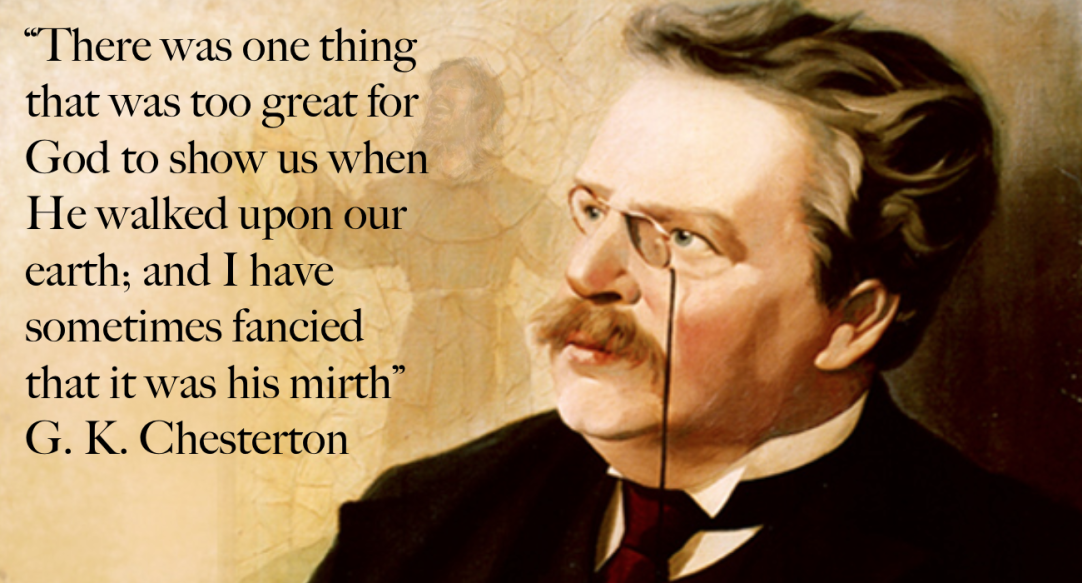
The great Anglican author GK Chesterton concluded his great book Orthodoxy with these words. He said, “Joy, which was the small publicity of the pagan, is the gigantic secret of the Christian. And as I close this chaotic volume I open again the strange small book from which all Christianity came; and I am again haunted by a kind of confirmation. The tremendous figure which fills the Gospels towers in this respect, as in every other, above all the thinkers who ever thought themselves tall. His pathos was natural, almost casual. The Stoics, ancient and modern, were proud of concealing their tears. He never concealed his tears; he showed them plainly on his open face at any daily sight, such as the far sight of his native city. Yet he concealed something. Solemn supermen and imperial diplomatists are proud of restraining their anger. He never restrained his anger. He flung furniture down the front steps of the Temple and asked men how they expected to escape the damnation of hell. Yet he restrained something. I say it with reverence; there was in that shattering personality a thread that must be called shyness. There was something that he hid from all men when he went up a mountain to pray. There was something that he covered by abrupt silence or impetuous isolation. There was some one thing that was too great for God to show us when he walked upon our earth, and I have sometimes fancied that it was his mirth.”[1]
As we read the Gospels, we do see Jesus expressing anger and sadness and even aggression, but we have no record of him ever laughing. However, if we were able to listen to the intonation of a lot of his teachings, we would probably hear much of it as hilarious. I imagine if we had a video recording of his teachings, we would most likely hear lots of laughing among the listeners in the audience. I’m thinking, for example, of Jesus’s teaching about how quickly we judge others: how we want to pick out the speck of dust in our brothers when there’s a plank in our own eyes (Matthew 7:1-5). That’s hilarious. When I read Jesus in the context of the other Jewish rabbis of his day, I can’t help but imagine that some of his immense popularity was because he had a bit of a Jewish comedian within him. I feel invited to imagine that because of the very words in our Gospel reading today in which Jesus says: “I have said these things to you so that my joy may be in you and that your joy may be complete.” He would not say that unless he had joy that was obvious and apparent. And he explains that receiving this complete joy is connected with abiding in the flow of love which originates in the Father, who loves the Son, who loves us so that we may love others and so that we may abide in the flow of love. As I talked about last Sunday, we receive love and then give love. We connect to the Vine, we abide in the Vine so that we can produce fruit and share with others. Our Cup overflows. We fill up like Phillip and then we replenish ourselves with more love. “If you keep my commandments you will abide my love just as I have kept my father’s commandments and abide in his love.” This is how we can have complete joy.

A friend of mine who is an author of a book called Heart and Mind helped me understand the four gospels in a powerful new way. His name is Alexander John Shaia and he’s actually going to be our guest preacher next Sunday. He offers this radical, new way of understanding the gospels that helps me appreciate the four canonical gospels. There are other gospel, like the Gospel of Thomas and there’s certainly some wisdom in there, but there’s something absolutely and spiritually significant about having four gospels and these specific gospels: Matthew, Mark, Luke and John. Alexander John Shaia studied with Joseph Campbell the great mythologist, who noticed in all myths four phases in the Hero’s Journey. You see these four phases in all great stories and all great myths and in all great narratives. The first phase is the call to the journey as one crosses the threshold and is often pushed into a new phase through some kind of change or catastrophe, perhaps a pandemic. Many myths begin with something like a pandemic. And then, the hero goes on a quest that is full of trials and tribulations, full of suffering. That’s the second phase. And then the third phase is when the hero receives the great boon, the insight, the treasure, the wisdom, maybe even the joy. And then the fourth phase (and this is important, and we often forget this) is returning home to share what was received. Again, just as I talked about last Sunday, when we go through difficulties we reconnect to the Vine and abide in the Vine to produce fruit, but that fruit is not for us, it’s for others. We return to the community and serve others. Those are the four phases.
Now what Alexander John Shaia argues (and quite convincingly in my opinion) is that each of the four gospels are not biographies. Rather, the gospels are spiritual practices that revolve around these four phases, The Gospel of Matthew is a spiritual practice. Everything in the Gospel of Matthew revolves around this question how do we deal with change which is the question that the hero has to deal with at the beginning of the journey, usually the change that launches him or her on the adventure: how do we deal with change? And when you look at the context in which Matthew’s gospel was written and those to whom the author was writing, that’s exactly what they were struggling with.
And then Mark’s gospel (the shortest gospel) deals with the question: How do we move through suffering? And that also makes a lot of sense when you look at the context of Mark’s gospel and the author and the original audience. Mark was likely written in Rome when Christians were being slaughtered at the Circus Maximus. They were facing extinction through martyrdom and near genocide. Alexander Shaia argues that everything in Mark is wrestling with the question: How do we move through suffering? And Mark’s Gospel invites us to wrestle with that question.
And then when it comes to Luke, we remember that Luke is the first part of a larger book. The sequel to Luke which is basically the second half of the larger volume is the book that we are also reading through during Easter. And what book is that? It’s the book of Acts. Scholars often refer to the two books as one collective volume called Luke-Acts because they are really meant to be read together. And Luke-Acts addresses the question: how do we live a life of service? Once we have received the boon, the wisdom that we’ve gained through our journey of trial and tribulation, how do we then return back to the community to serve and give others? This is so clearly what the book of Acts is about, right? That’s what we just read about last Sunday with Phillip evangelizing to the Ethiopian Eunuch Bachos, and I hope you guys all had a chance to evangelize this week in creative ways. And again, we have service and evangelism occurring in this morning’s reading from Acts 10 with Peter baptizing.
And the Gospel of John, which is the gospel that we read throughout Lent and Eastertide, revolves around the great boon, the wisdom, the great insight, the mystical enlightenment. This makes sense because Jesus sounds so different in John. He sounds very different than he does in the Synoptics, but in this discourse, as in many of the long discourses in John, Jesus is speaking intimately with his disciples. He is often repeating himself because he really wants to make sure that they’re hearing and understanding him. These aren’t sermons that he’s sharing with the wider community when he tells provocative stories and shares Beatitudes, almost pontificating about the law. But when speaking intimately with the disciples he’s saying, “I want you to hear me. The father loves me so have I loved you. Connect with the flow of love. Abide in the Vine because when you do this, my joy which you have experienced overflowing, my joy which you have experienced as healing to others, my joy will be in you and your joy will be complete.” This is what he’s speaking to his disciples in intimacy and thanks to John’s Gospel, we get be privy to that.
So the question that John is addressing, according to Alexander John Shaia, is: how do we receive joy? Matthew addresses the question: How do we face change? Mark: how do we move through suffering? Luke-Acts: how do we mature in service? And John” how do we receive joy? How do we receive that mirth that G.K. Chesterton described?
I invite you this week to contemplate that question: how do you receive joy? How do you receive that deep, fundamentally sound, consistent joy that is not dependent on circumstances? How do you receive joy? And part of that question includes: how do you enter into the flow of love that Jesus is talking about, that flow of love and friendship? That flow of love that Jesus is talking about with his friends which is part of the great insight and wisdom and boon of our spiritual journey. The great boon of the Christian journey is entering into intimate friendship with Christ, our Good Shepherd, the One who knows us my name, the One who wants us to be authentic in our prayers, even if that means being upset or crying or maybe it means laughing. How many times have you laughed in your conversations with Jesus in your prayers? How do you receive joy? How do you abide in the Vine? How do you enter more deeply into the flow of God’s love for you and others? I invite you to consider that question in the remaining days of this Easter season and perhaps the answer will lift you up just in time for the Feast of the Ascension. Amen.
[1] G. K. Chesterton, Orthodoxy: The Romance of Faith (Doubleday: New York, 1908, Image, 1990), 160.

 DANIEL DeFOREST LONDON