
Readings for the Twenty Second Sunday after Pentecost (Proper 27 Year C)
Haggai 1:15b-2:9
Psalm 98
2 Thessalonians 2:1-5, 13-17
Luke 20:27-38
This sermon was preached by Fr. Daniel London at Christ Episcopal Church in Eureka CA on November 10, 2019.
There’s a song titled “Children of the Revolution” by a 70s glam rock band named T Rex. The song includes the refrain: “You won’t fool the children of the revolution.” It’s a catchy tune and I hear it in the back of my mind every time I read or hear the phrase that Jesus uses in this morning’s Gospel: the children of the resurrection. In my head, I start singing, “You won’t fool the children of the resurrection. No, you won’t fool the children of the resurrection.” That refrain is somewhat appropriate since in our Gospel reading this morning, the Sadducees are using the Torah to try to fool Jesus, who is the first child of the resurrection (1 Corinthians 15:20). The Sadducees were a wealthy, elite, and exclusive religious class within Second Temple Judaism. One could not become a Sadducee. One had to be born a Sadducee. Based on their reading of the Torah, they denied the resurrection as well as the existence of angels. My Bible professors in college would often say, “The Sadducees were sad (you see?) because they did not believe in the resurrection nor angels.”
In our reading, the Sadducees try to fool Jesus by presenting him with a hypothetical scenario in which a woman’s husband dies, forcing her to then marry her deceased husband’s brother; which would be in accordance with the teachings of the Torah, specifically Deuteronomy chapter 25, which lays out the laws concerning levirate marriage (the name for this marriage to one’s brother-in-law). In the Sadducees’ scenario, this woman has to end up getting married seven times (!) because her husbands keep dying on her. So their question for Jesus is, “Whose wife will the woman be in the afterlife?” Although the men of the ancient, patriarchal and (according to our standards) misogynistic world had little difficulty imagining a man with many wives at the same time, they could not grasp the possibility of a woman with more than one husband at the same time. So obviously, according to the Sadducees, Moses must have also denied the resurrection since the Torah’s teachings (God’s teachings!) on levirate marriage would become nonsensical when it comes to the afterlife. The Sadducees were using the Torah to exclude possibilities (like the resurrection and angels) and as a weapon to humiliate and make a fool out of Jesus and his followers.
Jesus responded to the Sadducees by saying, “You won’t fool the children of the resurrection. Your narrow-minded thinking will never grasp the ever-expansive and inclusive love and life that will be enjoyed by God’s children. Although the children of the resurrection will indeed be reunited with departed loved ones (whom we honored just last Sunday), their relationships will no longer be bound and limited in the same way, by blood ties or by marriage. The children of the resurrection will be like angels.” And by mentioning angels here, Jesus is sneaking in a little jab at the Sadducees, who don’t believe in angels.
So the Torah’s teachings on levirate marriage were extremely important in this life because they protected women from the ostracism, destitution and danger often associated with barrenness and widowhood in the ancient world. Jesus makes it clear throughout the Gospels that the Torah (the Law) was given by God to humanity not as tool for narrow-minded thinking or exclusive clubs. The Torah was given by God to humanity to protect the vulnerable and to build up a safe, healthy and welcoming and ever-expanding community of love.
This is very important. The Torah is not meant to exclude, but rather to protect and include. And that truth applies to the entire Bible. The Bible is not to be used as a weapon of mass discrimination. All of our sacred Scriptures are concerned with protecting the vulnerable and building up a safe and welcoming and inclusive community. Jesus makes that very clear at the beginning of Luke’s Gospel when he sums up his entire mission by quoting the prophet Isaiah and saying, “I’m here to protect the vulnerable, liberate the oppressed and build up the beloved community.” (Luke 4:18-19.) Whenever we hear someone using the words of Jesus or verses from the Bible to hurt the vulnerable or to create an exclusive religious elite (like the Sadducees), let’s not be fooled. Because what we are hearing is someone who is working in opposition to the clear mission of Jesus Christ, which is to protect the vulnerable, liberate the oppressed and build up the beloved community. (“You won’t fool the children of the resurrection.”)
Here at Christ Church, we have community guidelines posted in the Heritage Room and in Lewis Hall. Many of you have heard me say: All are welcome, but not all behaviors are welcome. We do not welcome behaviors the create an unsafe environment especially for vulnerable people, such as our children. We do not welcome behaviors that are disrespectful and that tear down the beloved community.
We do welcome people who are different than us. We welcome people who look different, dress different, and even smell different. We welcome people who have different beliefs or who have no beliefs at all. Spirituality author Ronald Rolheiser says “[The Scriptures assure us that] heaven will be enjoyed within the communal embrace of billions of persons of every temperament, race, background and ideology imaginable. [That’s exactly what Jesus is talking about in the Gospel today]. A universal heart will be required to live there. Thus, in this life, it is good to get some practice at this, good to be constantly in situations that painfully stretch the heart.”[i] Preachers, teachers and priests who use the Bible to hurt and exclude others will not fool the children of the resurrection, who know that God’s mission is to protect the vulnerable, to liberate the oppressed and to build up a community of inclusive love and welcoming embrace.
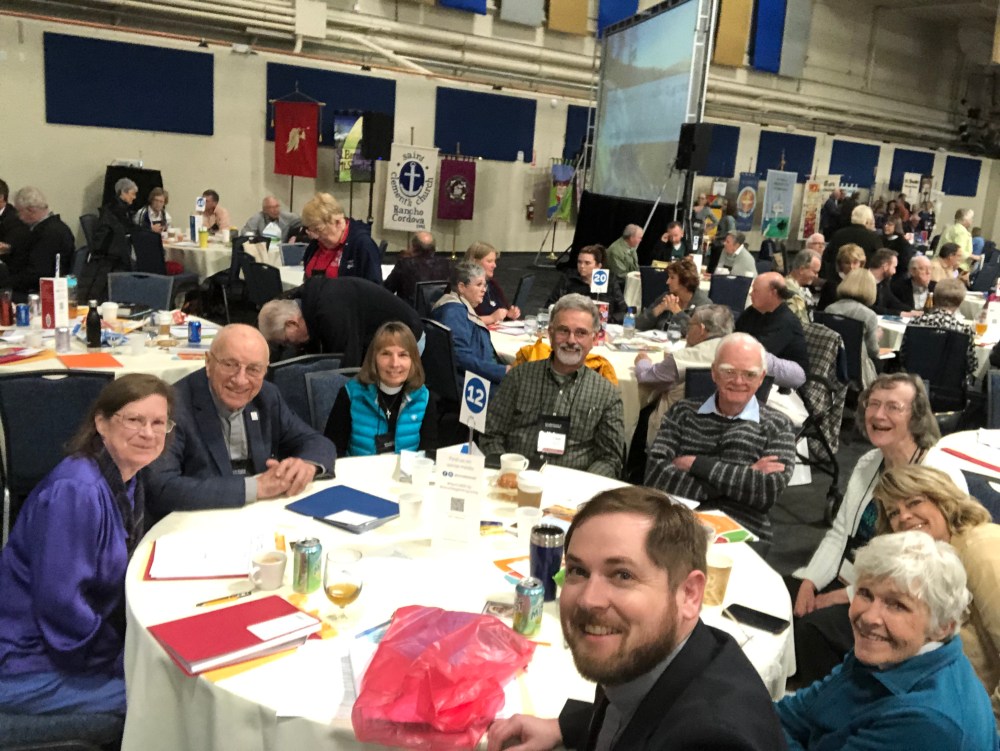
This last week and weekend, several of us gathered in Sacramento for the 2019 Diocesan Convention, which is the annual business meeting of the Episcopal Diocese of Northern California, a diocese comprised of 68 parishes and about 14,000 members. All the clergy of Christ Church along with our elected lay delegates Peg Gardner, Paul Gossard, Elizabeth Harper-Lawson, and Kathleen Lake participated in this meeting that began (for us) at Thursday afternoon and ended yesterday at noon. So we’re pretty tired.
We held several elections and passed some important resolutions, including a resolution to establish a Diocesan Commission on the Environment that will encourage and support congregations like us to be environmentally friendly and to minister in ways that honor Creation. This resolution coincides beautifully with the theme of this year’s Interfaith Thanksgiving Sing, which will be held here at Christ Church on Nov 20th at 7 PM. The theme this year is “Gratitude and Care for Creation.” At convention, we had fruitful conversation and debate about the proposed resolutions, so much so that I started thinking of us Episcopalians as “Children of the Resolution.” (And then the T Rex song came back into my head.) It was a real honor and privilege to be a part of conversations about resolutions that can impact thousands of people in positive ways.
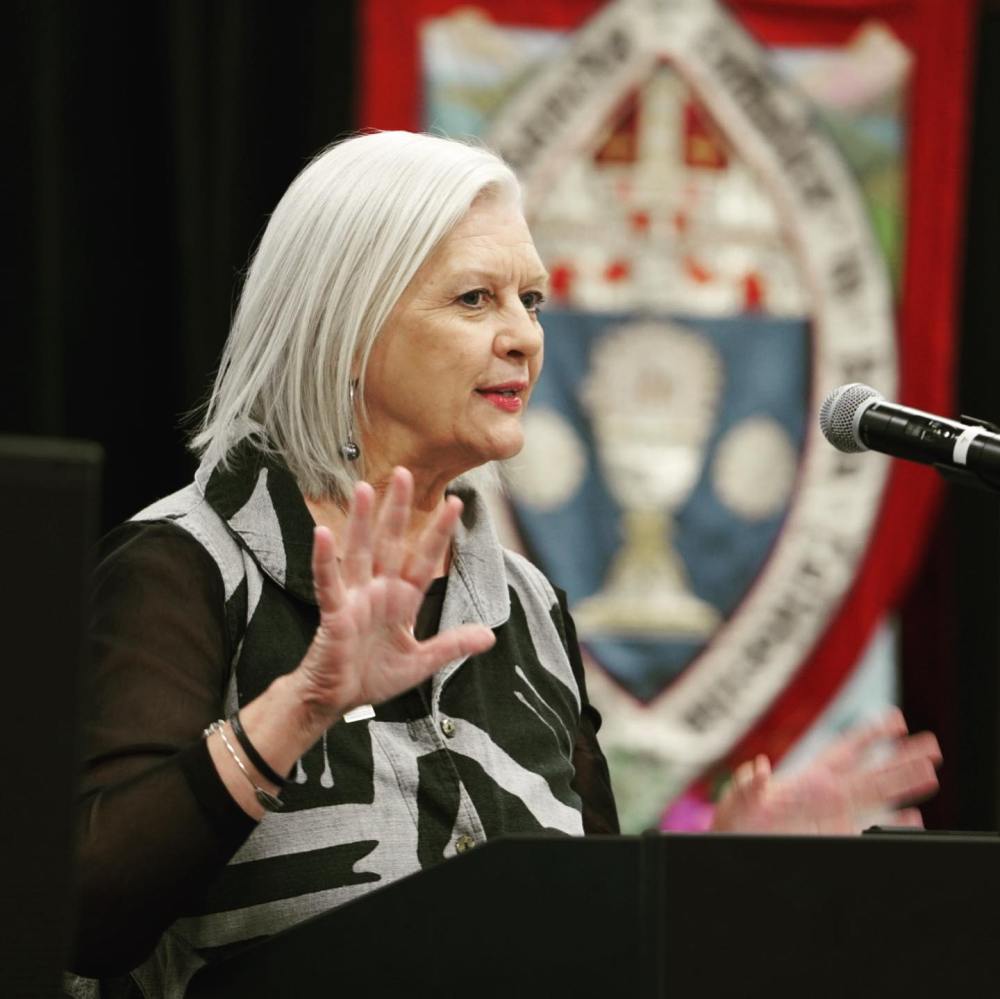
At the heart of the convention was a presentation by a guest speaker named Mary Parmer, who spoke about evangelizing through invitation, welcoming through hospitality, and connecting others to the church by providing a sense of belonging. She has written a book titled Invite Welcome Connect, with a foreword by our Presiding Bishop Michael Curry; and I really want us all to read this book and spend time talking about it. Mary Parmer said that someone approached (at another conference) her after hearing her talk about evangelism and the importance of inviting people to the Episcopal Church. The person asked, “Mary, why should we evangelize? Don’t you know that everyone who should be an Episcopalian already is?” That question reflects this belief that the Episcopal Church only exists for cradle Episcopalians. That kind of exclusive, narrow-minded thinking is Sadducee thinking and it will make the church not only sad (you see?), but also irrelevant and eventually non-existent.
I want us to learn together how we can become children of the resurrection here at Christ Church Eureka, children who have universal hearts that will stretch open not only by encountering people who are different than us, but by inviting them to connect with us and to enrich us and our community so that we can fulfill the intent of the Torah and the mission of Jesus Christ together: to protect the vulnerable, to liberate the oppressed and to build up the beloved community. And I want to be able to say with confidence to all the false teachers out there who seek to use the Bible as a weapon to exclude others and to tear down, when it comes to Christ Church Eureka, you won’t fool the children of the resurrection.
[i] Ronald Rolheiser, The Holy Longing: The Search for a Christian Spirituality (Random House: New York, 2014), 139.


