
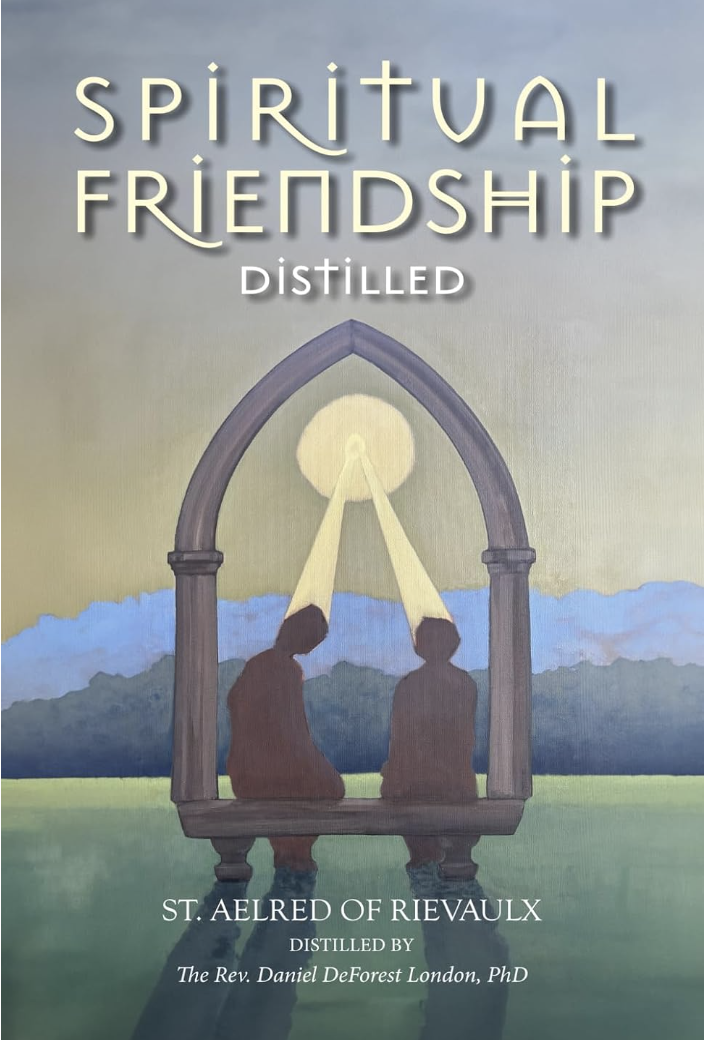
SPIRITUAL FRIENDSHIP DISTILLED
“Here we are. You and me. And I hope Christ makes three.” So begins a profound and yet playful conversation about the possibility that “God is friendship.”
In Spiritual Friendship Distilled, readers are invited into a robust conversation about the miracle of friendship and the practical ways that we can cultivate our friendships with God, others, ourselves, and the earth. Originally written in Latin by a 12th century English Cistercian abbot, this modern rendering makes the teachings of St. Aelred of Rievaulx more accessible than ever.
In the Introduction, Daniel DeForest London demonstrates how seamlessly Aelred weaves together the wisdom of Celtic Christianity, Anglo-Saxon tradition, and classic philosophy, and then dips the integrated wisdom into the “sweet honey of Christ’s love,” as understood in his medieval Cistercian context. As a scholar and teacher of Christian spiritualty and an Episcopal priest ordained on the Eve of the Feast Day of St. Aelred, London offers a distillation that shows how practical, relevant, and engaging Aelred’s teachings remain today.
This spiritual classic covers the divine origin, nature, and excellence of friendship in the format of a dialogue between an abbot and his fellow monks. The questions asked by Aelred’s interlocutors stir up our own questions while the four characteristics of a spiritual friend—loyalty, patience, good intention, and discretion—invite thoughtful self-reflection. The distilled dialogue can easily be read in prayerful solitude, but also among a community of friends in the style of “reader’s theater.” Including an appendix of spiritual practices inspired by Aelred’s wisdom, this book is an outstanding resource for students, teachers, retreat leaders, clergy, and anyone who wants to embrace for more fully the sacred gift of friendship.
“This little book radiates with Love and Friendship. First, Daniel brings us into the heart of Aelred of Rievaulx’s writings. And then, he goes beyond Aelred, offering us simple meditation practices that have the potential to expand our hearts in friendship with self, other, and the Divine. If you wish to deepen your friendships, run to bring these words to your heart.” —Alexander John Shaia, author and teacher at http://www.quadratos.org
“Rev. Daniel London has captured the essential content of St. Aelred’s famous, twelfth-century treatise on spiritual friendship and enhanced its dialogic form, giving it an updated expression. The result is a readable, inspirational text suitable to be read aloud at a parish gathering or retreat as a spur for an extended conversation about friendship as a special form of human and divine love. Dedicated to the memory of two of his own friends, London’s Spiritual Friendship Distilled awakens longing and gratitude for the gift of true friendship it describes and defines.” —Ann W. Astell, University of Notre Dame
“Aelred’s insights about friendship remain as fresh and relevant as they were during the twelfth-century monastic renewal he helped lead. This distillation is much more than a summary: it makes his words leap across the centuries and speak with a contemporary voice while keeping the conversational format and feel of Aelred’s treatise. By condensing the fuller discussions in the Latin original, it clarifies the main threads that weave through the three dialogues. A concise introduction gives a glimpse into the various cultural traditions of friendship–Celtic Christian, Anglo-Saxon, classical, and monastic–that Aelred inherited and synthesized. Brief notes indicate his sources and also suggest connections to more recent thinkers about friendship such as C. S. Lewis. As a bonus, three beautiful, Aelred-inspired practices at the end connect spiritual friendship to Buddhist meditation and forest therapy.” —Curtis Gruenler, PhD, Professor of English, Hope College
“A remarkable meditation on the deepest stratums of friendships. This book led me on a journey of reflection about my choices in friends, what agreements–often unspoken–existed between us, and how the bonds we shared have supported each other’s lives. There are many threads in this book that equip us to become better friends and spiritual companions.” —Amos Clifford, founder of the Association of Nature and Forest Therapy and author of Your Guide to Forest Bathing
“The Rev Dr Daniel London writes with deep insight into the matters of spirituality. He brings a remarkable combination of strengths: a wholehearted love of God, theological depth, and a broad engagement with the community around him. Further, the work is grounded in the realities of caring for his own congregation in the midst of a changing, post-pandemic world. If you come across his books—read them!”—Bishop Megan Traquair, Episcopal Diocese of Northern California
“Spiritual Friendship Distilled is an invitation to free yourself from the crowd, learn how to embody the transformative beauty of spiritual friendship, and dip the world in the sweet honey of divine love. This adaptable book will be helpful in academic classrooms, on spiritual retreats, during zoom conversations among friends, and even performed at local theaters. Here, friend, I trust you will find medicine for the global loneliness epidemic wounding our hearts and alienating us from each other.” —Paul Houston Blankenship-Lai, PhD, Assistant Professor of Spirituality, Earlham School of Religion
“I greatly appreciate Daniel’s work to make ancient texts accessible to the lay person. It gives me confidence as a reader to know that this distillation springs from his academic curiosity and rigor.” —Kathryn Lee, Pacific Center for Spiritual Formation Board Member and Spiritual Director
“London’s evident authorial wisdom, at once scholarly and pastoral, beautifully illustrates the difference between mere “abridgment” and true distillation. Just as lemon zest contains the essence of the lemon tree and honey the essence of the hive, this book communicates in highly attractive form the essence of Ælred’s dialog on friendship, shorn of rhetorical flourishes and complex allegories. Daniel London’s Spiritual Friendship, Distilled will serve well both the spirit-quester, short on reading time yet avid for solid nourishment, and the more leisurely depth-diver, who will be baited by this book to plumb the sweet fullness and fire of Ælred’s thought in the original.” —Simeon Leiva-Merikakis OCSO, author of Love’s Sacred Order: The Four Loves Revisited

THE CLOUD OF UNKNOWING DISTILLED
God is not an idea to be grasped but a presence to be enjoyed.
This is the central message of the 14th-century mystical text The Cloud of Unknowing, which many readers today find less-than-accessible due to the medieval milieu in which it was written.
In The Cloud of Unknowing Distilled, Daniel DeForest London offers a distillation of the text that speaks to today’s spiritual seekers and provides a spiritual practice for directly experiencing the God beyond all understanding. As a scholar, priest, and practitioner of contemplative meditation, London captures the Zen-like wisdom and whimsy of the anonymous medieval author, who describes an ancient form of prayer and meditation known today as Centering Prayer with practical acuity and evocative imagery.
Drawing from medieval understandings of Mary and Martha of Bethany, Mary Magdalene, angels, Bezalel, and even the devil’s nostril, the author of The Cloud offers one of the most colorful and unique introductions to the apophatic tradition and contemplation in general. In this brief distillation, a classic text of Western mysticism has become broadly accessible while remaining deeply penetrative and revelatory.
Within these few pages, you will become acquainted (or re-acquainted) with the anonymous author of The Cloud and refreshed anew by the benevolent presence of the divine who is beyond all knowing and yet closer to you than your very breath.
REVIEWS
“As Daniel London’s concise introduction explains, The Cloud of Unknowing teaches us that God is not a thought or an idea, but a loving presence to be encountered in the simplicity of silence. Whether you have treasured this classic text for years or are coming to it for the first time, you will find something here that speaks to your soul and invites you more deeply into the life of prayer.”
– Arthur Holder, PhD, Professor of Christian Spirituality, Graduate Theological Union, editor of Christian Spirituality: The Classics and The Blackwell Companion to Christian Spirituality
“Like meeting an old friend after an absence and immediately being on intimate terms again, I met the essence of the beloved author of “the Cloud.” This devotional brought me to tears and to belly laughs with that familiar wisdom and wink of slyness I have loved throughout my life. Daniel DeForest London has indeed distilled the author’s authentic voice.”
– The Rev. Suzanne Guthrie, author of Praying the Hours and Grace’s Window: Entering the Seasons of Prayer
“To paraphrase a mystical work such as the ‘Cloud’ is no easy task but Daniel London managed to bring this classic jar down to the lower shelf, so to speak, and made it quite accessible to us all. Definitely a must read! Contemplative prayer suddenly has become for me a joy to engage in. Thanks to the author for crystallizing for us that love is the only instrument that can pierce through our own unknowing.”
-Wil Hernandez, PhD,Obl. OSB
Executive Director of CenterQuest and author of a trilogy on Henri Nouwen and the recently released “Accidental Monk: A Chronicle of Struggle, Faith, and Surrender”
As both a scholar and ordained minister in the Episcopal tradition, Daniel London is able to do what few others are capable of today: a modern rendition of a “spiritual classic” that is both faithful to the original text, as well as immediately accessible and immensely rewarding to the contemporary reader. A fitting guide for either the classroom or personal spiritual sustenance, this edition is bound to become a “classic” in and of itself.
— David M. Odorisio, PhD, Director, the Retreat at Pacifica Graduate Institute & Assoc. Core Faculty; co-editor, Depth Psychology and Mysticism; editor, Merton and Hinduism: The Yoga of the Heart.

RENÉ GIRARD, THEOLOGY, AND POP CULTURE
In René Girard, Theology, and Popular Culture, fifteen contributors consider how Girard’s mimetic theory can be used to uncover and probe the theological depths of popular culture. Creative and critical engagement with Girard’s theory enables the contributors to offer fresh and exciting interpretations of movies (The Devil Wears Prada, Mean Girls, Star Wars), television (Hoarders, Cobra Kai), classical literature and graphic novels, and issues ranging from anorexia to social media. The result is a volume that establishes Girard as an innovative interpreter of culture and shows him as an invaluable guide for theologically reflecting on desire, violence, redemption, and forgiveness. Written in fresh and lively prose, the contributors demonstrate not only that Girard provides a powerful lens through which to view culture but also—and more provocatively—challenge readers to consider what popular culture reveals about them. Readers looking for an accessible introduction to mimetic theory and exploring its theological application will find this a welcome resource.
Chapter 10: Exorcising Blame Through A Contract with God: A Girardian Analysis of Will Eisner’s Graphic Novel by Daniel DeForest London
REVIEWS
“What a class act! These established and emerging Girard scholars demonstrate how mimetic theory, which cut its teeth on nineteenth-century novels, also illuminates contemporary film, television, and graphic novels–now that viewing has supplanted reading, as Girard acknowledges. And if these new genres don’t interest you, there are chapters on the weaponizing of Twitter, hoarding, anorexia, and the Church. Ryan G. Duns’s introduction, which explains mimetic theory via The Devil Wears Prada, is a master class. A must for Girardians, an upskilling for theologians, a resource for preachers, and an education for pop culture junkies.”
— Scott Cowdell, Charles Sturt University
“René Girard, Theology, and Pop Culture makes the case for what so many intrigued by mimetic theory intuit: it is everywhere. The editors have collected a range of impressive chapters covering blockbuster movies, graphic novels, the silver screen, and social media. Most delightful of all is an introduction that walks the reader through the stages of mimetic theory in relation to The Devil Wears Prada. This book is a great contribution to an important series and to scholars of religion interested in showing a theory at work.”
— Grant Kaplan, Saint Louis University
“This books is a marvelous illustration of what happens when encountering the seminal ideas of René Girard: one can no longer “unsee” what his work helps us to see. The volume as a whole provides an adventurous and often entertaining application of mimetic theory to a broad array of pop-culture phenomena without compromising any of the rigor of Girard’s insights. Ideal for the classroom, this volume will be equally engaging for those familiar with and brand new to Girard”
— Biran Robinette, Boston College
Order book from Rowman & Littlefield here


Theodicy and Spirituality in the Fourth Gospel
A Girardian Perspective
DANIEL DEFOREST LONDON
Daniel DeForest London argues that the Fourth Gospel offers a potentially transformative response to the question of suffering and the human compulsion to blame. Based on his reading of John 9 (the man born blind), London argues that the Gospel does not offer a theodicy, but rather a theodical spirituality, an experience of praying the question of suffering and remaining open to a divine response. London shows how the Johannine Jesus’s response poses three sets of symbols in dichotomy (day/night, vision/blindness, sheep/wolf), each subverted by another, core symbol (light, judge, shepherd). By interpreting these symbols in light of mimetic theory, he argues that Jesus’s response reveals the scapegoat mechanism in which an innocent victim is blamed by violent victimizers. However, rather than blaming the victimizers, Jesus continues to engage with the characters who appear to be villains: the light of the world transforms night and day into one continuous day; the Good Shepherd welcomes sheep and wolf into his beloved flock. In this way, readers are invited to bring to the Johannine Jesus their own violence, resentment, and wolfish rage regarding the question of suffering and to experience the theodical spirituality of the Fourth Gospel.
A 2021 GTU Borsch-Rast Book Prize Finalist
REVIEWS
In this readable and pioneering book, Daniel DeForest London offers a transformative reading of John 9 and 10. Employing the “Anthropological tale” of René Girard as an interpretive key to this section of John (i.e. the human propensity toward blaming and scapegoating) London shows how the Johannine Jesus transforms both victim and victimizer. The theodical spirituality emerging from his exegesis offers the promise of liberation and new life to the reader, the church and the world. This is the most important theological book I have read in the last twenty years!
— Peter Rodgers, Center for Bible Study
The problem of suffering is one of the most pastorally important issues in the Christian life, but a preacher hoping to offer a comforting word is faced with a tangled web of competing philosophical and theological explanations that finally fail to satisfy the quest for good news. In response to this challenge, London takes a deep dive into John’s story of “The Man Born Blind” (9:6-10:21). Respectful of the human urge to assign blame for misfortune, London’s approach instead emphasizes the evocative language of this Gospel, offering a perspective that suggests a path to spiritual transformation and an invitation to intimacy with God.
— Linda L. Clader, emerita, Church Divinity School of the Pacific
London offers a compelling reading of John 9–10 that challenges anti-Semitic interpretations of the gospel. Through mimetic theory, readers encounter a Johannine discourse aimed at breaking down the divide between victims and victimizer, and a Good Shepherd who invites them to deflect their need for finding blame onto the cross. Thoroughly informed by contemporary scholarship, this is a timely and significant contribution to the recovery of lament and protest prayer in the Church.
— William Morrow, Queen’s University
London’s premise is that we’re addicted to blame—somebody must be at fault for the pain we’re experiencing or the fix we’re in!—which sets in motion the tragic human cycle of scapegoating and persecuting, of violence and counterviolence. London’s Jesus won’t play that game. Instead, he invites us to blame him, even kill him, as a way to open our eyes and heal our souls. This is a most beautiful and creative retelling of the Jesus story, written from the heart.
A beautiful blend of careful scholarship, biblical insight, spiritual depth and genuine humanity.
— Douglas Frank, author of A Gentler God
One does not have to be interested in Girard to benefit from London’s contribution to Johannine studies, although anyone interested in applying Girard to biblical studies will profit from reading this book. Most importantly, pastors and laypersons will also find this book of pastoral value, both for Bible study and for helping fellow Christians deal with questions concerning theodicy. Even the detailed discussions of small points of Greek grammar and syntax are clearly presented so that one does not need to be a scholar to understand and benefit from them. Strongly recommended.
— Andrew Marr, Abbot of St. Gregory’s Monastery
To read Andrew Marr’s full-length book review of Theodicy and Spirituality in the Fourth Gospel click here: Theodicy and Spirituality in John’s Gospel
Might a robust analysis of suffering disclose the human species’ compulsory addiction to blame? Is it possible to hold someone responsible for the anguish in our world without creating more suffering? How did—how does—the Johannine Jesus respond to the question of suffering and the problem of blame? In Theodicy and Spirituality in the Fourth Gospel: A Girardian Perspective, the Rev. Dr. Daniel DeForest London explores these questions in a spiritual pilgrimage through a dynamic, proverbial river of the Fourth Gospel, the work of René Girard on mimetic theory, and London’s own innovative spirituality. The result of London’s pilgrimage is an erudite, creative, and brilliant piece of scholarship. It is further evidence that the academic discipline of Christian spirituality has come of age and is bearing good fruit in the world. What is at stake in Theodicy and Spirituality in the Fourth Gospel is more than a compelling piece of scholarship that will benefit theological educators and practitioners. At stake is a vision for a spirituality that might help free us from the shackles of blame and the maddening patterns of scapegoating violence, a spirituality that might shepherd us deeper into healing community and the Beloved’s boundless mercy.
— Paul Houston Blankenship, Seattle University
This book was exceptional, in among other respects, its writing. I didn’t expect to find this a “page turner,” but London does a wonderful job at engaging the reader.
— Elizabeth S. Peña, Graduate Theological Union

 DANIEL DeFOREST LONDON