
Readings for the Fifth Sunday in Lent (Year A)
This sermon was preached at Christ Episcopal Church Eureka on Sunday March 22, 2026.
“Well, everything dies, baby, that’s a fact / But maybe everything that dies someday comes back.” These are lyrics from the song “Atlantic City” by Bruce Springsteen, whose biopic I watched as I flew across the Atlantic to visit a city, where a saint who died 800 years ago remains very much alive.
On Friday March 6th, I celebrated the beginning of my 44th year on this earth by visiting a glass bed full of bones, specifically the bones of Christianity’s most beloved saint, Francis of Assisi, who died at age 44, in the year 1226. I had the honor of visiting his remains twice that day: first with a Franciscan friar from Santa Barbara and then with my wife and about a hundred other pilgrims. I was not permitted much time with the remains since the organizers of the exposition were trying to move about 850 people through the lower basilica each half hour. Altogether, about 400,000 pilgrims have visited the saint’s remains during this historic month-long exposition, which concludes today. When I saw the dust and bones of the saint’s remains, I was reminded of the cremains of my best friend Jacob which I held in my hands and placed in the ground a few months after he chose to leave this world. Jacob and I were both Pisces born in early March, and ever since we were teenagers in high school, we would go on special trips together for our birthdays, usually road trips or camping or both. In some ways, my pilgrimage to Assisi was a way of honoring him and our friendship, and as a way for me to continue grieving.
While the remains of St. Francis reminded me of the cremains of my friend Jacob, they also radiated and even seemed to rattle with a vibrant and pulsating hope as thousands of pilgrims from the four corners of the world came to venerate this saint and as seekers from the four winds came to breathe their prayers upon his bones.
Moments after visiting the remains, I was given a prayer card that portrayed St. Francis as glorified in the heavens; and was then invited to place in a glass box my own hand-written prayers, which would be read prayerfully by Franciscan friars. And I included you all in my prayers and in my requests to St. Francis to pray for us. I was then given a few moments to view the medieval frescoes of the lower basilica, painted by the Italian proto-Renaissance masters Giotto and Cimabue, portraying scenes from the life of St. Francis juxtaposed with scenes from the life of Christ, including the Raising of Lazarus. Like other medieval portrayals of this event, the painters depict the people closest to Lazarus as covering their mouths and noses because, as Martha says to Jesus in the King James Version, “Lord, by this time he stinketh.” Martha and Mary kneel before Jesus as he cries out, “Lazarus, come out!” and his friend emerges from the tomb.
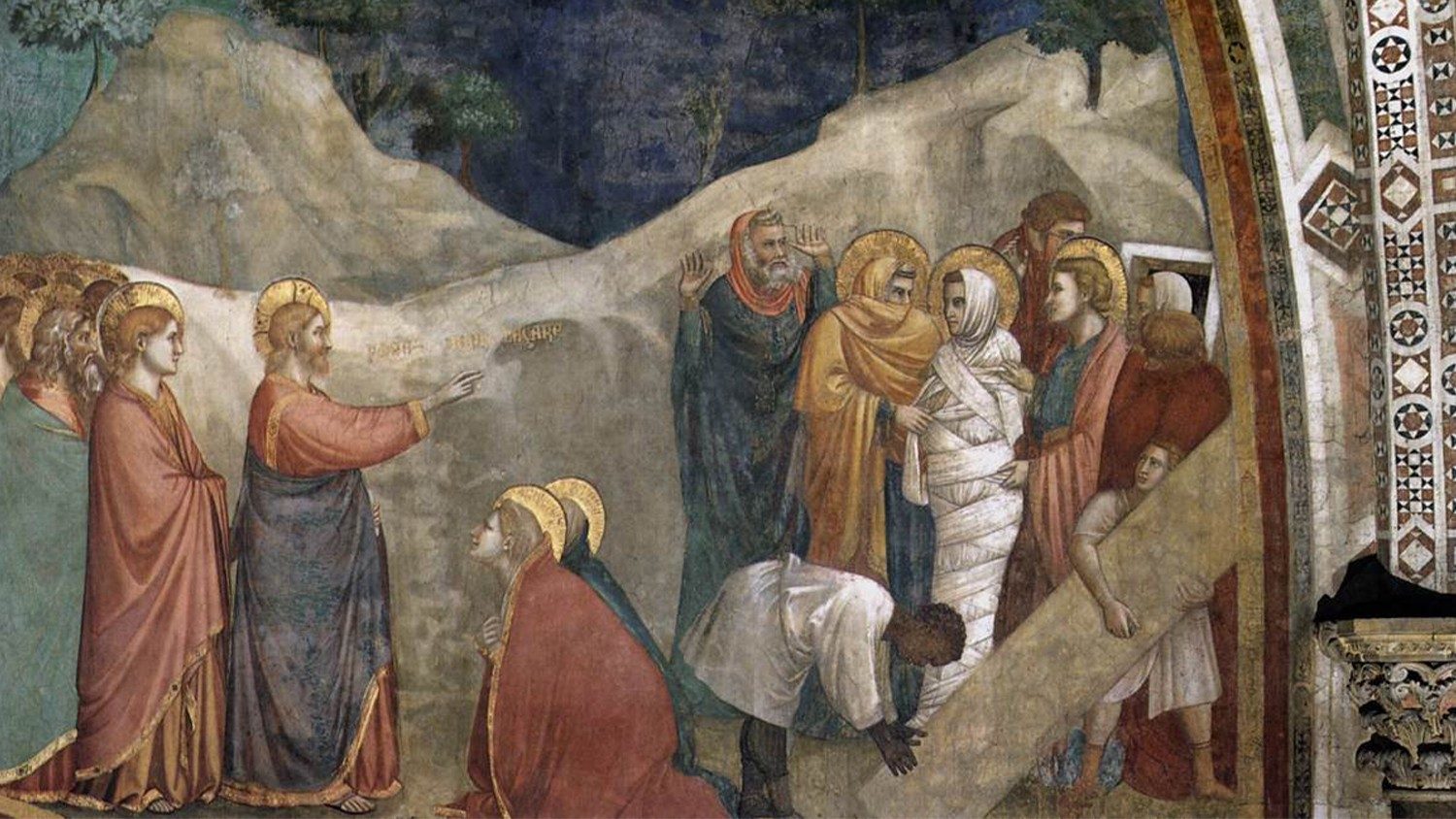
“Everything dies, that’s a fact / But maybe everything that dies someday comes back.” Or as Jesus put it, “Those who believe in me, even though they die, will live, and everyone who lives and believes in me will never die.”
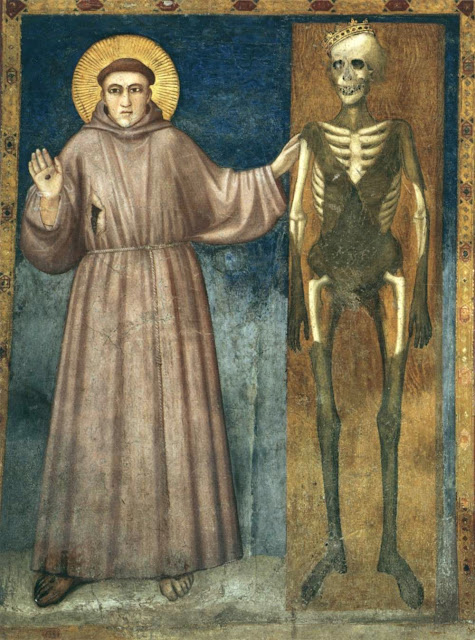
Not too far from the fresco of the Raising of Lazarus is an image of St. Francis with his right hand revealing his stigmata and his left hand on the shoulder of a skeleton, who represents Death. We were told we couldn’t take any pictures and when I asked why, the friar told me it was simply because it would just take up too much time. So, I very quickly snapped a photo of this fresco of St. Francis and Death, which felt especially apt after visiting his own skeletal remains on my birthday during this season of Lent, when we are reminded of our mortality, when we are reminded that we are all but dust and to dust we shall return. Today’s readings about bones and death and resurrection echo this reminder.
In what is considered the first Italian poem “The Canticle of the Creatures,” perhaps the greatest Italian poet, Francis himself, writes, “Praised be You, my Lord, through our Sister Bodily Death from whom no one living can escape. Woe to those who die in mortal sin. Blessed are those whom death will find in Your most holy will, for the second death shall do them no harm.”
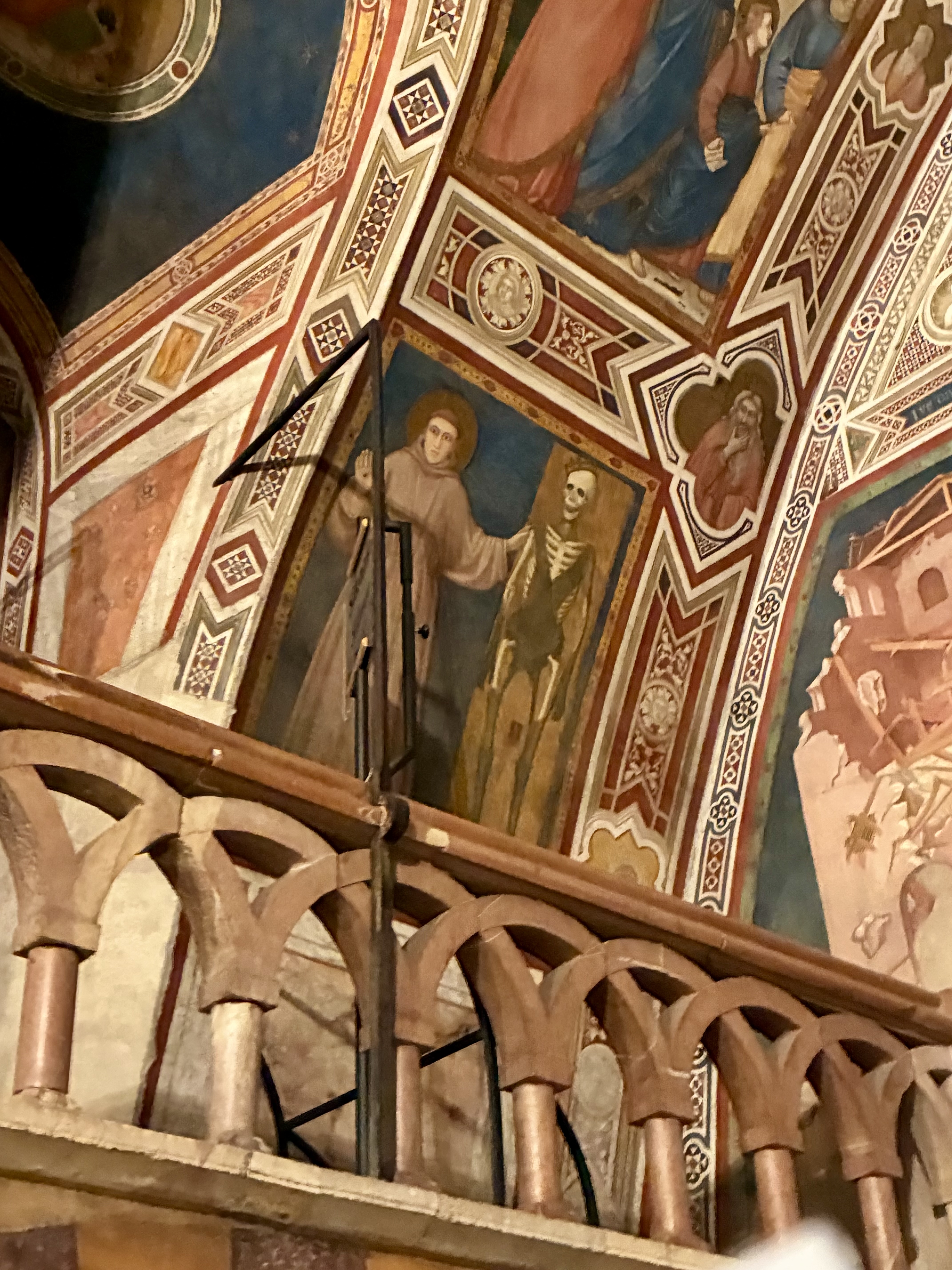
These words, along with the fresco, offer one of the most helpful Christian perspectives on death. In the fresco, Francis has his left hand placed on the shoulder of the skeleton as if befriending Death as a fellow sibling. The friar pointed out to me the crown upon the skull of Death is sliding off because Death no longer reigns supreme, Death has lost its sting, thanks to Christ’s victory on the Cross. Since Death has been defeated, Francis can see Death as indeed a fellow sibling through whom God receives praise: “Praised be You, my Lord, through our Sister Bodily Death from whom no one living can escape.” Death becomes an unavoidable, inevitable, inescapable gateway into greater life. We need no longer fear death. We can even befriend death when it comes, but we certainly do not seek death, lest we die in mortal sin: Woe to those who die in mortal sin, but blessed are those whom death will find – and death will find us all – blessed are those whom death will find in Your most holy will, because for them, for us, death is a gateway to greater life.
We may still have all kinds of doubts and questions and turbulent feelings about death as Jesus himself did, but we are called to remain ever hopeful that death is not the end, that death never has the last word, death’s crown is teetering. In our Gospel, Jesus becomes intensely expressive with his emotions as he grieves the death of his dear friend, Lazarus. The Greek words used to describe his emotions are etraxen (from tarasso) which means profoundly unsettled as well as the word enebrimesato (from embrimaomai) which is used elsewhere to describe a horse snorting in anger. Jesus is not afraid to express his troubled spirit and his growling rage in the face of death. Throughout this Lenten season, we’ve been invited to listen to Brother Wind with Nicodemus, to taste Sister Water with the Samaritan woman, and to see Sister Earth with the man born blind; and today, we are invited to engage the bodily sense that is most directly associated with our memory and with the fire of our emotions: our sense of smell, which is explicitly referenced a few times in our Gospel today. A simple aroma can bring one to tears. Jesus, who is unfazed by the stench of death, snorts in anger in the face of death and yet remains also unafraid to publicly shed tears for his friend whom he knows he will see again, very soon.
“Everything dies, that’s a fact / But maybe everything that dies someday comes back.” – “Those who believe in me, even though they die, will live, and everyone who lives and believes in me will never die.” This is the message we will proclaim from the rooftops in a couple weeks on Easter Sunday, and yet it remains a message that we proclaim every Sunday because every Sunday is a mini-Easter, even during Lent. And because if we stop proclaiming this message, then the church should give up and close down. The message that Christ is risen and because He is risen, we too shall rise; or as Paul puts it this morning in Romans, “He who raised Christ from the dead will give life to your mortal bodies also through his Spirit that dwells in you.”
Jesus, St. Francis, and the Boss offer us a helpful and deeply Christian perspective on death. In conclusion, I offer the words of a poem by Mary Oliver whom we Episcopalians like to claim as our own, a poem that invites us to see death as a sibling who, when she comes, leads us into greater life, but also as a sibling whom we ought not seek out, a sibling who calls us to live each day of this life as faithfully and as fully as possible. The poem is called “When Death Comes.”
When death comes
like the hungry bear in Autumn;
When death comes
like an iceberg between the shoulder blades,
I want to step through the door full of curiosity, wondering:
what is it going be like, that cottage of darkness?
And therefore I look upon everything
as a brotherhood and a sisterhood,
and I look upon time as no more than an idea,
and I consider eternity as another possibility,
and I think of each life as a flower, as common
as a field daisy, and as singular,
and each name a comfortable music in the mouth,
tending, as all music does, toward silence,
and each body a lion of courage, and something
precious to the earth,
When it’s over, I want to say: all my life
I was a bride married to amazement.
I was the bridegroom, taking the world into my arms.
When it’s over, I don’t want to wonder
If I have made of my life something particular, and real.
I don’t want to find myself sighing and frightened,
or full of argument.
I don’t want to end up simply having visited this world.
“Praised be You, my Lord, through our Sister Bodily Death,” because although “everything dies, that’s a fact,” we who look for the resurrection of the dead, believe that maybe “everything that dies someday comes back.”

 DANIEL DeFOREST LONDON