
Isaiah 58:1-12
Psalm 103
2 Corinthians 5:20b-6:10
Matthew 6:1-6, 16-21
This homily was preached at Christ Episcopal Church in Eureka CA on Ash Wednesday, February 18, 2026.
Your Father who sees what is done in secret will reward you. Ha pater sou ha blepon en to krypto apodosei soi. Your Father (pater) who sees (blepon) what is done in secret (krypto) will reward you. The Greek word for “secret” in Matthew’s Gospel is krypto; and while I can assure you that Jesus is not speaking about cryptocurrency, he is indeed calling us to be a bit cryptic about our practices of piety and devotion. Now I will admit that this is a bit confusing for a couple reasons. First, because at the beginning of this same sermon in Matthew’s Gospel, (the Sermon on the Mount) Jesus says, “Let your light shine before others so that they may see your good deeds and praise your Father in heaven.” He says this right before teaching us that we need to perform our good deeds (our prayers, our fasting, and our almsgiving) in secret, so that others do not seeus. So, which one is it? Shine our light so others see our good deeds? Or be cryptic so that they don’t? The second reason why this is a confusing Gospel for us to read on this day, Ash Wednesday, is because this is the one day of the year when we mark ourselves on our foreheads and are encouraged to keep that mark on our foreheads throughout the day, thus increasing the likelihood that other people will see that we went to church today. They will see our good deeds. The cross on our forehead is a sign to others that we most likely prayed and fasted and gave alms today, the very practices that Jesus told us to do in secret.
Now I acknowledge this paradox almost every year on Ash Wednesday. Most of the time, I offer some kind of resolution to this apparent contradiction, but sometimes I leave it open-ended. This year, I want to offer a story that will hopefully shed some light on this Lenten mystery. It is a story of San Francesco de Assisi, whose tomb will be taken out of the crypt this Lent and into the Basilica in honor of the 800th year of his death. The story is about his conversion from a wealthy and self-absorbed playboy to a penitent and voluntarily impoverished friar. There are many different accounts of his conversion, and it is also clear that he underwent multiple conversions, like the time he heard God tell him to rebuild his church and to sell everything he had and follow him. However, the most dramatic turning point in his life occurred while he was on his way to join the pope-sponsored army of Walter of Brienne in Apulia, where he intended to achieve knighthood and military glory for himself. On his way to Apulia, he stopped in Spoleto, where he supposedly heard the voice of God speak to him. German author Hermann Hesse writes about this experience in a fairly cryptic way, saying,
Now it came to pass that on the first day of the journey young Francis heard the voice of God so clearly that his heart trembled in his chest and all the riveting visions of glory and vanity melted away within him. No one knows what was revealed to him in that hour and what kind of voice ripped into his startled soul and bent him over with humility, for that moment when an individual’s personal destiny is decided always remains veiled in darkness, as a sacred mystery. Francis never spoke about his inner thoughts and visions. But it seems that suddenly the mysteries of life and death were revealed before his eyes with clarity; and a sacred power unequivocally compelled him to seek a new purpose for his life. At Spoleto, he was seized by a fever, and soon afterwards he returned alone to Assisi, where he gave away all his magnificent armor to a poor nobleman.
Another biographer of St. Francis writes with similar obscurity, saying, “Something did happen at Spoleto, doubtless. But nothing clear: neither God the Father with His drums nor the Most High with His thunder voice. It was the Most Low who whispered in the ear of [Francis], who spoke only as He can—very low. A wisp of a dream. The twitter of a sparrow. And that is enough to cause Francis to give up his conquests and make his way back to his own country. A few words full of shadows can change a life.”[1]
Modern biographers of Francis tend to be very cryptic and secretive about this part of the saint’s life, as these examples demonstrate. However, one of the earliest accounts of Francis’s life, written by his fellow Franciscans (Brother Leo, Brother Rufino, and Brother Angelo), reveals the words that Francis heard from God. According to The Legend of the Three Companions, “Francis felt unwell on arriving at Spoleto; and thinking with apprehension about the journey, he went to bed; but, half asleep, he heard a voice calling and asking him whither he was bound. He replied, telling of his plan [to join the pope’s army in Apulia]. Then he [heard] these words:
“Who do you think can best reward you, the Master or the servant?”
“The Master,” answered Francis.
“Then why do you leave the Master for the servant?”
Francis replied: “O Lord, what do you wish me to do?” [2]
“Return to Assisi and there you will be told what to do next. You will soon learn how vain and meaningless it is to seek glory and honor for yourself through the praise of others. You will discover the true riches of poverty, and the power of my light shining through you and your simple and unassuming acts of penance and compassion.”
So, Francis returned home to Assisi, where he was mocked for his failure to become a knight and then insulted for what appeared to be his madness. After giving away his wealth as well as much of his father’s wealth, he stripped down naked in the middle of town and then lived as a beggar on the streets, caring for lepers, praying and fasting, and repairing dilapidated churches. He dressed as a lay penitent and eventually became a deacon. People knew he was a man of prayer, but they also knew that he didn’t pray to bring attention to himself. He prayed to bring glory to the God who revealed to him the true riches of poverty and the power of His light shining through him.
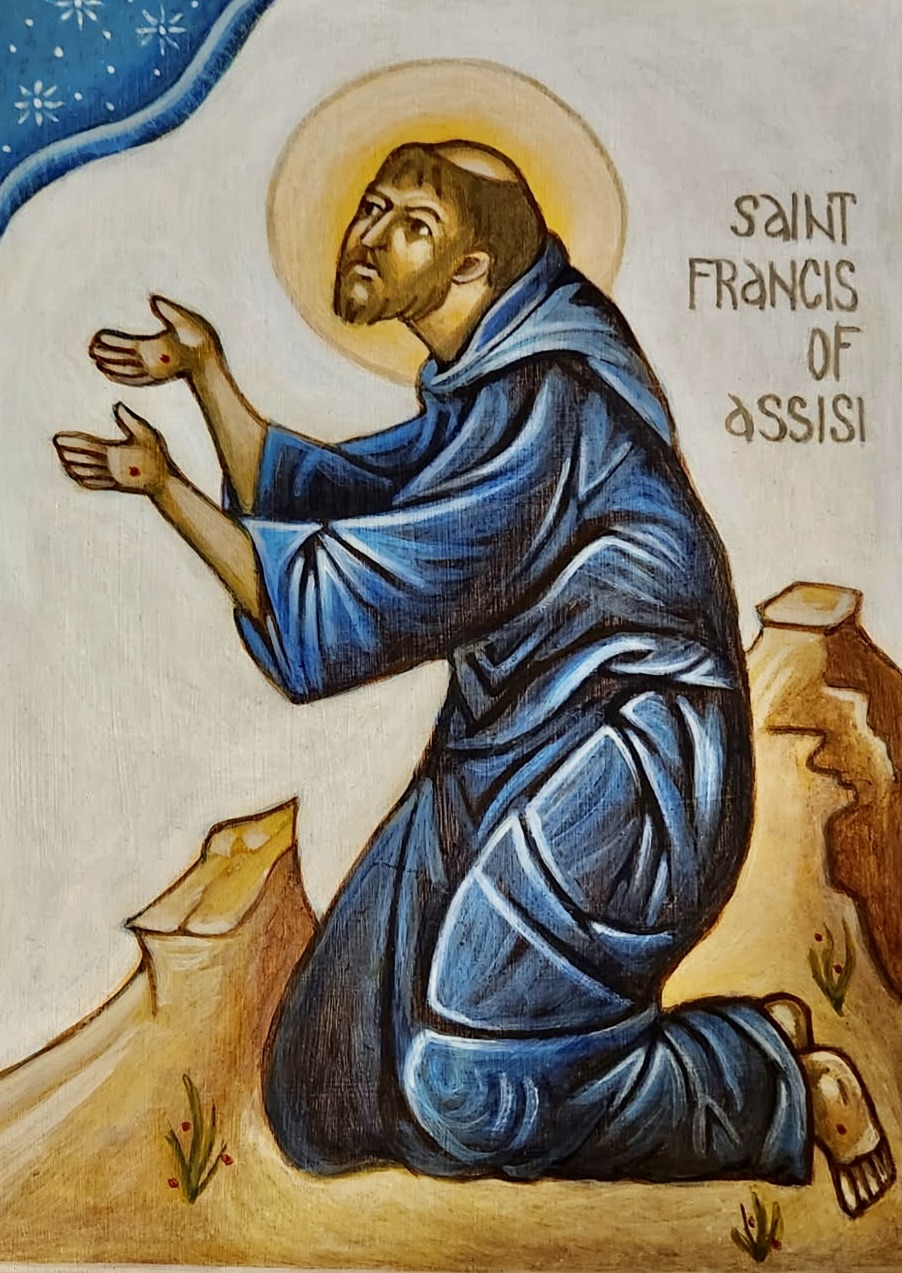
On this Ash Wednesday and throughout this season of Lent, I invite you to pray and to fast and to give alms –remembering that a portion of your donation to the church goes directly to helping those in need—and I invite you to do so with a sober sense of cryptic secrecy, with an openness to receiving the riches of prayer, and with a Franciscan faith that God’s light will shine through you and all your imperfections so that others may give glory not so much to you but to our God who is most eager to share His glory with you and to reward you with everlasting treasures. Amen.
[1] Christian Bobin, The Very Lowly: A Meditation on Francis of Assisi, translated by Michael H. Kohn (Boulder CO: New Seeds, 1997),40.
[2] Legend of the Three Companions, 894 – 895.

 DANIEL DeFOREST LONDON