
“The best of Anglicanism is unexcelled” – Thomas Merton
Thomas Merton was baptized Anglican, grew up Episcopalian, and later became perhaps the most influential Christian mystic of the 20th century, whose writings and spirituality still inspire Episcopalians and Anglicans today.
Baptized in the Church of England while living in France and raised in the Episcopal Church while living on Long Island, Thomas Merton later converted to Roman Catholicism and became a Trappist monk. While his relationship with the Episcopal Church and Anglicanism fluctuated between disappointment and appreciation, he has remained a source of profound spiritual wisdom for Episcopalians and Anglicans ever since he first published his bestselling autobiography The Seven Storey Mountain in 1948 (titled Elected Silence in the UK).
This webpage exists for the purpose of adding Thomas Merton to the Episcopal Church’s Calendar of Lesser Feasts and Fasts, with the suggested feast day of December 10, which is the day he entered the Abbey of Our Lady of Gethsemani (Catholic monastery in Trappist Bardstown, Kentucky) in 1941 as well as the day he died tragically in Bangkok Thailand in 1968.
This webpage serves as a hub for collecting information about worship services and other commemorations honoring Thomas Merton throughout the Episcopal Church.
The Standing Commission on Liturgy and Music wants to see evidence of local commemorations before new names are added to the calendar, keen to make sure that sufficient time is given to let the “cult” grow.
Please submit the date, time, location and general format (Holy Eucharist, Morning Prayer, Reading Group, Special Event, etc.) of your local commemoration(s) of Thomas Merton in the comment (“thoughts”) section below.
Any other connections you wish to include between Thomas Merton and the Episcopal Church / Anglicanism are also welcome!


 DANIEL DeFOREST LONDON
Resolution Text
Resolved, the House of ________________ concurring,
Resolved, That the 82nd General Convention meeting in Phoenix AZ designate December 10 or another appropriate date on the Church Calendar as the annual celebration of the life and work of Thomas Merton, Trappist monk, poet, social critic, contemplative, and spiritual writer who lived in Kentucky; and be it further
Resolved, That the 82nd General Convention direct the Standing Commission on Liturgy and Music to prepare or review previously prepared biblical lessons, collects and other liturgical resources commemorating the life and work of Thomas Merton.
Explanation
Thomas Merton has already been included in Holy Women and Holy Men and A Great Cloud of Witnesses, although he is not yet included in Lesser Feast and Fasts. In June 2024, Episcopal bishops and deputies gathered for the 81st General Convention in Louisville KY, only blocks away from the Thomas Merton Square, where Thomas Merton had a vision of everyone around him “shining like the sun.” Moments after being elected, Presiding Bishop Sean Rowe referenced Merton’s vision on Fourth and Walnut (now Muhammad Ali St.) as a “touchstone” for the entire convention. He then concluded his remarks with the following quote from Thomas Merton: “What really matters [in times of drastic change] is openness, readiness, attention, courage to face risk” (Conjectures of a Guilty Bystander, 206).
General Convention 81 met only 55 miles away from the Abbey of Gethsemani where Thomas Merton lived as a monk and hermit from 1941 to 1968. The Trappist monks of Gethsemani were praying for the Episcopalians of General Convention while also hosting several deputies and bishops in their retreat house before convention. Brother Paul Quenon, who was a novice under Thomas Merton, graciously brought several Episcopal visitors to Merton’s hermitage, where Merton often hosted ecumenical guests, including Anglicans and Episcopal seminarians from Nashotah House. Also, the Abbey of Gethsemani includes statues created by Walker Hancock and donated to the Abbey by Trinity Episcopal Church in Topsfield MA as a memorial to Episcopal seminarian and martyr Jonathan Myrick Daniels (August 14).
At GC 81, Merton was referenced and quoted not only by our Presiding Bishop (see above) but also by the Reverend Chaplain Lester Mackenzie on June 23 (“our job is to love others without stopping to inquire whether or not they are worthy” Disputed Questions, 125), the Reverend Dr. Kelly Brown Douglas at the “God Talk, Justice, and the Church” conversation (hosted by the Diocese of Kentucky and EDS), and the Reverend Yejide Peters Pietersen in her sermon on June 26 (“I believe that the desire to you does in fact please you” Thoughts in Solitude). Moreover, at General Convention, participants sang a beloved hymn tune named “Thomas Merton,” a tune that Episcopalians around the world have been singing for decades: Hymn #679 (Canticle 9: The First Song of Isaiah). The hymn tune was written by Episcopal organist and composer Ray Urwin who described Merton and his works as “very important and influential” to him.
This resolution is being sponsored by deputies from the Diocese of Kentucky, where Thomas Merton lived, and the Diocese of Northern California, a region where Merton offered his final US presentations before travelling East, where he died by accidental electrocution in Bangkok Thailand.
Background: Merton and Anglicanism
Thomas Merton was born in France to a New Zealand artist and an American Quaker who was baptized in the Church of England. He was raised on Long Island, where his father served as a church organist at Zion Episcopal Church in Douglaston NY, a church that Merton attended with pleasure, saying that “one came out of the church with a kind of comfortable and satisfied feeling that something had been done that needed to be done.”
While studying at Ripley Court in England, Merton attended the local Anglican Church where he enjoyed singing hymns and hearing portions read aloud from Pilgrim’s Progress. During this time, he began praying more sincerely and felt “happy and at peace.”
Later, after attending Oakham School at Clare College, Cambridge, Merton offered criticized the Church of England, calling it a spiritually sterile and ineffective “class religion… of the ruling minority in a nation.” He was also not afraid to dole out similarly strident criticisms of certain aspects of the Roman Catholic Church and his own Cistercian community.
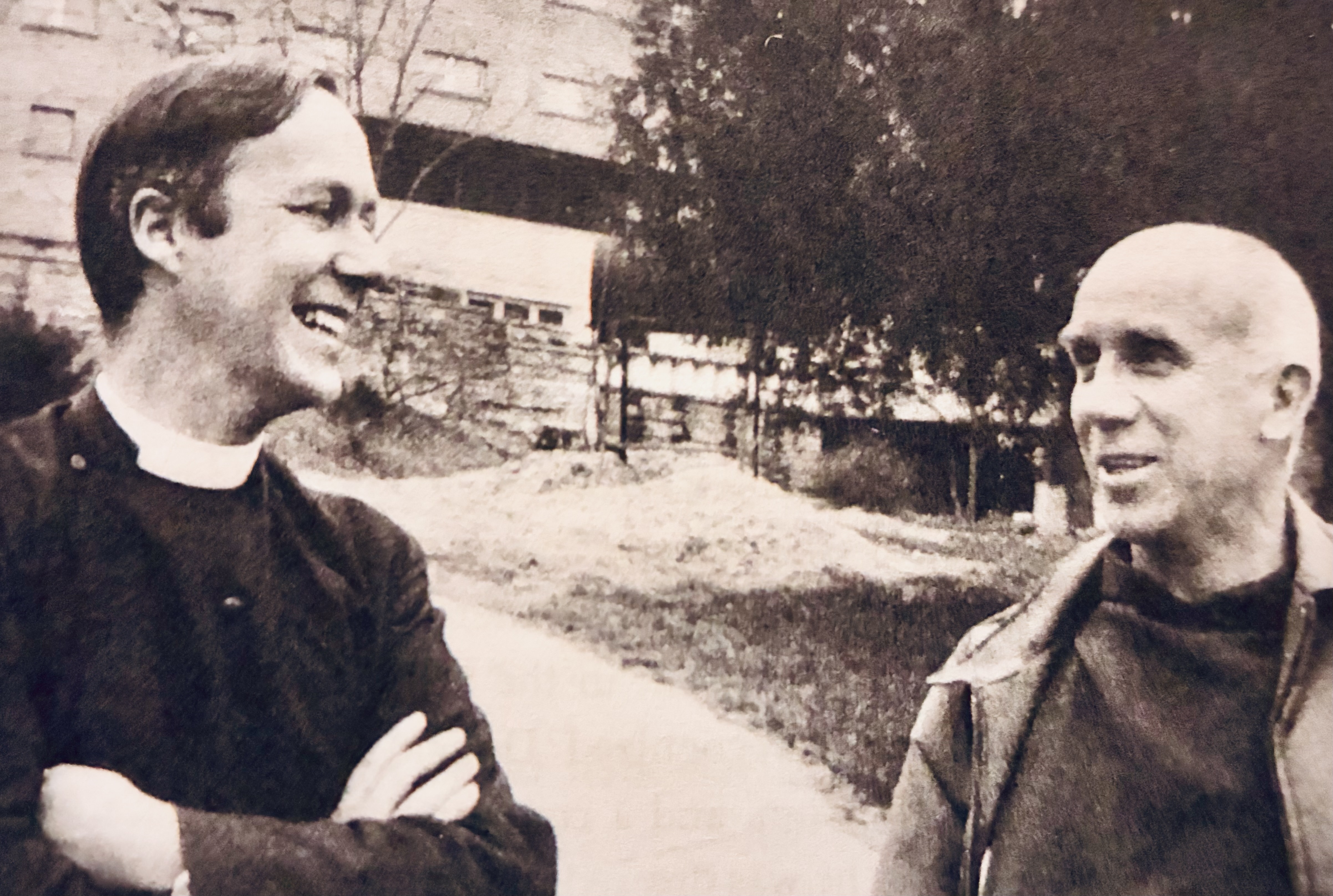
During the 1960s, Merton became close friends with Anglican priest and theologian, the Rev. Arthur Macdonald “Donald” Allchin, who served as the librarian of Pusey House, Oxford, and residentiary canon at Canterbury Cathedral. Through his friendship and correspondence with Allchin, Merton discovered a new appreciation for Anglican Divines, especially Lancelot Andrewes, and Anglican Mystics, such as Thomas Traherne. He expressed a desire to write a book on Anglican Mystics and, in a letter to Allchin, he exclaimed, “The best of Anglicanism is unexcelled.”
Date & Time: December 10, 2025 (9 AM)
Place: Chapel of Our Merciful Saviour at Christ Episcopal Church Euerka CA
Format: Holy Eucharist for the Feast of Thomas Merton
Sermon: Thomas Merton and the Angels of Advent
The bishop of Western Massachusetts Douglas Fisher recently quoted in Thomas Merton in an article he wrote in the Faith Matters section of the Greenfield Recorder:
There is an awful lot of “terrible” right now, but we do not have to settle for what is. We can be inspired by the faithful who went before us and by the good works done by living communities of faith today. Trappist monk, Thomas Merton, understood that we must keep going amid the worst of it all. “You do not need to know precisely what is happening, or exactly where it is all going. What you need is to recognize the possibilities and challenges offered by the present moment, and embrace them with courage, faith and hope.”
https://recorder.com/2026/02/13/faith-matters-finding-hope-in-the-midst-of-the-terrible/