

Readings for the Feast Day of Thomas Merton
- Isaiah 57:14 – 19
- Psalm 62
- Colossians 2:2 – 10
- John 12:27 – 36
This sermon was preached at Christ Episcopal Church in Eureka CA on December 10, 2025
Collect for the (proposed) Feast Day of Thomas Merton
Gracious God, you called your monk Thomas Merton to proclaim your justice out of silence, and moved him in his contemplative writings to perceive and value Christ at work in the faiths of others: Keep us, like him, steadfast in the knowledge and love of Jesus Christ; who with you and the Holy Spirit lives and reigns, one God, for ever and ever. Amen.
I’d like to begin by reading a poem by Thomas Merton titled “Advent.”[1] I invite you to let these words wash over you and fall gently upon you like a morning dew. Let go of the need to overanalyze the poem; rather let the words soak into you.
Charm with your stainlessness these wintry nights,
Skies, and be perfect!
Fly vivider in the fiery dark, you quiet meteors,
And disappear.
You moon, be slow to go down,
This is your full!
The four white roads make off in silence
Towards the four parts of the starry universe.
Time falls like manna at the corners of the wintry earth.
We have become more humble than the rocks,
More wakeful than the patient hills.
Charm with your stainlessness these nights in Advent,
holy spheres,
While minds, as meek as beasts,
Stay close at home in the sweet hay;
And intellects are quieter than the flocks that feed by starlight.
Oh pour your darkness and your brightness over all our solemn valleys,
You skies: and travel like the gentle Virgin,
Toward the planets’ stately setting,
Oh white full moon as quiet as Bethlehem![2]
Thomas Merton’s Advent poem is addressed to the skies, the meteors, the stars, and the moon, all symbols that have been associated with the beloved saint whom the poet refers to as “the gentle Virgin.”[3] According to Merton, the secret of Advent is “the presence of God in Mary”[4] and Advent invites us to emulate the One who made room in her body for the presence of Christ by making room for the presence of Christ in our own lives, our hearts, our souls and bodies. The Scripture readings appointed for this Feast Day of Thomas Merton (which falls in the middle of Advent) offer ways that we can, like Mary, make room for Christ in this season.
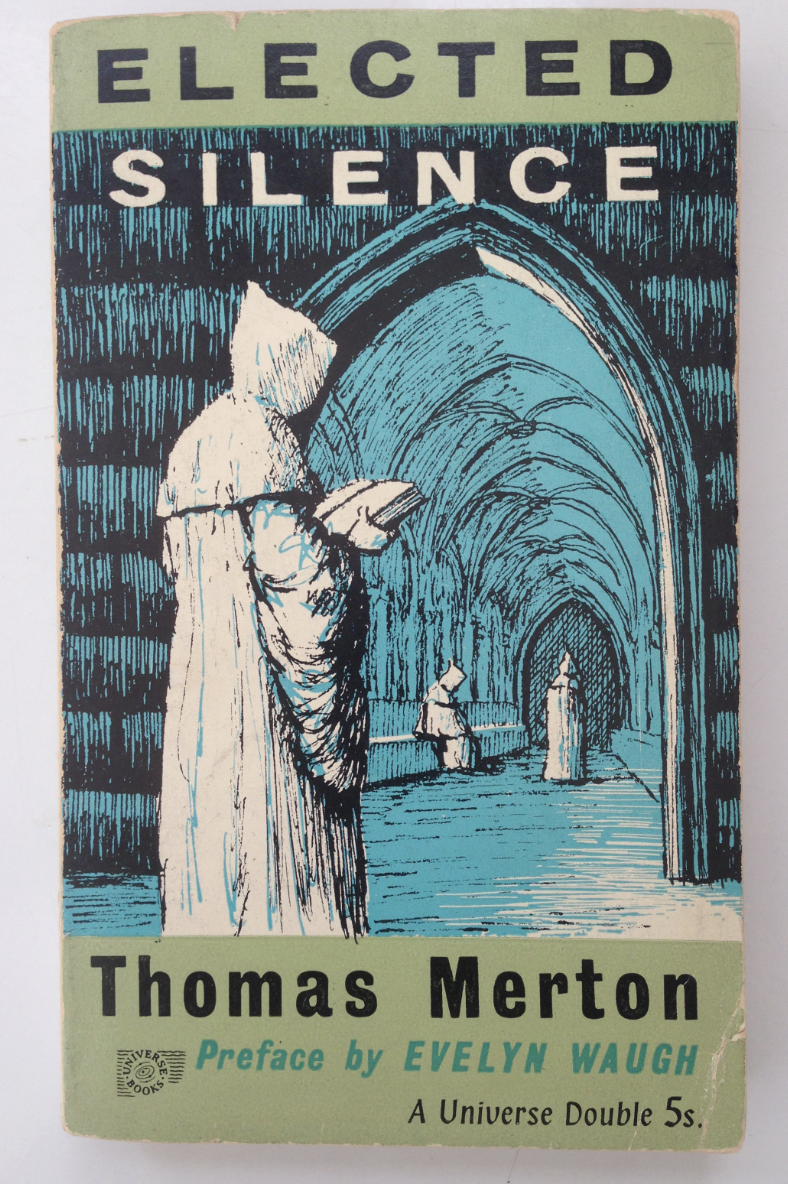
Our first reading from Isaiah, a prophet often read during Advent, proclaims that the God who dwells in the high and holy place also dwells “with those who are contrite and humble in spirit” (Isaiah 57:15), thus calling us to make room for Christ by practicing humility and penance and contrition. The poet of Psalm 62 declares, “For God alone my soul in silence waits” (Ps 62:1), inviting us to not only practice patience but to also elect silence and stillness as central practices.[5] Merton believes that St. Mary was immersed in prayerful silence when Gabriel first appeared to her, writing, “The angel finds Mary praying in solitude, the door closed upon her, in secret.”[6] By stepping into our own closed doors of prayerful silence, penance, and patient solitude, we open ourselves up to receive the arrival – the adventus – of the One in whom the fullness of deity dwells bodily. By participating in the Sacrament of Advent, which is the Holy Eucharist, we can come to fullness in him, who is the head of every ruler and authority, according to our reading from Colossians (2:9 – 10).
Finally, the Gospel calls us to listen, to listen in the silence for the voice from heaven, the voice that may sound to us like an angel…or like thunder…or both. Merton writes, “My life is a listening, His is a speaking. My salvation is to hear and respond. For this, my life must be silent. Hence, my silence is my salvation.”[7] In silence, we increase our capacity to listen like the shepherds, like the dreamers, and like the gentle Virgin to the glorious One who comes to us like angelic thunder or like a thunderous angel. Merton describes angels as “invisible messengers of [Christ’s] divine will, as mysterious protectors and friends in the spiritual order. Their presence around us, unimaginable, tender, solicitous and mighty, terrible as it is gentle.”[8] When the angels of Advent come to us, will we be ready to not only hear them but to also respond to them with the same humility and openness as St. Mary?
The secret of Advent is not just that Mary made room in her heart for the presence of God to appear to her in the form of an archangel, but that she also made room in her body for the presence of God to transform her entire life in a glorious and yet terrifying way. Thomas Merton also responded to the divine voice by vowing, at the age of 26, to spend the rest of his life as a Trappist monk in Kentucky. Are we ready for the angels of Advent to not only speak to us in our silences like thunder but to also call forth in us a new level of commitment? Are we ready for the thunderous angels of Advent to call forth in us the presence of the One who sent them to us in the first place?
In Merton’s reflection on angels, which he calls God’s “exclamation points,” he asks, “Do not the angels come to us from afar, from ‘out there’ in order to underline the inexplicable fact that he who sent them from afar is already present within us? Do not their exclamation points simply make us aware that what God tells us of his will is simply his own seeing and his own loving at work within us? In the last analysis the angels are saying, by their personal and sudden presence, that a greater [One] than they is here, and they are sent to inform us that we are rooted in the very Light by whom they were sent. Yet if they were not sent our eyes would never open, our hearts would never leap out of their own little constraint into the large freedom of a perfect and total response.”[9]
Advent invites us to leap with St. Mary out of our own little constraint into the large freedom of a perfect and total response to the angels who long to set us free with their rousing thunder. For Merton, a total response required radical engagement not only with other Christian denominations and faith traditions but also radical engagement with the most controversial issues of his day: race relations, economic injustice, environmental degradation, war, violence, and the nuclear arms race. For Mary, a perfect and total response resulted in the Miracle of Christmas: the Incarnation of the One in whom the fullness of deity dwells bodily. Mary’s perfect and total response calls forth a response in us, which is what I hear Merton saying to us when he says that, at Christmas, “Christ is born to us…in order that he may appear to the whole world through us”[10] and when he concludes his poem “The Victory” with these angelic and thunderous words:
Lift up your heads, begin to sing:
The message of their lamps and fires
Warns you: make ready for the Face that speaks
like lightning,
Uttering the new name of your exultation
Deep in the vitals of your soul.
Make ready for the Christ, Whose smile, like lightning,
Sets free the song of everlasting glory
That now sleeps, in your paper flesh, like dynamite.[11]
May the angels of Advent speak to us and set free the divine glory that is already within us. Amen.
[1] When asked for advice on what a speaker should bring to an audience, Donald Allchin, an Anglican priest and friend of Thomas Merton’s, offered the following wisdom: “Give them poetry, poetry, poetry!” So, it only seems apt to begin a sermon on Merton with one of his poems, especially one titled “Advent.” Allchin introduced Merton to poets R. S. Thomas, David Jones, and Ann Griffiths and encouraged Merton’s reading of Thomas Traherne and George Herbert. Paul M. Pearson, “‘Give them Poetry, Poetry, Poetry’: The Donald Allchin Memorial Address Delivered at the Ninth General Meeting of the Thomas Merton Society of Britain and Ireland at Oakham School, Rutland on 13th April 2012.” The Merton Journal 19.2 (Advent 2012):8-17. https://thomasmertonsociety.org/Journal/19/19-2Pearson.pdf. It was in correspondence with Allchin that Merton wrote, “It seems to me that the best of Anglicanism is unexcelled.” Thomas Merton, Hidden Ground of Love: The Letters of Thomas Merton on Religious Experience and Social Concerns, edited by William Shannon (New York: Farrar, Straus, Giroux, 1985),26.
[2] Thomas Merton, The Collected Poems of Thomas Merton (New York: New Directions, 1977), 88. “Advent” from A Man Divided in the Sea (1946).
[3] St. Mary has traditionally been interpreted as the “woman clothed with the sun, with the moon under her feet, and on her head a crown of twelve stars” (Revelation 12:1). St. Alphonsus Liguori says, “the moon is a figure of Mary,” https://devotiontoourlady.com/the-glories-of-mary-st-alphonsus-liguori.html. Also, see Robert M. Place, A Gnostic Book of Saints (St. Paul MN: Llewellyn, 2001), 130 – 133.
[4] Thomas Merton, “Advent in Spirituality of St. Bernard” [1952] in Seasons of Celebration (New York: Farrar, Straus and Giroux, 1965), 87.
[5] The title of Merton’s bestselling autobiography, known in the US as The Seven Storey Mountain, was published in the UK under the title Elected Silence.
[6] Thomas Merton, “Advent in Spirituality of St. Bernard” [1952] in Seasons of Celebration (New York: Farrar, Straus and Giroux, 1965), 85.
[7] Thomas Merton, Thoughts in Solitude (Boston: Shambhala, 1993), 77.
[8] Thomas Merton, “The Angel and the Machine,” 3 in The Merton Seasonal 22 (Spring 1997): 3-6.
[9] Thomas Merton, “The Angel and the Machine,” 3 – 4 in The Merton Seasonal 22 (Spring 1997): 3-6.
[10] Thomas Merton, “The Nativity Kerygma” [1956] in Seasons of Celebration (New York: Farrar, Straus and Giroux, 1965), 112.
[11] Thomas Merton, The Collected Poems of Thomas Merton (New York: New Directions, 1977), 113. “The Victory” from A Man Divided in the Sea (1946).

 DANIEL DeFOREST LONDON