
Readings for the Twenty-Second Sunday after Pentecost (Proper 27 – Year C – Track 2)
This sermon was preached at Christ Episcopal Church in Eureka CA on November 9, 2025.
There’s a song titled “Children of the Revolution” by a 70s glam rock band named T Rex, a band that our deceased beloved parishioner Rex White particularly loved. The song includes the refrain: “You won’t fool the children of the revolution.” It’s a catchy tune and I hear it in the back of my mind every time I read or hear the phrase that Jesus uses in this morning’s Gospel: the children of the resurrection. In my head, I start singing, “You won’t fool the children of the resurrection. No, you won’t fool the children of the resurrection.” That refrain is somewhat appropriate since in our Gospel reading this morning, the Sadducees are using the Torah to try to fool Jesus, who is the first child of the resurrection (1 Corinthians 15:20).[1] The Sadducees were a wealthy, elite, and exclusive religious class within Second Temple Judaism. One could not become a Sadducee. One had to be born a Sadducee. Based on their reading of the Torah, they denied the resurrection as well as the existence of angels. My Biblical Studies professors would often say, “The Sadducees were sad (you see?) because they did not believe in the resurrection, nor did they believe in angels.”
In our reading, the Sadducees try to fool Jesus by presenting him with a hypothetical scenario in which a woman’s husband dies, forcing her to then marry her deceased husband’s brother; which would be in accordance with the teachings of the Torah, specifically Deuteronomy 25, which lays out the laws concerning levirate marriage (the name for this marriage to one’s brother-in-law. Levir is Latin for Brother-in-law). In the Sadducees’ scenario, this woman must end up getting married seven times (!) because her husbands keep dying on her. So, their question for Jesus is, “Whose wife will the woman be in the afterlife?” Although the men of the ancient, patriarchal and (according to our standards) misogynistic world had little difficulty imagining a man with many wives at the same time, they could not grasp the possibility of a woman with more than one husband at the same time. So obviously, according to the Sadducees, Moses must have also denied the resurrection since the Torah’s teachings (God’s teachings!) on levirate marriage would become nonsensical when it comes to the afterlife. The Sadducees were using the Torah to exclude possibilities (like the resurrection and angels) and as a weapon to humiliate and make a fool out of Jesus and his followers.
Jesus responded to the Sadducees by saying, “You won’t fool the children of the resurrection. Your narrow-minded thinking will never grasp the ever-expansive and inclusive love and life that will be enjoyed by God’s` children. Although the children of the resurrection will indeed be reunited with departed loved ones (whom we honored just last Sunday), their relationships will no longer be bound and limited in the same way, by blood ties or by marriage. The children of the resurrection will be like angels.” And by mentioning angels here, Jesus is sneaking in a little jab at the Sadducees, who don’t believe in angels.
So, the Torah’s teachings on levirate marriage were extremely important in this life because they protected women from the ostracism, destitution and danger often associated with barrenness and widowhood in the ancient world. Jesus makes it clear throughout the Gospels that the Torah (the Law) was given by God to humanity not as a tool for narrow-minded thinking or exclusive clubs. The Torah was given by God to humanity to protect the vulnerable and to build up a safe, healthy and welcoming and ever-expanding community of love.
This is very important. The Torah is not meant to exclude, but rather to protect and include. And that truth applies to the entire Bible. The Bible is not to be used as a weapon of mass discrimination. All our sacred Scriptures are concerned with protecting the vulnerable and building up a safe and welcoming and inclusive community. Jesus makes that very clear at the beginning of Luke’s Gospel when he sums up his entire mission by quoting the prophet Isaiah and saying, “I’m here to protect the vulnerable, liberate the oppressed and build up the beloved community.” (Luke 4:18-19.) Whenever we hear someone using the words of Jesus or verses from the Bible to hurt the vulnerable or to create an exclusive religious elite (like the Sadducees), let’s not be fooled. Because what we are hearing is someone who is working in opposition to the clear mission of Jesus Christ, which is to protect the vulnerable, liberate the oppressed and build up the beloved community. Preachers, teachers and priests who use the Bible to hurt and exclude others will not fool the children of the resurrection, who know God’s mission.
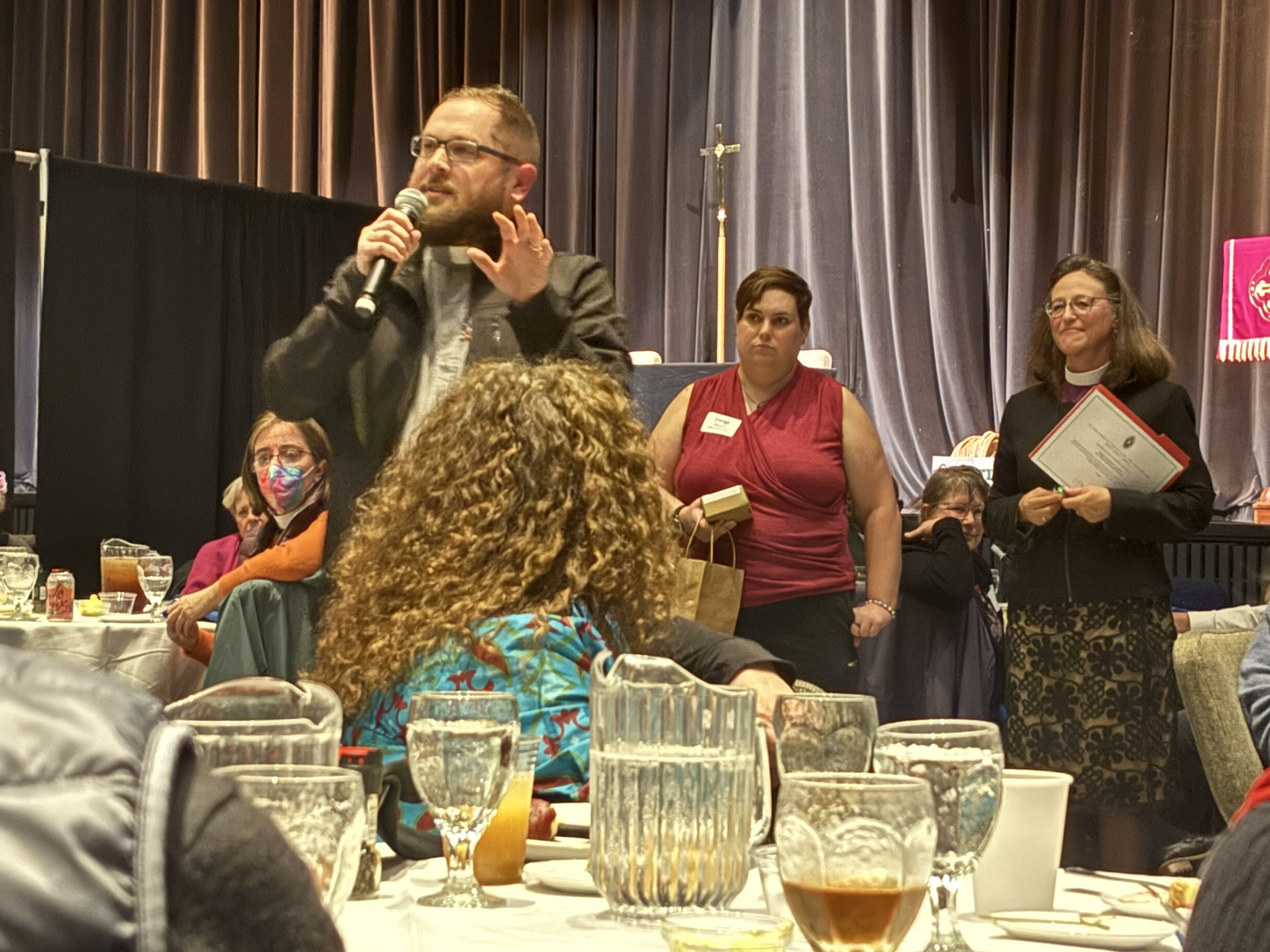
This weekend, several of us gathered in Redding for the 2025 Diocesan Convention, which is the annual business meeting of the Episcopal Diocese of Northern California, a diocese comprised of 63 (formerly 68) parishes and about 14,000 baptized members. This year, Christ Church was represented by Rich Baker, Robin Cardona, Pam and Paul Gossard, Jeri and Perry Gray-Reneberg, Berta Rodriguez, Sheena Ruchte, Elizabeth Harper-Lawson, Merry and Dan Phillips, Steve Preston, Nancy Streufert, and me. We held elections and passed resolutions, including one resolution that begins with Jesus’s mission statement from Isaiah in which he says, “I’m here to protect the vulnerable, liberate the oppressed and build up the beloved community.” This resolution called for the Episcopal Church to continue serving and supporting migrants. At the Convention Banquet, our community Christ Church received a special recognition from Bishop Megan for our creative and successful Sacred Saunter Outdoor Eucharists. We received a certificate that includes this prayer, “Everlasting God, strengthen and sustain Christ Episcopal Church through Sacred Saunter, as they worship in the beauty of creation, may they bring strength and beauty to the world. For all good things come from you, Lord. Amen.”

Our keynote speaker this year was Bishop Phyllis Spiegel (the bishop of Utah), who compared discipleship to birdwatching. Just as birdwatchers learn to sit still in the proper environment and wait for the birds to show up, discipleship also involves learning to regularly sit still in unique habitats of the Holy Spirit (like this church) and wait for the Spirit to show up and speak to us and through us. May we, as children of the resurrection, learn to sit still in this unique habitat of the Holy Spirit like a bird watcher sitting attentively in an aviary; and then may we, in the words of Mary Oliver, “pay attention. Be astonished. Tell about it.” Bishop Megan echoed this call to discipleship by urging us all to pray the Daily Office, not just once in a while or just once a week, but daily! It’s not called the “Once in a While Office,” but the Daily Office! Bishop Megan also quoted a former clergy colleague of hers who, after receiving complaints from a parishioner about the lack of silence before Mass, told the parishioner, “You are encouraged to spend as much time as you’d like in silence during your Daily Morning Prayer, but when we gather as a community, such verbal fellowship is natural and even appropriate.” There was much to share and celebrate; however, along with encouraging signs of spiritual growth in the diocese, there was also an undeniable fear and anxiety about the ubiquitous growth of church deficits and church closures. Six years ago, when I reported back on Convention, I described our diocese as comprised of 68 parishes, which is 5 less than today. Every year, we seem to be closing another parish (as we did this year: St. John’s in Marysville) and I have yet to see the founding of a new church in our diocese. In the face of these sobering realities, it is tempting to fall into despair and succumb to fear. It is tempting to fall into the narrow-minded thinking of the Sadducees which will not only make us sad (you see?), but ultimately insular, irrelevant and non-existent.
Our faith is founded upon the death and resurrection of Christ and upon the belief that because Christ is risen, we too shall rise! We who are in Christ are the beloved children of the resurrection; and if the church as we know it is dying, then we children of the resurrection ought not be fooled or overwhelmed by this “death” because, thanks to Christ, “death” has lost its sting, and in Christ all forms of death become opportunities and gateways for new life and resurrection. If the Episcopal Church as we know it disappears or dies in forty or thirty or even twenty years as some researchers suggest, then we, who remain in Christ, get to be part of witnessing and participating in that which will inevitably follow after death: resurrection and new life. So, to all the false teachers who use the Bible as a weapon to exclude others, and to all the growing temptations to fall into fear and anxiety and despair, I hope and pray that we, as faithful disciples of Christ in this diocese and in this parish, can learn to say, with ever-growing confidence, you won’t fool the children of the resurrection!
[1] Christ has been raised from the dead, the first fruits of those who have died.

 DANIEL DeFOREST LONDON