
Sermon begins at 23:55
Readings for the Seventeenth Sunday after Pentecost (Proper 22 – Year C – Track 2)
This sermon was preached at Christ Episcopal Church in Eureka CA on October 5, 2025.
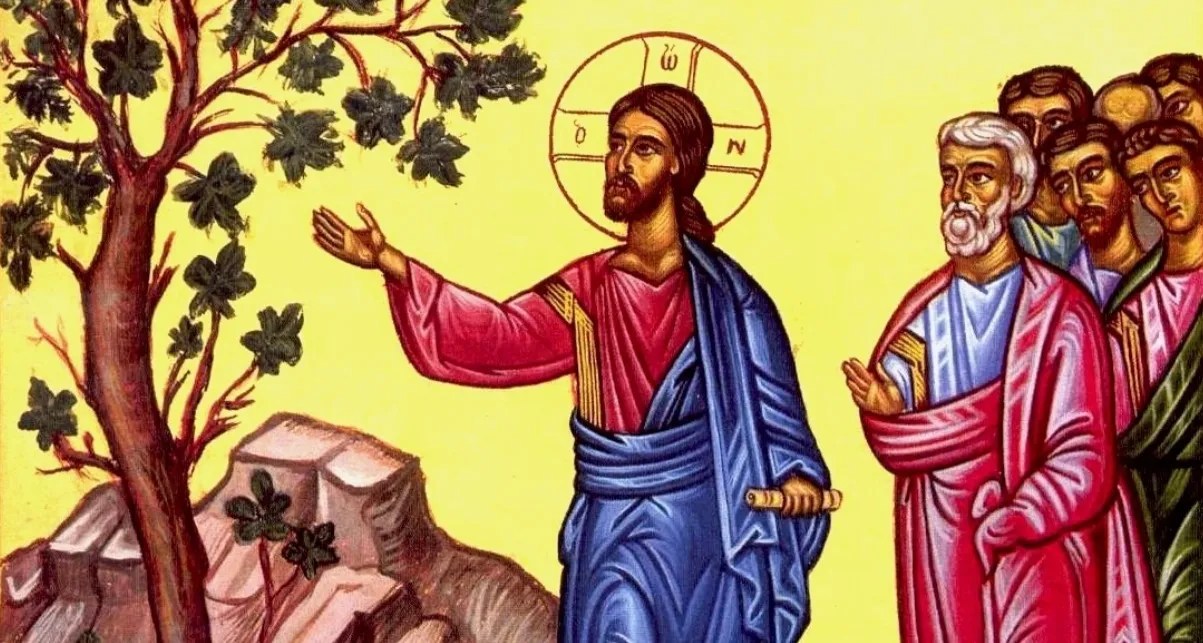
On this final Sunday of Creation season, Jesus uses imagery from creation to explain the mighty power of a little faith. When the disciples ask Jesus to increase their faith, he invites them to consider and trust that their faith, however little – even the size of a mustard seed—is already enough to uproot trees and replant them in the sea. In the Gospels of Matthew and Mark, Jesus speaks of faith moving the mountains (Matt 17:20; Mark 11:23), but here in Luke, he emphasizes the moving of trees from the land into the sea, which may sound a bit strange to us. It reminds me of that joke that Anglican clergy in New Zealand Aotearoa used to share with me: “Why do you never see hippos hiding in trees? Because they’re very good at it.” Maybe this is Jesus’s version of that kind of joke, pushing us to imagine bizarre scenarios merely for the sake of stretching our imagination and thereby increasing our faith in what God can do. In Jewish literature at this time, however, there are stories of rabbis miraculously uprooting trees in order to prove their point. So, Jesus is not as “out there” as we might think, but I’ll admit that I’m still puzzled by his words this morning. A traditional sermon on this passage would underscore the exhortation to have faith the size of a mustard seed; and to trust that your faith, however small, is enough to open the floodgates for God’s miraculous power to move through you. And that’s a great message; and perhaps that’s all some of us need to hear today. And we can thank God for speaking to us through that encouraging word. But bear with me as we dig a little deeper into these teachings of Jesus, including the following parable of the humble servant.
Let me point out a few key words in the original Greek. When Jesus speaks of the mulberry tree, he says, te sukamino taute; taute means “this.” So, Jesus is not talking about some abstract tree but rather a particular tree that stands right in from of him and his disciples, which they can see and touch and smell and and taste (mulberries are a good source of iron and vitamin C) and hear (psithurism). This conversation with Jesus is not occurring in a synagogue or anywhere indoors, but rather outside, during a sacred saunter or an outdoor gathering like the ones we had yesterday in Rio Dell and at Betty’s Bayside Village and the one we’re offering later today in the Sts. M & M courtyard for our St. Francis Blessing of the Animals. This conversation is taking place outside next to a mulberry tree and in this conversation, Jesus, who loves talking about trees, speaks of having a conversation with a tree! A conversation in which the tree listens! When the text says that the tree will obey you, the word is actually hupekousen, which means “listen.” If you have just a little faith, you can have conversations with trees and other creatures, and they will listen to you!
St. Francis knew this well. One day when he was preaching at a castle called Savorgnano, there was a kettle of swallows singing and making noise in the courtyard. So, he told them to be silent until he had finished preaching to the people, and the swallows listened to him and obeyed him. Another day, when he was walking cheerfully in the region near Bevagna, he looked up and saw a huge flock of birds perched on the trees along the path. He then turned towards his companion friars and said, “Wait for me here on the road, I want to go preach to my beloved bird brothers.” So, he went into the field and began preaching to the birds, who immediately approached him and remained very attentive until he had finished his sermon, flying away only after he gave the final benediction. Brother Masseo eavesdropped and listened to some of Francis’s sermon to the birds. He heard him say, “You little birds, my brothers, remember to practice humility and to give thanks and glorify the God who has clothed you with beautiful feathers, who has given you the freedom to fly, who feeds you and provides you with rivers and springs from which to drink and mountains and trees upon which you can build your nests. Your Creator loves you tremendously, so thank him and praise him always.” And Br. Masso saw that as St. Francis was speaking to them, all the birds opened their beaks, stretched out their necks, spread their wings, and bowed their little heads to the ground in a gesture of humble gratitude; and then they let him know through their chirping that he had brought them great joy. And St. Francis took delight in each of them and praised the Creator, whom he saw within them. St. Francis had the kind of faith that inspired him to converse with creation and that inspired creation to listen to him. He had faith that could move mountains and uproot trees.

As human beings who have faith that we are made in the image of God our Creator, we believe we have been given a unique power and authority over creation. In Genesis chapter 1, God says, “Let us make humankind in our image and let them have dominion over the creatures of creation” (1:26). We do indeed have power to uproot trees and move mountains. In fact, some trees were, in a sense, “uprooted” to construct this magnificent church building. However, before we get carried away with this power to manipulate creation, Jesus immediately follows his teaching on uprooting trees with one of the most extreme parables about selfless and humble service to God. Here, Jesus is making it abundantly clear that the only proper way to understand our God-given power and authority as bearers of the divine image and as “rulers” of creation is within the frame of selfless humble service to God. It is within this frame, that the idea of being a ruler of creation transforms so much that it begins to make much more sense to call ourselves caretakers rather than rulers. And if we look at the Hebrew word for “dominion” which is radah, we learn that it is associated not at all with a tyrannical ruler who uses his subjects for selfish gain and exploitation but rather with a benevolent ruler who walks among her people, who listens to them, cares for them, and seeks ways to humbly serve them. That is what it means when God says in Genesis that we are to have “dominion” over creation. We are to tend and till and care for all of God’s creation (as God mandates in Genesis 2:15) and when we do this, we should not be expecting heaps of praise or seats of honor. Rather, we should say like the servant in the parable, “We have done only what we ought to have done.”

In the parable of this most humble servant, we see in the original Greek the word diakonei, where we get the word “deacon.” Remember that St. Francis was not a priest, not a bishop, not a cardinal, but a deacon. He was the most beloved deacon in church history, right up there with Archdeacon Pam and Deacon Anne. Not only did St. Francis the Deacon have faith that the trees and birds and other creatures would listen to him, but he also had enough humility as a servant to listen to them, as a benevolent ruler listens to her people. This is why St. Francis is the great patron saint of creation because he knew how to listen to creation as a humble servant. He would never tell a tree to be uprooted without first listening to it and receiving its permission. After a rainfall, St. Francis would carefully pick up earthworms from the road and move them to safety in the grass so they would not be trampled or die in the sun. He knew he had the power to make creation listen to him and obey him, but he preferred to be the one listening. It is this attitude that inspired the great “Prayer of St. Francis”; and although Francis never wrote this beautiful prayer (which was written in the early 20th century), it has roots in the famous saying of Francis’s close companion and disciple, St. Giles of Assisi who said, “Blessed is the one who loves and does not therefore desire to be loved; blessed is the one who serves and does not therefore desire to be served; and blessed is the one who listens and does not therefore desire to be listened to.” [1] May the faith in our power to uproot trees always be formed and informed by our call to serve with the utmost humility, to listen to the birds and trees and mountains and all of creation with the tender care and compassion of St. Francis the Deacon who said, “I have done only what I ought to have done. May Christ teach you what is yours to do.” Amen.
[1] Giles of Assisi, The Golden Sayings of Blessed Brother Giles, translated by Paschal Robinson (Dolphin Press, 1907), 5.


 DANIEL DeFOREST LONDON