
Readings for the Sixteenth Sunday after Pentecost (Proper 21 – Year C – Track 2)
This sermon was preached at Christ Episcopal Church in Eureka CA on September 28, 2025.
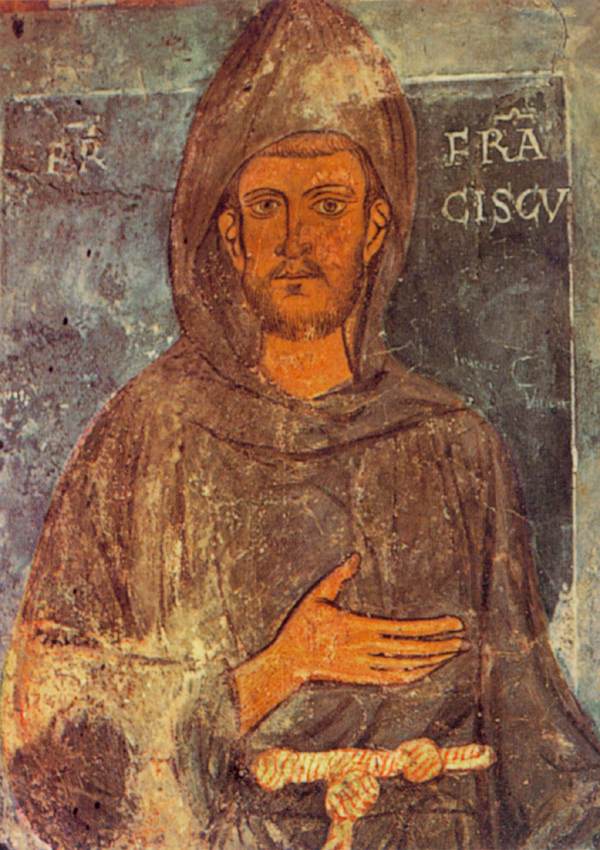
As we continue to move through the Season of Creation, I feel invited to continue my sermon series on the patron saint of Creation, the little poor man, the Poverello of Assisi, San Francesco. While St. Francis preferred to preach the Gospel more through his actions and radical lifestyle than through his words, he had some disciples who became especially influential and eloquent theologians. Not least among these was Giovanni di Fidanza who, as a young boy, was cured by St. Francis from a fatal illness. When he grew up and became a Franciscan friar, he changed his name to Buenaventura or Bonaventure. One of the earliest biographies we have of St. Francis was written by Bonaventure, who also wrote a massive commentary on the Gospel of Luke. In this commentary, he offers a deeply Franciscan interpretation of this morning’s parable of the Rich Man and Lazarus.

In the parable we are introduced to a rich man dressed in purple who feasted sumptuously every day. (Purple garments at the time were highly prized, made from the purple dye of the murex sea snails. Roman senators wore purple as a symbol of status and this practice carried over into the church, where bishops continue to wear purple to this day.) At the gate of this wealthy man was a poor, sick, and hungry person named Lazarus, who only received attention from the dogs who would come and lick his sores. When Lazarus died, he was carried away by angels to be in the comforting bosom of his ancestor Abraham. When the rich man died, no angels carried him away; instead, he was buried and then tormented in Hades, where he suffered great agony among the flames and longed for a simple drip of cool water to soothe his tongue.
Bonaventure’s commentary on the parable suggests that the descriptions of the rich man and Lazarus are less about their afterlife in Hades and Abraham’s Bosom and more about the state of their souls while on earth. Although the rich man is overly satisfied in the flesh, feasting sumptuously every day, he is, in fact, spiritually malnourished. The soul of the rich man is not just barren but is in agony as the flames of envy and greed grow hotter within him. His soul desperately longs for some reprieve, some rest and refreshment from the constant clamor of his own covetousness. While feasting like a glutton, his parched soul cries out for a simple drop of water. However, because the rich man remains caught up in his own self-importance with his purple dresses and fine linens and overabundance of food, he remains deaf to the cries of his own soul. This is made evident by the fact that a clearly poor, hungry, and sick man reclines right outside his gate, and he fails to even share a crumb with him. He fails to realize that it is by sharing a simple morsel of his sumptuous meal with poor Lazarus that he would refresh his parched soul with the spiritual water that he so desperately needs. It is because the rich man remains stuck in his myopic, self-centered worldview that a great chasm has indeed been fixed between him and Lazarus. Not so much the chasm of the afterlife, but the chasm in this present life.
This Franciscan perspective opens up this parable in powerful ways for us, suggesting that many of the souls of the materially wealthy are crying out to the poor for spiritual reprieve. This Franciscan perspective suggests that although the poor man Lazarus did indeed hunger for crumbs from the rich man’s table, his soul remained comforted by his ancestors and upheld by angels. In his state of spiritual health and consolation, he likely developed a warm friendship with the dogs who licked his wounds and indeed with all of creation. Lazarus was certainly hungry and needed some food, but his soul was well fed. The rich man feasted sumptuously each day, but his soul was in torment.
As a young man, Francis lived his life much like the rich man in the parable, feasting sumptuously each day and dressing in the finest linens. His father was, after all, a wealthy cloth merchant and he likely had access to the same purple linens described in the parable. However, something occurred in his life that woke him up to the agonized state of his soul and he began to see the poor and the lepers, whom he previously ignored and shunned, as his pathway out of the torturous hell he was stuck in. He quickly discovered that his soul received the refreshment that it so terribly needed whenever he cared for the poor and the lepers. The more he let go of his material possessions the more his soul felt comforted in the bosom of Christ and upheld by angels. Through fasting and poverty, Francis discovered the most glorious spiritual riches. Anglican author G. K. Chesterton wrote, “The whole point about Saint Francis of Assisi is that he certainly was [self-denying] and he certainly was not gloomy…He devoured fasting as a man devours food. He plunged after poverty as men have dug madly for gold” (GKC, 63). Francis, who felt like his spirit had been raised from the dead and rescued from hell, eventually chose to live the rest of his life not only caring for the poor but as a poor man himself. He chose to live the rest of his life like Lazarus, which happens to be the same name of Jesus’s dearly beloved friend in the Gospel of John whom Christ raises from the dead.
According to Bonaventure’s biography of St. Francis, when the saint lay on his death bed at the young age of 44, he asked to have the Gospel of John read aloud to him, beginning with chapter 13, the chapter in which the beloved disciple (whom some believe to be Lazarus) reclined his head on the bosom of Christ. Francis then began praising and thanking God and urging his followers to set their hopes not on the uncertainty of riches but rather on the God who richly provides us with everything for our enjoyment (1 Timothy 6:17). According to Bonaventure, “One of his brothers and disciples saw his blessed soul under the appearance of a radiant star [which was believed to be an angel] being carried aloft on a shining cloud over many waters on a direct path into heaven. It shone with the brightness of sublime sanctity and was full of the abundance of heavenly grace by which the holy man had merited to enter the place of light and peace where forever he reclines in the bosom of his Savior” (155 – 156).
The life of Francis and the parable of Jesus invite us to reflect on the ways that we see ourselves in the rich man and Lazarus. Insofar as we see ourselves as the rich man, we are called, as Paul says in his letter to Timothy, “to do good, to be rich in good works, generous, and ready to share, thus storing up for themselves the treasure of a good foundation for the future, so that [we] may take hold of the life that really is life.” Insofar as we see ourselves as Lazarus, we are invited to rest in the strength of our ancestors, to befriend creation, to be uplifted by angels, and to recline on the bosom of our Lord. And the deeper Franciscan truth of the parable is that we are all both the rich man and Lazarus. It is in recognizing this that we can traverse the great, untraversable chasm. What part of you is myopic, self-absorbed and driven by envy? And what part of you is poor, hungry and ignored? What part of you is physically full but spiritually dead? And what part of you is spiritually full but physically starving? May we extend compassion to these parts of ourselves so we can more authentically extend compassion to all people.
Let us pray.
O God, you declare your almighty power chiefly in showing mercy and pity; Grant us the fullness of your grace and set our hopes not on the uncertainty of riches but rather on You who richly provides us with everything for our enjoyment. Help us attend to the deep thirsts of our souls prayerfully enough to know that our true fulfillment and enjoyment comes not from accumulating more for ourselves but rather by letting go, befriending Your creation, and generously sharing the gifts You’ve given us in a spirit of holy poverty that will lead us, like Lazarus and Francis, into the hands of angels and into the bosom of Your consoling and refreshing and revitalizing love. Amen.

 DANIEL DeFOREST LONDON