
Readings for the Fourteenth Sunday after Pentecost (Proper 19 – Year C – Track 2)
This sermon was preached at Christ Episcopal Church in Eureka CA on September 14, 2025.
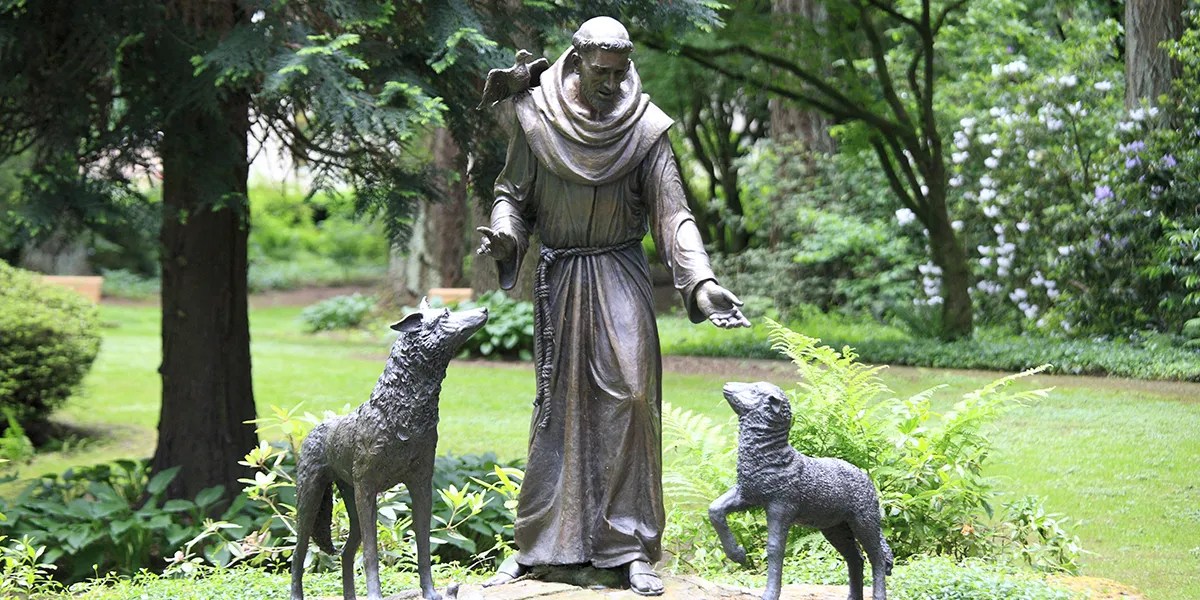
Last Sunday, I spoke about St. Francis as the one disciple who took Christ seriously and literally. Yesterday, at our Holy Cross Sacred Saunter, I spoke about St. Francis as embodying the Holy Cross with his stigmata. Today, I want to talk about St. Francis as the Good Shepherd, a title that many early authors attributed to the saint. The theme of the divine Good Shepherd appears all throughout our sacred Scriptures, beginning most clearly in Psalm 23 (“The Lord is my Shepherd”); and there’s no doubt that Jesus had Psalm 23 in mind when he declared “I am the Good Shepherd” in John 10 and when he told the parable of the lost sheep in Luke 15. This same theme persists throughout the early writings of St. Francis, who is often called the Good Shepherd and who often addressed his dear friend Friar Leo as “my little lamb” (an endearing and ironic nickname for someone whose name means “lion.”)[1] It is Francis’s identity as a courageous and self-giving shepherd that I believe can speak most powerfully to us today, specifically his identity as a shepherd who seeks out the one sheep that is lost.
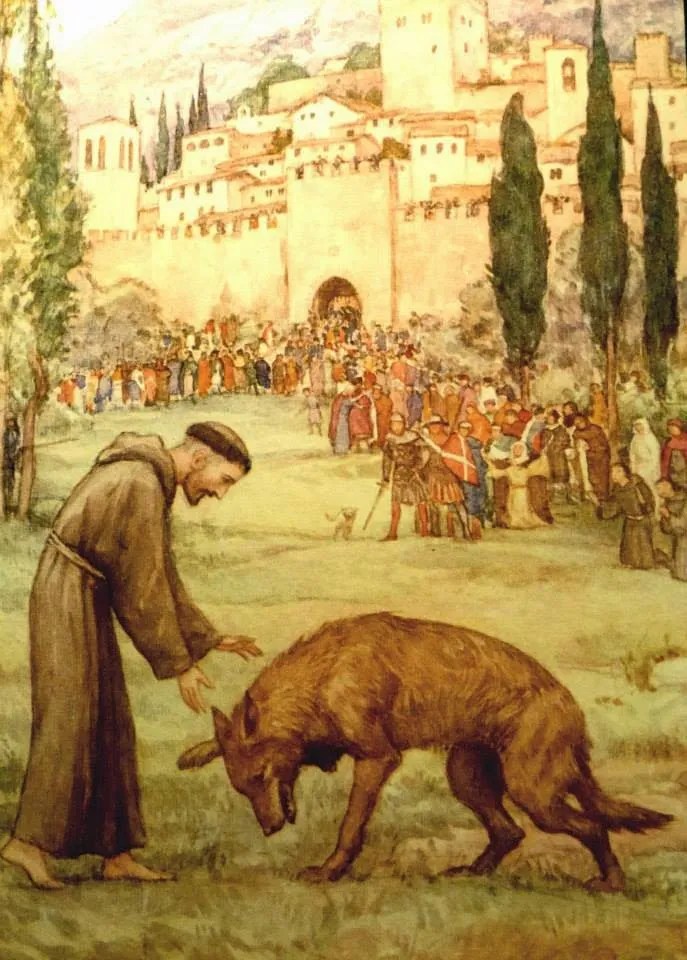
Francis embodied the good shepherd by affirming, guiding, and challenging his friars; and he embodied the good shepherd by responding with courageous compassion to the violent wolf that was terrorizing Gubbio, not by running away in fear as a hired hand would do, but by meeting the wolf face to face and quickly discerning that the wolf was hungry and that the wolf was a lost sheep who needed to be carried home with love and nourishment. Francis was a good shepherd because he refused to demonize and exclude others, because he always cared for the one sheep that was missing, even if ninety-nine were doing just fine. Francis was a good shepherd because he was willing to see himself in the lost sheep.
Francis refused to demonize others even when respected Christian leaders were encouraging him to do so. The brilliant spiritual leader Bernard of Clairvaux of the 12th century (whom I generally admire) was tragically an outspoken proponent of the violent Crusades, emboldening Christians to kill Muslims whom he insisted were all completely evil unless they converted. He believed that killing a Muslim was not homicide but “malicide,” because it would be killing a personification of evil. This twisted way of thinking led many Western Christians to murder Eastern Christians during the Fourth Crusade, thus solidifying the Great Schism between the Eastern and Western Church, a schism that lasts to this day.
Francis, on the other hand, refused to scapegoat or demonize anyone. He knew that a good shepherd was always ready to reach out courageously to those who are being excluded, to those he believed were lost sheep. This is why Francis crossed enemy lines to meet face to face with the Sultan of Egypt Al-Malik al-Kamil. Francis’s initial intent was to bring the sultan into the fold of Christ the Good Shepherd, but the sultan, who already admired Jesus as a great prophet, did not end up converting to Christianity. However, Al-Malik al-Kamil was so impressed with the courage and compassion of this monk that instead of executing him as his soldiers advised, he offered him a sumptuous meal and, before sending him safely away, asked Francis to pray for him.

While the world around him was caught up in a violent whirlwind of political and theological divisiveness, Francis remained the good shepherd whose heart always went out to the vulnerable outsiders, to the sheep who were outside of the fold. And Francis was willing to risk his own safety, his own life, to extend love and friendship to the outsiders. The life of Francis helps us understand the meaning and challenge of Jesus’s parable of the lost sheep in our own context today.
Our world is caught up in a violent whirlwind of political and theological divisiveness. In June of this year, Melissa Hortman, her husband Mark, and their dog Gilbert were victims of political violence. Just a few days ago, Charlie Kirk was a victim of gun violence. And between June of this year and today, there have been 88 mass shootings in our country (according to Gun Violence Archive), including a school shooting on the same day that Charlie Kirk was killed. Although we have many strong feelings and differing opinions about these issues and realities, I trust we can all agree that violence and schism and civil war are not the way forward. They are certainly not the way of the Good Shepherd nor the way of St. Francis.
What does it mean to embody the good shepherd who seeks out the lost sheep in our world today? Howard Thurman, who was a spiritual mentor to Martin Luther King Jr. and who had a special love for St. Francis, wrote, “The violent act is the desperate act. It is the demand of a person to force another to honor his desire and need to be cared for, to be understood. In this sense, the violent act is a plea, a begging to have one’s need to belong fulfilled and confirmed.”[2] St. Francis saw this plea in the violence of the wolf of Gubbio and he extended compassion. In the book Feed the Wolf: Befriending Our Fears in the Way of St. Francis, author Jon M. Sweeney says, “When we overcome our fears and do what’s right, we meet the wolf, sometimes in ourselves, and begin to understand that we are all wolves, after all, at one time or another.”[3]
As we discern what it means to embody the good shepherd who seeks out the lost sheep in our world today, let us also acknowledge the wolf within ourselves. We might want to dismiss all perpetrators of violence as mentally ill and twisted, but that potential and propensity is in each of us. We might want to accuse those with whom we disagree as being the source of all our problems, but the Gospel invites us to reflect on the lost sheep and to consider the possibility that we all might be lost in some ways, waiting to be carried home. What part of you needs to be loved and nourished and carried home? Let Christ the Good Shepherd find you and lead you to still waters today; and then come to the table, the altar, prepared for you in the presence of St. Francis and all the saints who embodied the way of the Good Shepherd. Amen.
[1] See Chapters 21, 28, 30 (Brother Leo as “little lamb”), 31, 34, 36, 48, 49 of The Little Flowers of Saint Francis.
[2] Howard Thurman, “Reconciliation,” in Disciplines of the Spirit (Richmond, IN: Friends United Press, 1963), 112. (126-127)
[3] Jon M. Sweeney, Feed the Wolf: Befriending Our Fears in the Way of Saint Francis (Minneapolis MN: Broadleaf Books, 2021), 36.

 DANIEL DeFOREST LONDON