
Readings for the Thirteenth Sunday after Pentecost (Proper 18 – Year C – Track 2)
This sermon was preached at Christ Episcopal Church in Eureka CA on September 7, 2025.
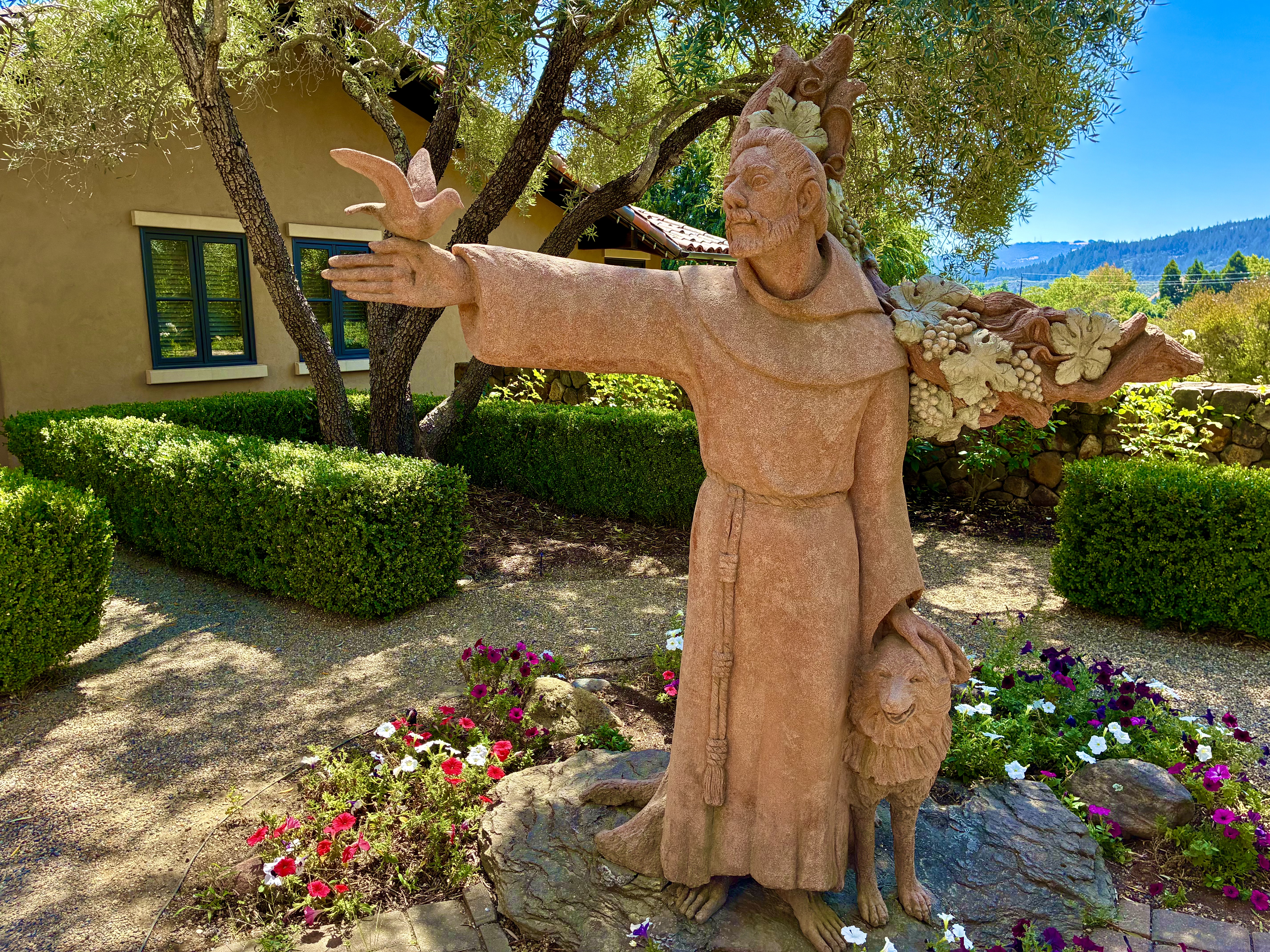
Today we celebrate, for the first time in Christ Church Eureka history, the first Sunday of the Season of Creation, a new liturgical season established in 1989 by the Ecumenical Patriarch of Constantinople Demetrios I. The season of creation officially began on September 1st and concludes on October 4th, the Feast Day of St. Francis; however, we will conclude here on Sunday October 5th, the first day of “St. Francis tide,” a term that our bishop made up last time she was here. And I believe it is St. Francis, the patron saint of animals, ecology, and creation, who can best help us in understanding today’s most challenging teaching from Jesus in the Gospel of Luke, when he says, “Whoever comes to me and does not hate father and mother, wife and children, brothers and sisters, yes, and even life itself, cannot be my disciple” (Luke 14:26).
St. Franics was originally given the name Giovanni Bernardone by his mother Pica, but his father, a wealthy cloth merchant named Pietro Bernardone, changed his son’s name to Francis, which essentially means “Frenchman.” His father felt that the name “Francis” would help boost his cloth business, especially his business with the French. Signore Bernardone also felt that the name would help inspire his son to master the French language, which would serve him well when he eventually took over the family business. Bernardone had high hopes for his son, Francis, expecting him to significantly increase the family’s wealth. His mother Pica was likely more interested in his son getting married and having lots of children so that she could enjoy the gift of being a grandmother. Francis was initially enthusiastic about becoming a heroic and noble Chrisitan knight like Lancelot or Orlando Furioso, the great knights about whom he had heard so many inspiring legends. However, after being captured and becoming a prisoner of war and then surviving a serious illness, young Francis began to undergo profound spiritual experiences in which he heard the voice of Christ calling him to give up everything in order to be a true disciple. For him, this meant giving up his identity as a son and heir to a successful business. This also meant giving up the possibility of becoming a husband or a father or even a priest. His only wife was to be Lady Poverty.
To raise money for a struggling and dilapidated church in Assisi, Francis began selling many of the goods and belongings of his father, who understandably grew upset and then apoplectic with his son’s bizarre and seemingly disrespectful behavior. Francis responded by humbly removing all his clothes and while standing naked, handing them to his father, confessing that his only father now was his Father in heaven. St. Francis took seriously the teachings of Jesus, including many of the teachings that we choose not to take seriously today: “Go, sell everything you have and give it to the poor and you will have treasure in heaven” (Mark 10:21). “Take nothing for your journey, not even a staff or a bag or bread or money or an extra shirt” (Luke 9:3). “If you want to be my disciple you must deny yourself and take up your cross and follow me” (Matthew 16:24). These teachings of Christ were central to the mission and ministry of St. Francis and his first followers. Francis also took seriously the challenging teaching in our Gospel today: “Whoever comes to me and does not hate father and mother, wife and children, brothers and sisters, yes, and even life itself, cannot be my disciple” (Luke 14:26).The Greek word that is translated “hate” here is miseo; and I wish I could tell you that “hate” is a poor translation of miseo, but it’s actually fairly accurate. Miseo means to hate, to regard with ill-will, or even to detest and abhor. So, what is Jesus saying here? If Jesus is really telling us to hate our loved ones and our own lives, then he is blatantly contradicting himself because this same Jesus sums up all the Torah and the Prophets by saying, “Love God. Love others; and love yourself.” This same Jesus chastises people who are angry with their brothers; and one of his closest followers said, “Whoever claims to love God yet hates a brother or sister is a liar. For if you do not love your sibling whom you see, you cannot love God, whom you cannot see” (1 John 4:20).
On one level, Jesus is trying to get our attention and help us wake up by shattering the domesticated, stained-glass window image we so often make of him. On another deeper level, Jesus is teaching us to prioritize our love for God above all other loves and to prioritize our identity as his disciples and as the Creator’s beloved children above all our other identities. Jesus is saying that your identity as a beloved child of God and as my disciple needs to be prioritized way above your identity as a spouse or a sibling or a parent or a citizen or a Republican or a Democrat or an Episcopalian or anything else. And your love for God needs to surpass all other loves in your life to such an extent that your other loves, when compared to your love for God, almost look like hate.
St. Francis prioritized his identity as a disciple of Christ above all his other identities and although other people experienced him as a loving person, his love for God made all his other loves look almost like hate in comparison. St. Francis is perhaps the only follower of Christ who took Christ’s teachings seriously and, as a result, he changed the world. And as a result, he was able to experience a freedom that most of us can only dream of. German author Hermann Hesse wrote, “The earth was not lost to Francis, but was rather given to him anew…His heart was free to embrace the divine love that holds all of Creation together with sheer delight so that he too could delight in Creation with that same love and freedom.”
It was because he prioritized his love for the Creator above all other loves that he became free to enjoy Creation with utmost abandon. Hesse writes, “Overjoyed with his newfound freedom, Francis wandered through the green hills and valleys of the country as a soul intoxicated with grace. Because of his childlike wonder, the beauty of the earth blossomed before him as if it were a new creation: the blooming trees and gentle grass, the flowing rivers and shimmering waters, the sapphire sky and drifting clouds, the wild blue hills and the verdant fields, the birds and their cheerful songs all became his dear friends and family. A veil had fallen from his eyes so that he saw the world as pure and holy, suffused with the splendor of paradise, with the fresh blessing of creation’s first day. And this was not a passing ecstasy, intoxication or illusion, [no,] Francis remained blessed and chosen [in this way] to hear the voice of God ring out from every blade of grass and every flowing stream.”
When Francis died, he said, “I, Brother Francis, your humble servant always ready to kiss your feet, beg and implore you by that Love which is God himself to accept these words!” He then said, “I have done what is mine to do; may Christ teach you what is yours!” In other words, St. Francis prioritized his love for God above all other loves in his own unique and world-shattering way. May Christ teach each of us to do the same in our own unique ways.
The life of St. Francis teaches us that one of the fruits and signs of prioritizing our love for the divine Creator above all other loves is a deeper appreciation and care for God’s creation. Throughout this Creation Season and beyond, may we learn to follow in the footsteps of St. Francis who was following (perhaps more closely than anyone else) in the footsteps of our Savior, so that we too may have eyes to “see the world as pure and holy, suffused with the splendor of paradise, with the fresh blessing of creation’s first day; and have ears to hear the voice of God ring out from every blade of grass and every flowing stream.” May it be so. Amen.


 DANIEL DeFOREST LONDON