
Readings for the Twelfth Sunday after Pentecost (Proper 17 – Year C – Track 2)
This sermon was preached at Christ Episcopal Church in Eureka CA on August 31, 2025.
Do not neglect to show hospitality to strangers, for by doing so some have entertained angels (Hebrews 13:2)
This morning, I want to share an ancient story about a married couple named Baucis and Philemon. Baucis was the wife whose name sounds a bit like my own wife’s: Bacchi. The two lived in a small wicker hut thatched with reeds from a nearby marsh. One day, two hooded strangers (which are called xenoi in Greek) arrived in the village where Baucis and Philemon lived. The xenoi or strangers were seeking a place to rest, but over a thousand households refused to open their doors to them since they all suffered from xenophobia, that is a fear of outsiders. The xenoi faced one closed door after another until they approached the home of Baucis and Philemon, who graciously welcomed them into their humble abode. Although they were not wealthy, the married couple brought out all their best food and wine for these two random strangers. Philemon started a fire and fluffed the couch pillows while Baucis fixed their awkwardly uneven table by placing a small pot under one of the short table legs. Baucis and Philemon were exhibiting philoxenia, a love for strangers.
Baucis and Philemon noticed that whenever the wine bowl emptied, the wine would refill of its own accord, seeming to well up magically from below. When Baucis and Philemon witnessed this, they realized that they were in the presence of skilled magicians or sorcerers or perhaps angels. They trembled and prayed for forgiveness for failing to provide a more worthy banquet for their clearly special guests. To appease these super-powered strangers, Baucis and Philemon felt they needed to offer them roasted goose, but they only one goose who had been like a pet and guard dog to them. As they prepared to make this significant sacrifice, the goose ran away from them and cuddled up to the guests, who laughed and embraced the elusive bird. The two strangers then stood up from the table and said, “We are the gods Hermes and Zeus. Do not slay your goose for us. Instead, come with us to the top of the hill outside.”

Baucis and Philemon then followed in the footsteps of Hermes and Zeus to the top of a nearby hill, where the gods said to them, “No one in this entire village extended hospitality to us except for the two of you.” And at these words, Baucis and Philemon looked down from atop the hill and saw that their entire village had sunk into a swamp, except for their house which had been transformed into a marvelous, golden temple. After mourning the fate of their neighbors, Baucis and Philemon heard Zeus say to them, “Tell us, what is your wish?”
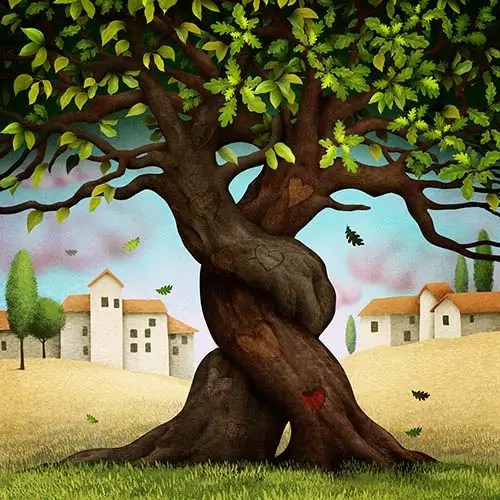
Philemon spoke with Baucis and then said, “We would like to become priests who serve at this new temple you have made; and we also wish that when it comes time for us to die that we both pass on at the same hour so that I never need to see my wife’s grave and she never needs to bury me.” The gods granted them their wish; and so, after many years of attending to the temple, Baucis and Philemon stood one day at the temple steps, full of immense gratitude. They both smiled as they began sprouting leaves and branches. They embraced one another, saying, “I love you” to each other one final time before they metamorphosed into two trees forever twisted together. For centuries after, people would make pilgrimage to the two trees and place fresh garlands on their branches in honor of Baucis and Philemon and their world-renowned philoxenia, the Greek word for “love of stranger” which we generally translate to “hospitality.”
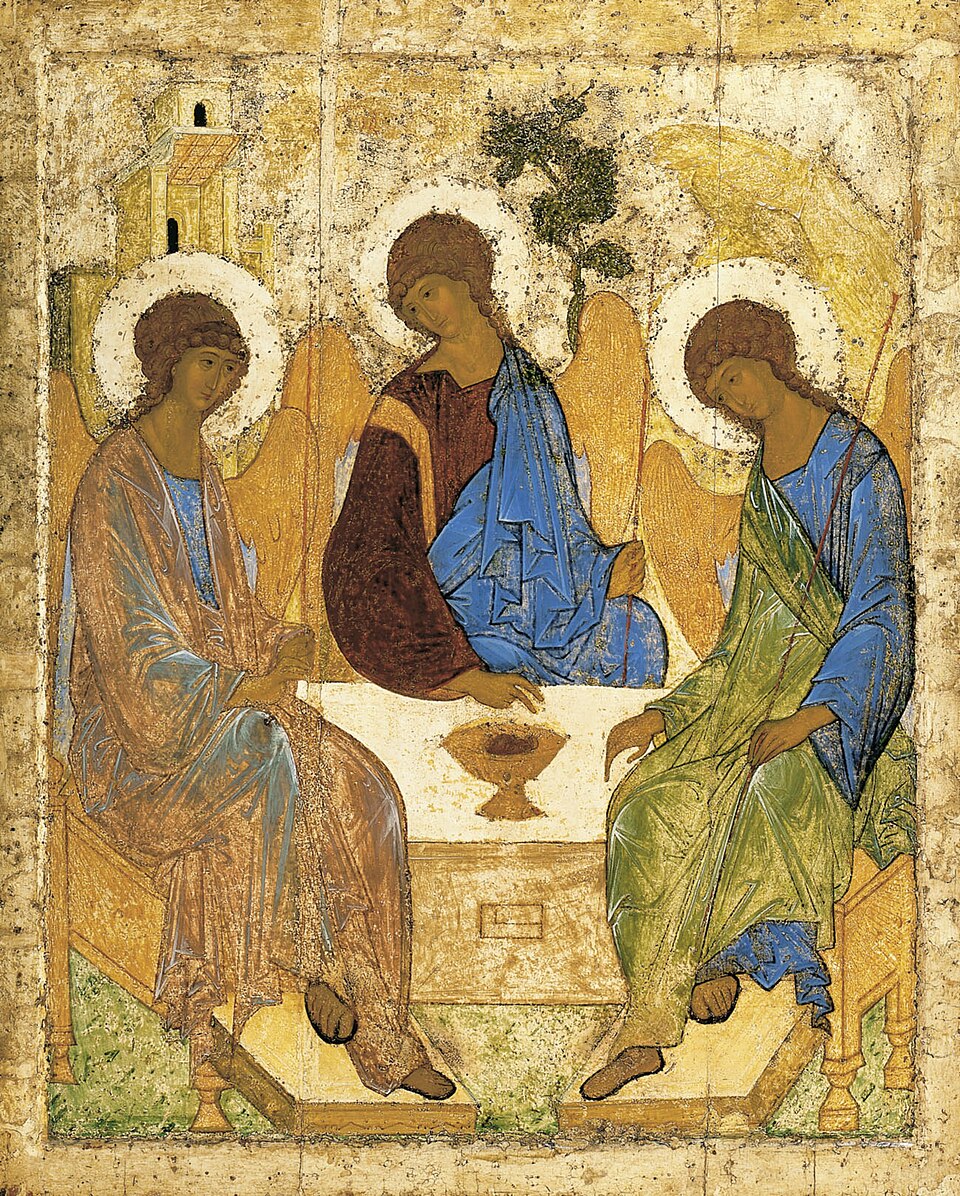
The author of the Book of Hebrews writes, “Do not neglect to show hospitality to strangers, for by doing so some have entertained angels without knowing it” (Hebrews 13:2). The original Greek word used for “hospitality to strangers” in the Bible is philoxenia, a word that would have very likely made Greek Jews think of the beloved story of Baucis and Philemon who had entertained Zeus and Hermes without knowing it. Jewish readers would have also thought of Abraham who had shown philoxenia (hospitality) to the visitors at the Oaks of Mamre, visitors who later revealed themselves to Abraham as God in three persons and who also told Abraham of the impending doom fated for the xenophobic cities of Sodom and Gomorrah. This same God of Abraham also stayed Abraham’s hand as he lifted his knife to sacrifice his son Isaac not unlike the Greek gods who prevented Baucis and Philemon from sacrificing their goose.
According to our biblical tradition and what I consider the best of our Greco-Roman tradition, God does not desire bloody sacrifice, but God does seem to mete out punishment for communities that succumb to xenophobia and fail to show philoxenia. On the other hand, God seems to delight in honoring and rewarding communities that show philoxenia like Abraham and Baucis and Philemon, communities that welcome strangers, communities that even give banquets to the poor, the crippled, the lame and the blind, communities that give special treatment to humble guests and visitors and guide them to seats of honor, communities that do this because they know that Christ can be a bit of a trickster and he likes to appear among us in sometimes distressing disguise.
This last month, we have had several visitors, including four visitors whom I personally invited (Mike Kinman, Charles, Paul, and Evelyn); and they all felt welcomed and embraced by you, as well as moved by our worship. Thank you for being a community that practices and embodies philoxenia and overcomes xenophobia. Thank you for being like Baucis and Philemon and Abraham.
There’s a tradition in Judaism that calls us to show philoxenia to strangers no matter what the circumstance because for all we know that stranger could be the Messiah, and if we don’t care for them, we would be thwarting the Messiah’s return. There’s another more common tradition in Judaism which suggests that the Messiah will not be one single person but rather a community of people who are fully devoted and committed to philoxenia. This tradition resonates with our Christian belief that the Church is the Body of Christ here on earth. So, as we continue to extend philoxenia to visitors, treating them as angels and as Christ in disguise, we ourselves become more and more like Christ as a community, extending divine love to strangers in a world that is so often plagued by xenophobia. May God nourish us with all goodness; bring forth in us the fruit of good works; and increase in us true philoxenia. Amen.

 DANIEL DeFOREST LONDON