
Readings for the Fifth Sunday after Pentecost (Proper 10 – Year C – Track 2)
This sermon was preached at Christ Episcopal Church in Eureka CA on July 13, 2025.


Last month, while visiting family in Ithaca NY, I decided to go on a mini pilgrimage to a Trappist monastery called the Abbey of the Genesee in Piffard NY, about a 2 and a half hour drive north.[1] Although I invited all my Ithaca family members to join me on this pilgrimage, including my in-laws who were visiting, the only one who decided to tag along was my mother. And I’m glad she did.
As we were heading out of Ithaca on Route 13, approaching a busy intersection,[2] we saw a young woman lying face down, not on the side of the road but in the middle of the road. And she seemed to be writhing in pain with gnarled and twisted limbs as if she had been hit by a car. There was no blood and no indication of a car accident, which made us wonder what was really going on with this woman. Since Ithaca has been called “the Berkeley of the East,” I wondered if this was some kind of radical protest or dangerously avant-garde street art. She was pressing her face against the asphalt with her arms and legs unnaturally protruding. It became very clear to me that this woman was troubled, perhaps having a severe reaction to some drugs. And to be honest with you, I did not want to pull over and try to help. The situation seemed too messy and dangerous.[3] My initial impulse was to give the woman a wide berth with my car and continue on my holy pilgrimage to my religious destination, since we were already off to a late start and I wanted to make sure I arrived in time to join the monks for their mid-afternoon prayer, for Nones.
“Now by chance a priest was going down that road; and when he saw him, he passed by on the other side.” For a moment, this priest (myself) saw someone in need in the middle of the road and wanted to pass by in order to arrive on time for his prayer date with monks. How often do we pass by others in need? How often do we pass by others in need on the road because we are too busy or hurried with our far more important and holy business? How often do we pass by others in need on the way to church? [4]
Fortunately, before I could pass by and leave the distressed woman in my rearview mirror, my mom spoke up and said, “Maybe we should stop and help her.” Yes, maybe we should. So, I pulled over into a parking lot (where, because it was full, I had to temporarily park illegally). I got out of the car and approached the woman who was still lying face down in the middle of the road. A young man, who was watching her from a distance, explained to me that she was having an “epi,” meaning “episode.” He was reluctant to give me any information beyond that. He didn’t want me calling the police and he was initially hesitant to tell me his name but then after telling me that the woman’s name was Brittany he told me his name was John. A man on the other side of the road had already called 911 on his cell phone and shouted across the road, asking, “Do you need the police or an ambulance?” And John yelled back, “Definitely an ambulance! Not the police.” Another car drove up and fortunately stopped in front of Britanny, rather than driving over her. After turning on his hazard lights, the driver, who was a young Hispanic man named Ben, got out and asked how he could help. When we explained that she was having an episode, he prudently suggested that we pick her up and move her out of the road to safety. A great idea that only made sense when three able bodies were present to carry her because if it was just one or two of us, we could have easily been kicked or punched severely by this woman whose movements were disturbingly reckless and erratic. Ben and I each grabbed a leg as John lifted her arms and the three of us carried her safely off the road and onto a patch of grass between the sidewalk and the parking lot.
One kind woman approached me from her car and asked if we needed Narcan, which she had, since she thought Brittany might be experiencing an overdose. John told her it wasn’t an overdose, but just an episode. Honestly, to me, Brittany’s behavior resembled that of a victim of demon-possession that I’ve seen in horror films. It really seemed like some destructive force or energy was in possession of her body, trying to hurt her by twisting contorting her limbs and forcing her into the road. While the vast majority of cases that have traditionally been considered demon-possession are manifestations of mental and psychological illnesses,[5] the Episcopal Church does include a rubric “Concerning Exorcism” in our Book of Occasional Services.[6] “The rituals of exorcism,” it says, “are weighty and never to be undertaken lightly” and must only be performed when the bishop determines they are needed. I personally know just enough about exorcisms to know that I don’t know enough. I also know that performing a ritual of exorcism would be above my pay grade. However, the rubric also reminds us of the exorcistic power inherent in the non-esoteric and ordinary practices of celebrating Eucharist and praying the Great Litany and fasting. So, in one sense, we perform rituals of exorcism every Sunday.
When I saw this young woman writhing in pain on the ground, I couldn’t help but feel her suffering call forth the priest in me and I found myself raising my hand in a gesture of blessing. I looked at her and kept repeating silently, “God loves you. God loves you. God loves you. Jesus loves you.” And her face, which was previously pressed against the ground, turned to me and our eyes locked. Even though I was wearing sunglasses, she was looking right at me and did not look away as I kept repeating, “God loves you. God loves you.” And I began nodding my head, saying “Yes, it’s true. Jesus loves you.” And I felt like my silent words were getting through to her, speaking to her vulnerable soul, and cutting through whatever illness or destructive energy was holding her captive. And she began nodding her head along with mine as her eyes continued peering at me as if she were dying of thirst and I was offering her fresh water. And then her face began to scrunch and scowl as she let out a shriek of pain, almost as if someone had just removed a bullet from her flesh wound. And then after that, she finally began to sit up and start coming back to her senses. At that point, the ambulance and police began to arrive, and I needed to move my car out of its illegal spot. I could tell that her “episode” had mostly subsided and, as I walked to my car, I glanced back at Brittany and saw her glancing back at me as John was talking to her.
I began processing this experience on the drive to the monastery with my mom, who witnessed the whole thing and saw Brittany locking eyes with me, and I have been processing the experience ever since. When I told my spiritual director about it, she said to me, “The question of whether it was mental illness or demon possession doesn’t matter. What matters is that you were a channel of love and that’s exactly what was needed at that moment.” And I share this story with you today (on Good Samaritan Sunday) partly as a way of confessing my own selfish impulses and tendencies to be like the priest and Levite in the parable. I also share it as an invitation for us to occasionally slow down, pull over, and allow ourselves to be channels of God’s healing love, especially when we see others in distress. Because when we do, when we channel just a fraction of the love that the Good Samaritan showed, we will discover that the one who has experienced healing is not the only who is blessed. The Good Samaritan is also blessed. The one through whom God’s healing power flows is also blessed beyond measure.
To paraphrase Moses, “God’s healing love is not too far away. It is not in heaven, that you should say, ‘Who will go up to heaven and get it for us?’ Neither is it beyond the sea, that you should say, ‘Who will cross to the other side of the sea and get it?’ No, God’s healing love is very near to you; it is in your mouth and in your heart for you to share with those in need.” As our world writhes in pain, may we experience the blessing of being channels of God’s peace. Amen.
P.S. Yes, I eventually arrived in time to join the brothers for Nones (Afternoon Prayer) and was also able to visit the gift shop / bookstore before it closed. I was especially pleased to see that the bookstore was selling the latest issue of Cistercian Studies Quarterly [CSQ 60.1 (2025)] that included a generally positive review of my two books by Fr. Cassian Russell OCSO of Our Lady of the Holy Spirit in Conyers GA:
“I think London’s texts [The Cloud of Unknowing Distilled and Spiritual Friendship Distilled] will be a good way to introduce these classics to many lay people who visit our monasteries and attend our retreats. As a novice director, I will certainly use Spiritual Friendship, Distilled with postulants to introduce Saint Aelred’s significant ideas about human relationships grounded in cenobitic life…
…The distillate of these works offers readily digestible essential notions
to contemporary readers and may entice them to bite more deeply into
the original texts, full of metaphor and wry observation, to savor the rich
and varied flavors offered by these spiritual classics.”
Cassian Russell, OCSO, Our Lady of the Holy Spirit / Conyers, GA, CSQ 60.1 (2025), 103 – 104

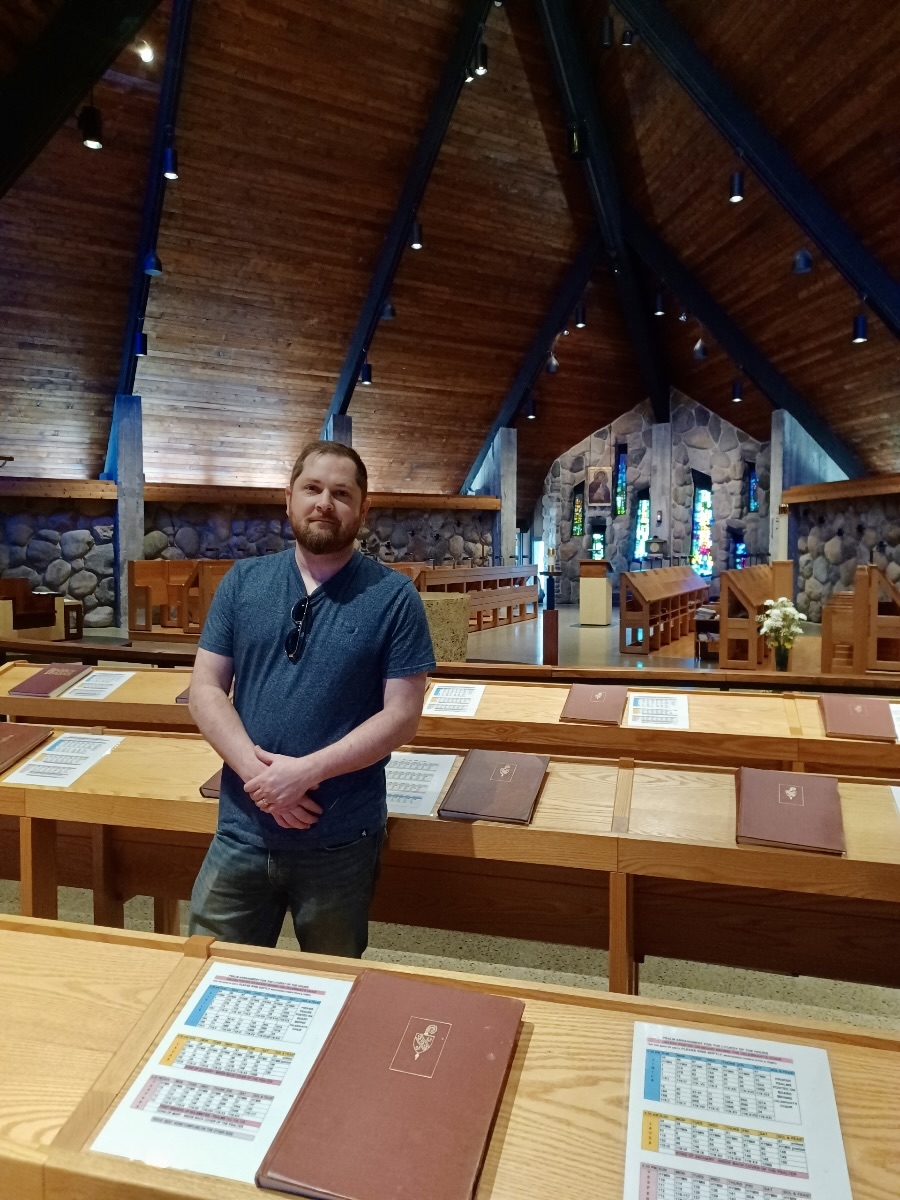


[1] Abbey of the Genesee is where one of my favorite authors Henri Nouwen was considering a call to the Trappist vocation. Although my favorite Trappist monk Thomas Merton never visited the Abbey of the Genesee, I was still pleased to see that they named a hall after him, which features a painting of Thomas Merton by artist Jim Cantrell whom I met in Denver and who gave me a poster of that same painting, which now hangs in the Pierson Room
[2] Meadow and Buffalo Street.
[3] Martin Luther King Jr. said, regarding the Parable of the Goos Samaritan: “I imagine that the first question the priest and Levite asked was: ‘If I stop to help this man, what will happen to me?’ But by the very nature of his concern, the good Samaritan reversed the question: ‘If I do not stop to help this man, what will happen to him?’”
[4] In the 1970s, social psychologists John Darley and Daniel Batson studied a group of 67 seminary students, asking each of them to deliver a sermon on the parable of the Good Samaritan. After giving them instructions, they added, “Oh, and you’re late. The congregation was expecting you a few minutes ago. You’d better get moving.” Each student walked alone to the church where they would deliver the sermon. On the way, the student encountered a man slumped in a doorway with his eyes closed, coughing and groaning, clearly in distress. From a distance, the researchers (who planted that man there) watched and wondered, would the seminary student stop to help the stranger in need? Darley and Batson found that only 10% of the seminary students stopped to help the man: “a priest was going down that road; and when he saw him, he passed by on the other side. So likewise a Levite (a member of the priestly tribe), when he came to the place and saw him, passed by on the other side.”
[5] Such as dissociative identity disorder, schizophrenia, epilepsy, or other neurological and psychological disorders.
[6] “Concerning exorcism: The practice of expelling evil spirits by means of prayer and ritual derives its authority from Christ Jesus, who understood power over these forces as a sign of Messianic identity. The Church in succeeding centuries recognized this power of Christ in their shared life but reserved the rites of exorcism to its bishops. Later still the bishops began to delegate this authority to select presbyters and others deemed competent. In accordance with this established tradition, someone in need of such a ministry, and anyone desiring to exercise it, makes the matter known to a presbyter, who in turn consults with the bishop. The bishop then determines whether exorcism is needed, who is to officiate at the rite, and what prayers or other formularies are to be used. The rituals of exorcism, while weighty and never to be undertaken lightly, are not by nature esoteric. The Celebration of the Eucharist, especially in a place that has been disturbed, and the prayer of the Great Litany, for example, are ordinary practices. And as Christ has said and as scripture counsels, any rites of exorcism include preparatory prayer and fasting.” The Book of Occasional Services 2018, 187. https://www.episcopalchurch.org/wp-content/uploads/2021/01/lm_book_of_occasional_services_2018.pdf

 DANIEL DeFOREST LONDON