
Readings for Trinity Sunday (Year C)
This sermon was preached at Christ Episcopal Church in Eureka CA on June 15, 2025.
“I awoke this morning with devout thanksgiving for my friends, the old and the new. Shall I not call God the Beautiful, who daily showeth himself so to me in his gifts?”[1] These are among the opening words of an essay on friendship (1841) written by 19th century American poet Ralph Waldo Emerson, who said, “I do not wish to treat friendship daintily but with roughest courage;”[2] and who then, after highlighting the two key elements of friendship—truth and tenderness, concluded that “the essence of friendship is entireness, a total magnanimity and trust;” for friendship is a gift from God that helps us discover the divine within ourselves and within our friends and thus “defies us both.”[3] According to Emerson, who was the first American writer to explore the theme of friendship, we are called to wish for and seek the thriving and wellbeing of our friends; and when we pray for our friend’s honor and when we honor our friends through prayer, we acquaint ourselves firsthand with Deity. Emerson understood better than most how prayer-soaked friendship connects us intimately with God, the same God whom the Celtic Christians described as “an eternal interflow of friendship” and whom medieval English abbot St. Aelred of Rievaulx nearly equated with the experience of friendship when he wrote, “God is friendship.” Although Emerson was a Unitarian minister who rejected the doctrine of the Trinity, his poetic insights on friendship have helped me deepen my appreciation of the mystery of our Triune God.


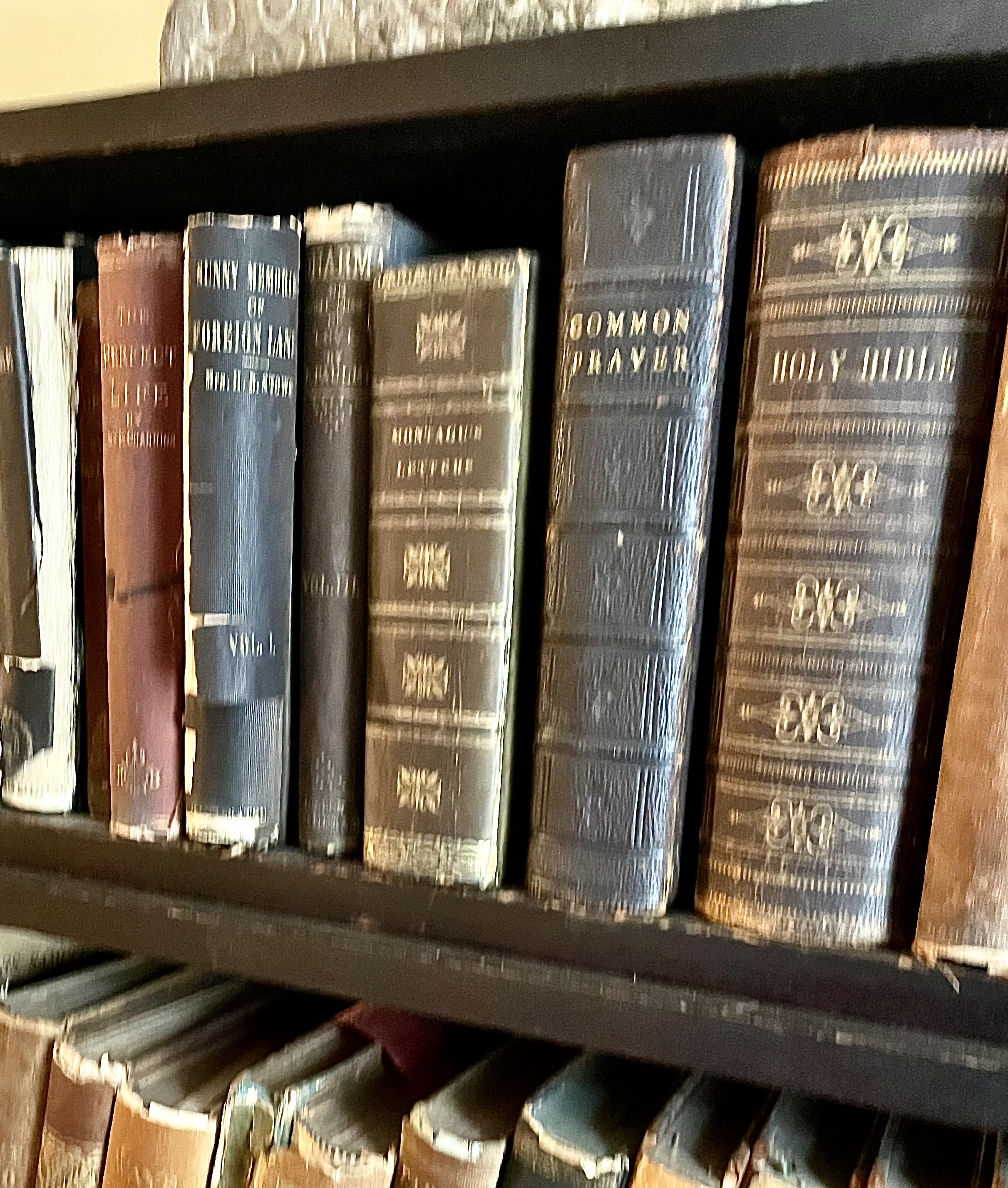
This is why I made a trip up to Emerson’s house in Concord MA when I was in Boston a couple weeks ago. I got to sit in Emerson’s office, which was the intellectual center of Concord in the 1840s and 50s and was therefore the intellectual center of the United States at the time; and it was the same office where he wrote his most famous book-length essay on Nature as well as his essay on Friendship. During our tour of his house, we were told we could not take any photos or touch any of the furniture or books, which was a bit challenging for me. But I enjoyed looking at the book titles on Emerson’s shelves and was especially pleased to see, right next to the Bible, a Book of Common Prayer, which Emerson himself used. Emerson’s maternal grandfather was an Episcopalian and according to his journal, his mother Ruth Haskins Emerson “was bred in the English church & always retained an affection for the Book of Common Prayer.”[4] The prayer book on Emerson’s shelf was the 1789 Book of Common Prayer, the first prayer book published in the United States (followed by the 1892, 1928 and then 1979 prayer books). I highlight this because the day before yesterday was the Feast of the first Book of Common Prayer, published in England in 1549 (476 years ago); and I love it when the Prayer Book Feast and the Feast of the Holy Trinity fall on the same weekend because they remind us that the Holy Trinity is not so much a concept to be explained but more of an experience in which we can participate through the practice of common prayer. This is how we Anglicans and Episcopalians experience the Trinity: by praying together from a shared book, by praying with one another and for one another, and by deepening our friendships through prayer. This is how we enter more fully into the eternal interflow of friendship which is the very nature of our Triune God. This is how we join the great circle dance of the Father, the Son, and the Holy Spirit.[5]. It is through prayer that we wake up with devout thanksgiving for God’s beautiful gifts and it is through prayer that we learn to treat friendship not daintily but with roughest courage; and it is through prayer that we become deified, because when we pray together, we are indeed dancing with our Triune God. Amen.
[1] Ralph Waldo Emerson, “On Friendship” in Self-Reliance and Other Essays, 40.
[2] Emerson, “On Friendship,” 44.
[3] Emerson, “On Friendship,” 50.
[4] https://concordlibrary.org/special-collections/emerson-celebration/Em_Con_68
[5] The 4th century Cappadocian Fathers—Basil of Caesarea (whose feast day was yesterday), Gregory of Nazianzus, and Gregory of Nyssa—used a Greek word to describe the Trinity: perichoresis. Peri means “around” and chorea means “dance”: the great circle dance of the Lover, the Beloved, and the Love Overflowing.

 DANIEL DeFOREST LONDON