
Readings for Pentecost Sunday (Year C)
This sermon was preached at Christ Episcopal Church in Eureka CA on June 8, 2025.
Today we feel the wind beneath our wings
Today the hidden fountain flows and plays
Today the church draws breath at last and sings
As every flame becomes a Tongue of praise.
This is the feast of fire, air, and water
Poured out and breathed and kindled into earth.
The earth herself awakens to her maker
And is translated out of death to birth.
The right words come today in their right order
And every word spells freedom and release
Today the gospel crosses every border
All tongues are loosened by the Prince of Peace
Today the lost are found in His translation.
Whose mother tongue is Love in every nation.[1]
This poem titled “Pentecost” was written by Anglican priest and poet Malcolm Guite; and it is apt to share a poem on this day, the Feast of Pentecost, when the Holy Spirit descended to give birth to Christ’s Church and to unleash her poetry in and through all of us because the Holy Spirit empowers each of us to become prophets; and prophets are poets. Just a few days ago, we lost a brilliant biblical scholar Walter Brueggemann,[2] who wrote over a hundred books including a book titled The Prophetic Imagination. He said, “The most defining point about the prophets in the Old Testament is that they’re poets. They’re not, as conservatives want to say, predictors [of the future]. They’re not, as liberals want to say, social activists. But they’re [poets who awaken in their listeners an imagination that challenges the status quo and the dominant culture.]”[3] According to our Nicene Creed, it is the Holy Spirit who has spoken through the prophets; and at Pentecost, we learn that that same Holy Spirit longs to unleash her prophetic imagination and poetry through each of us, through each of you. You are God’s poetry.
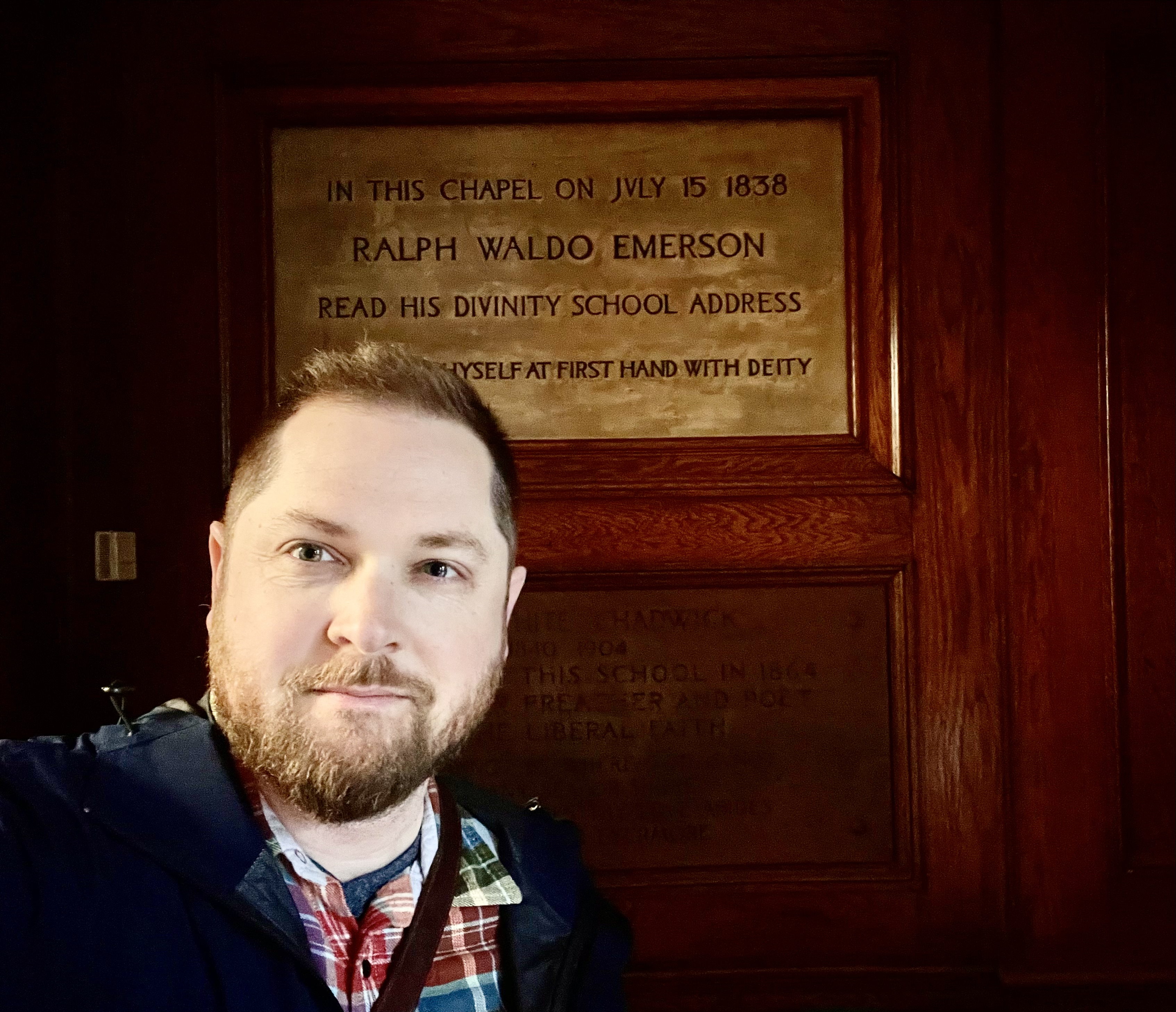


When I was helping Ashley move out of her apartment in Cambridge, she brought me to the Emerson Chapel in Divinity Hall at Harvard, where the great American poet Ralph Waldo Emerson delivered his famous and controversial Divinity School Address back in 1838.[4] And in his speech to graduating divinity students, Emerson described Jesus Christ as a prophet, as someone who belonged to “the true race of prophets…as a true man…and [perhaps as] the only soul in history who has appreciated the worth of a [person].” Although his theology veered away from apostolic Christianity, Emerson understood each person as a unique expression of God’s poetry, saying, “You are newborn bards of the Holy Ghost, [so] cast behind you all conformity, and acquaint [yourself and others] at first hand with Deity.” Like the disciples in our reading from Acts, you who have acquainted yourselves directly with God through Baptism are newborn bards of the Holy Ghost, the Holy Ghost who longs to express her poetry through you, your words, your actions, your life. In his speech, Emerson also said, “The [person] on whom the Spirit descends, through whom the Spirit speaks, alone can teach; and everyone can open [their] doors to [this Spirit, which] shall bring [them] the gift of tongues. But the man who aims to speak as books enable, as synods use, as the fashion guides, and as interest commands, babbles. Let him hush.” In other words, those who simply regurgitate theological formulas and conventional clichés of the dominant culture are merely babbling and should stop doing so.
With these words, Emerson references our reading from the Old Testament about the Tower of Babel, a fascinating story that I want to reflect on briefly with you this morning. I have never really preached on this story except to teach that the Spirit at Pentecost reverses the curse of the Tower of Babel. This story from Genesis, which is best understood as poetic narrative, seems to inspire more questions than answers, as all good poetry does. One of the main questions I have is “Why was God so hostile to the builders of the tower?” Later texts (such as the Book of Jubilees and Book III of the Sibylline Oracles) explain that it was the arrogant hubris of the builders that upset God, the arrogant attempt of the builders to try reaching the heavens with their own effort, apart from God.[5] Josephus, a Jewish historian writing a few decades after Christ, explains that they were trying to create a structure tall enough to keep them safe if another flood were to come like the one that had destroyed their forefathers.[6]

As I read this story in the light of the wisdom of the late Walter Brueggemann, I can’t help but notice the oddly detailed description of the bricks, a description that makes up about one fifth of a generally sparse account. Brueggemann would point out that the Book of Genesis was written during the Exodus period as the Israelites were breaking free from the oppressive regime of Pharaoh, who forced them into slavery to make bricks. So, this seemingly out-of-place description of the bricks in the story of the Tower of Babel serves a clear reminder of the people’s trauma under the oppression of Pharaoh, who valued people only for their productivity. Pharaoh saw other people as mere objects to help him accumulate more and more for himself.
Brueggemann points out the fact that the Creation story in Genesis crescendos with the Sabbath, a commandment and practice that remind us that our worth is not determined by our productivity. “The Sabbath,” Brueggemann explains, “is hugely subversive because what it declares is that your worth is not established by your productivity and Pharaoh only valued productivity of making more bricks. You are not a brick.”[7]
You are not a brick. You are a newborn bard of the Holy Ghost. Perhaps we are being invited to read the story of the Tower of Babel not so much as a story of an insecure God feeling threatened by humanity’s progress in building, but rather as a critique of Pharaoh’s obsession and our obsession with productivity, as a biblical and poetic critique of our culture’s fixation with ascribing worth to people based on their productivity.
You are not a brick. You are a newborn bard of the Holy Ghost. Your worth and value are not based on your productivity, on how many bricks you can make, or on how many words you can babble. Your worth and value are based on your belovedness in God’s eyes. Your worth and value are based on the Love that brought you into existence out of sheer joy. As the Psalm says, “There is that Leviathan, whom God has made for the sport of it” (104:27). Your worth and value are based on the Spirit of Love and Truth who abides with you and in you, as Jesus said. And it this Spirit who longs to speak through you and through your words and your actions and your life. And we open ourselves up to the Spirit by practicing Sabbath, by resting and abiding in God’s Love as the disciples were doing at Pentecost, by letting God express his poetry through us, and by receiving peace from the One who said, “Peace I leave with you; my peace I give to you. I do not give as the world gives. [I do not give as Pharaoh gives]. Do not let your hearts be troubled, and do not let them be afraid” for you are not a brick, you are a newborn bard of the Holy Ghost. Amen.

[1] Malcolm Guite, Sounding the Seasons: Seventy Sonnets for the Christian Year (Norwich UK: Canterbury Press, 2012), 47.
[2] Brueggemann died in his sleep on June 5, 2025, the feast day of St. Boniface (d. 754), the saint who initially proclaimed the Gospel to the Germans. Coincidentally, Brueggemann was of German descent and grew up in a family of German Lutheran ministers.
[3] Words in parentheses are my paraphrase of these words: “But what they [the prophets] do is they use a different mode of rhetoric and discourse to try to help their listeners imagine the world beyond the socio-political rhetoric that is generally taken as given and as uncriticized.” https://processthis.substack.com/p/the-life-and-work-of-walter-brueggemann?utm_source=podcast, 1:11:52
[4] We also took a trip to the Emerson House in Concord MA, where I got to see several of his books, including his personal copy of the 1789 Book of Common Prayer.
[5] Book of Jubilees 10:18 – 19; 3 Sibylline Oracles 99 – 100, as cited by Erich S. Gruen, Scriptural Tales Retold: The Inventiveness of Second Temple Jews (New York: T & T Clark, 2024), 14 – 15.
[6] Josephus Antiquitates Judaicae 1:114. Gruen, Scriptural Tales Retold, 15.
[7] https://processthis.substack.com/p/the-life-and-work-of-walter-brueggemann?utm_source=podcast, 1:30:18.

 DANIEL DeFOREST LONDON