
Readings for the Fifth Sunday of Easter (Year C)
This sermon was preached at Christ Episcopal Church in Eureka CA on May 18, 2025.

This last week, I led a retreat on Spiritual Friendship for clergy at the Bishop’s Ranch in Healdsburg. We read aloud my distillation of the medieval classic Spiritual Friendship by St. Aelred of Rievaulx in a reader’s theatre format; and we connected with our heart sense by simply placing our hands on our chests. We prayed prayers of goodwill for everyone we know, wishing for their happiness, their health, their peace, and their growth in wisdom and virtue. And we reflected together on the original patron saint of friendship, St. John the Apostle, who according to a traditional reading of the chapter we just read from John, was the apostle who leaned upon the bosom of Jesus and listened to his heartbeat. As John was listening to his heartbeat, Jesus revealed the identity of his betrayer Judas who went out into the night to hand him over to the Jewish and Roman authorities. And that’s where our reading today begins, with Judas going out to betray Jesus, who then says, “Now the Son of Main has been glorified.” Nun edoxasthe ha Huios tou Anthropou.
In the Gospels of Matthew, Mark, and Luke, the glorification of Christ occurs at the Resurrection. However, in the Gospel of John, the glorification of Christ occurs in the Passion: in the betrayal, the trial, the crucifixion, and death of Jesus. For the mystic author of John’s Gospel, the horrific and unjust suffering and death of Jesus is his glorification. Obviously, the Cross is understood through the lens of the Resurrection, but it is the Cross itself that is the glorification, more so than the Resurrection, in John. While I have spent many years studying John’s Gospel, I am still puzzled by this. Of course, we believe in the atoning and salvific power of the Cross of Christ, but I’m still troubled by what could be conceived as a glorification of violence; or a glorification of docile submission to torment and evil and abuse. After leading the retreat, I then participated in a larger clergy conference in Healdsburg that was led by a South African Anglican priest and social activist named Father Michael Lapsley who has helped give me a new perspective on this mystery of Christ’s glorification on the Cross.
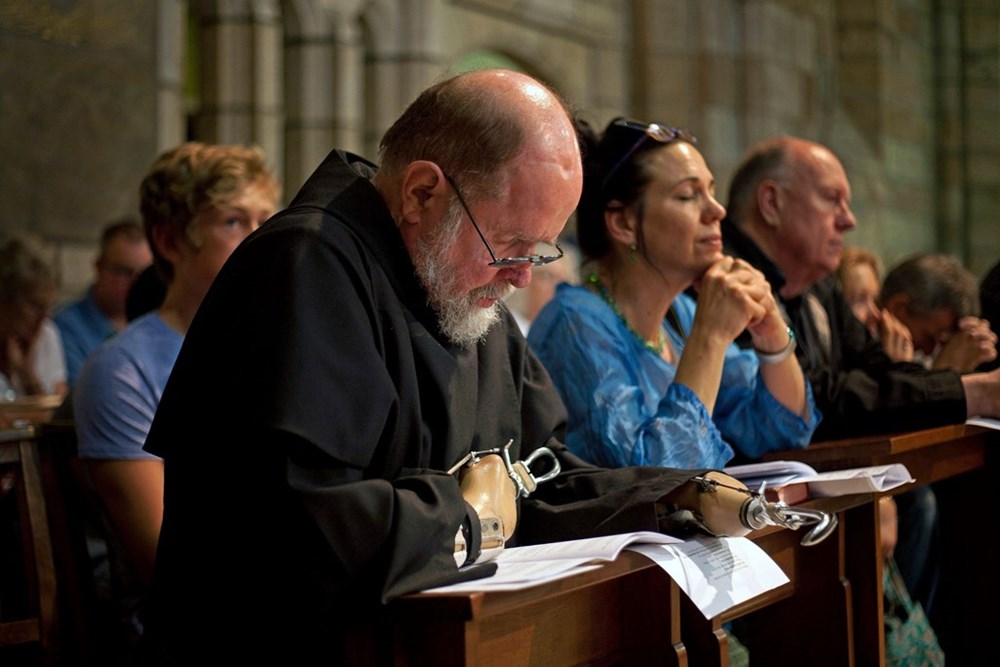
Father Michael was born in New Zealand and ordained to the priesthood in Australia before he moved to South Africa in his early 20s, where he spoke out against apartheid, and especially against the violence inflicted upon black schoolchildren. In 1976, Father Michael was exiled from the country, but instead of returning to the safety of New Zealand, he traveled around the world, encouraging faith communities to oppose apartheid and support the struggle for liberation. While in Zimbabwe, the apartheid regime sent Fr. Michael a sophisticated letter bomb hidden inside two religious magazines. If he had opened the magazines while standing, he would’ve been killed instantly, which was likely the intent. However, he instead opened the magazines while sitting at a table and, in the blast, lost both of his hands as well as vision in his left eye. Fr. Michael responded to this horrific attack not by seeking vengeance, but by deepening and expanding his work of healing and reconciliation, establishing the Institute for the Healing of Memories, which emerged from his participation in South Africa’s Truth and Reconciliation Commission with Archbishop Desmond Tutu, who said, “Since his bombing Fr. Michael has become a marvelous advocate for healing and reconciliation in South Africa and other strife-torn regions of the globe…I have watched his work with a growing sense of awe and admiration. Although he was broken physically, he has become the most whole person I know, truly a wounded healer.”

PICTURE: MARK WESSELS. 03/09/2012.
atomic7@mweb.co.za
http://www.markwesselsphoto.com

I had the honor of spending quality time, drinking wine, and breaking bread with “the most whole person” that Desmond Tutu ever knew. I experienced him in a similar way, a man whose wounds are undeniably visible, whose hands have been replaced with metal hooks, who seems entirely comfortable in his own skin (even though it’s been severely burnt), and whose sense of humor and compassion glimmer brightly in the twinkle of his eye. When he spoke to us clergy, he told us that he harbors no ill will against the person who sent him the bomb, but he doesn’t know how to forgive that person because he doesn’t know the person and doesn’t know how to forgive an abstraction. He often fantasizes about meeting the person who sent him the bomb; and in that imagined meeting, he says to him, “Sir, what you did that day was an act of evil. Nevertheless, I wish to thank you for what you did. With God’s help and many companions, I have been able to create a global network, contributing to the healing journey of individuals, communities, and nations. Thank you, sir. Now please tell me about your life.”
When Fr. Michael imagines meeting the person who destroyed his hands, impaired his vision, severely burnt his skin, and made him permanently disabled, he imagines thanking the perpetrator. Sending Fr. Michael the letter bomb was indeed an act of evil, but instead of using his victimhood as an excuse to victimize others (as we so often do), Fr. Michael responded as a survivor and a victor and a wounder healer; and in so doing, that act of evil became transformed mysteriously into Fr. Michael’s glorification. Likewise, the crucifixion of Christ is an act of evil, but Christ responded as the survivor and victor par excellence and as the divine wounded healer: “By his wounds you are healed; and insofar as we are on our own journeys of healing, our own wounds can help to heal others.”
When I asked Fr. Michael to reflect briefly on this Sunday’s Gospel and Christ’s understanding of being glorified on the Cross, he said that, in John’s Gospel, we see Jesus transforming an unjust and brutal state-sponsored murder into an act of friendship. In John’s Gospel, Jesus says, “There is no greater love than to lay down one’s life for a friend” (John 15:13). At the Cross, Jesus is glorified because it is there that he lays down his life for his friends, the same friends who abandoned and denied and betrayed him. Jesus lays down his life for his friends, including all of us who have entered into friendship with him through Baptism, and who have allowed him to transform our wounds into catalysts for healing and glory. Jesus lays down his life for his friends so that we may share in his glory by uniting our hearts with his, so that we might hear and feel his heartbeat when we hear and feel our own, and so that we too might transform acts of evil into the glorification that we share with God. Amen.

 DANIEL DeFOREST LONDON