
Readings for the Fifth Sunday in Lent (Year C)
This sermon was preached at Christ Episcopal Church in Eureka CA on April 6, 2025.
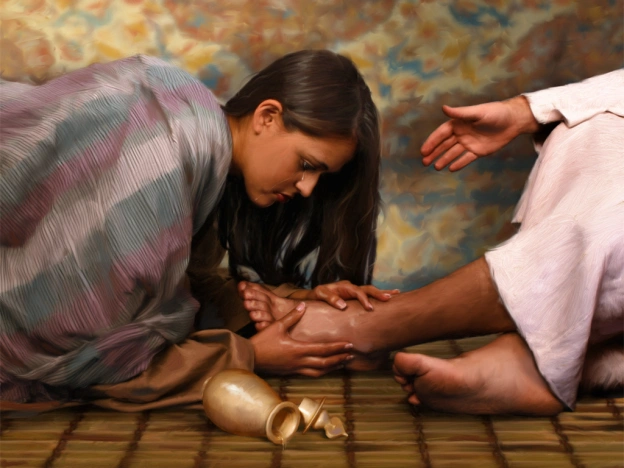
In today’s Gospel, Mary of Bethany prays with her whole body, arousing multiple senses, and leaning into the earthy dirtiness of everyday life. She pours a pound of pure nard all over Jesus’s feet, making a wonderful oily mess and filling the entire house with the fragrance of her perfume. Now, in the ancient Near East, people did not wear shoes or socks and the roads were very dusty and sometimes covered in camel dung. So, the feet of a peripatetic rabbi like Jesus would have been extremely dry, dirty and probably quite stinky. And Mary kneels down and pours valuable, expensive oily perfume all over these dry and dirty feet. And just when the onlookers think that this act of extravagance could not get anymore excessive, she then starts wiping the oil on his feet with her hair! It was rare for Jewish women, at the time, to even unbind their hair in public at all, much less to wipe a man’s dirty feet with it.[1] Mary connects intimately to Christ with her knees, with her hands, with her expensive perfume and with her hair. Her worship becomes a multi-sensory experience for her and for everyone watching as the oil glistens and gushes before their eyes and ears and as the fragrance overwhelms their nostrils so much that they can almost taste it. The act is so human and sensuous that it actually scandalizes and horrifies some of the onlookers. According to Luke’s version of the anointing, the onlookers called the woman a “sinner.”
Judas Iscariot especially did not approve of this extravagance and asks, “Why was this perfume not sold for three hundred denarii and the money given to the poor?” 300 denarii would be equivalent to about $60,000 today. So that is certainly some expensive oil and perfume. Judas suggests that the money earned from selling the oil could be given to the poor, which actually doesn’t sound like a horrible idea, right? Although the Gospel is clear that Judas Iscariot has no interest in serving the poor and simply wanted to fatten the common purse in order to steal more from it, many of us still might be initially bothered by Jesus’s response, when he says, “You always have the poor with you.” He sounds rather dismissive of the plight of the poor. It sounds like he’s saying, “There will always be poor people around no matter what you try to do about it. So, you should probably be focusing on something else instead of wasting your time with them.” Fortunately, a closer look reveals that Jesus is saying something very different than that. In fact, Jesus is quoting Torah. Any Jewish listener would know that Jesus is referencing the book of Deuteronomy, which says “There will always be poor people in the land” (15:11) a verse that is sandwiched between two commandments to serve the poor. The prior verse is “Give generously to the needy and do so without a grudging heart” (15:10). And the following verse is “Therefore I command you to be openhanded toward your fellow Israelites who are poor and needy in your land.” So, by saying “You always have the poor with you” Jesus is, in fact, invoking the divine command to be generous.
In today’s Gospel, I hear two invitations for us. The first is the invitation to give generously, even lavishly, like Mary; to be openhanded. And the second is to connect intimately with Christ by worshipping God with our whole body, with all our senses, including our heart sense, just as Mary did.
Today, we can respond to the Gospel’s first invitation by giving generously to the Eureka Chinatown Monument, a monument that will be located on the corner of First and E Streets and which will highlight themes of hope and healing, themes that are central to our faith. The monument will exemplify how past actions can be acknowledged and reframed with present day grace, compassion, and beauty in the form of public art, education, and poetry. The vestry decided to match the amount that you all give in the loose plate offering today, understanding that this donation reflects our church’s connections to the past history of the Chinese Expulsion as well as our present support of the Eureka Chinatown Project, an initiative that honors the history and culture of the first Chinese People in Humboldt County. The Gospel invites us to be generous and openhanded and so I invite you to be generous in supporting the Eureka Chinatown Project.

The Gospel also invites us to connect intimately with Christ by worshipping God with our whole body, with all our senses. And the church has set aside these final two weeks of Lent (which are called Passiontide) and especially the final week of Lent (Holy Week) to do just that: to give ourselves as fully as possible to the worship of God, to connect as intimately as we can to Christ. I invite you to participate in as many Holy Week services as you can. If you’re travelling during this time, find a church where you can worship. Make it a priority to worship on Palm Sunday, Maundy Thursday and Good Friday and Easter, the three great days of the Holy Triduum.
Episcopal priest and scholar Fleming Rutledge says, “Nothing–I think I mean that literally–compares with Holy Week to ground the Christian. Faithful attendance each day at some sort of gathering, however simple, however poorly attended, will make it work. Each day, with its appointed readings, is a dose of unfiltered gospel.”
Yesterday, I listened to author Diana Butler Bass interview Senator Chris Coons of Delaware, one of two senators who has a theology degree, and she asked him what we can do to help encourage and support him. She said, “I know a lot of people are going to the protests on April 5th, but what do you need from us?” He gave a multi-faceted answer, but the first thing he said was clear and solid advice worth heeding no matter where one finds themselves on the political spectrum. The first thing he said was “Pray. Do not forget to start in prayer. Pray and study and reflect on the traditions that ground all of us. Do simple acts of kindness and engage in local community.”[2]
Today, you are invited to do a simple act of kindness and engage in local community by giving generously to the Eureka Chinatown Project. And during this Passiontide and Holy Week you are invited to pray and study and reflect on the traditions that ground all of us. Make it a priority to connect intimately with Christ in these final days of Lent. Amen.
[1] One of the few times that a woman would publicly unbind her hair would be at her wedding (Mishnah, tractate Ketubbot 2.10). So, some scholars like Jo-Ann Brant, have suggested that Mary is offering herself as a wife to Jesus. Brant, “Husband Hunting: Characterization and Narrative Art in the Gospel of John.” Biblical Interpretation 4 (1996), 219.
[2] https://dianabutlerbass.substack.com/p/a-cottage-conversation-with-sen-chris, 17:25

 DANIEL DeFOREST LONDON