

Readings for the Second Sunday in Lent (Year C)
This sermon was preached at Christ Episcopal Church in Eureka CA on March 16, 2025.
About fifty years after the 318 bishops gathered for the first ecumenical council and adopted the Nicene Creed, a teenage boy in Britain named Maewyn Sucat was kidnapped by Irish pirates and sold into slavery in Ireland. For six years, he lived as a slave on Mount Slemish, where he prayed one hundred times a day, in the frost, in the snow, in the rain, and in the dark before the dawn. Inspired and guided by the Holy Spirit, he escaped slavery and found his way home to Britain, where he became a priest and then a bishop. But not just any bishop: a missionary bishop, who felt called to return to Ireland to evangelize and teach the Irish people about the Gospel of Jesus Christ, the very same people who had enslaved him. His ministry among the Irish was so successful that the people began to call him the Father of all Celtic and Irish Christians. Eventually, Maewyn Sucat’s name was changed to Patricius, a Latin way of saying “Father.” Today, we know this person as St. Patrick, whose feast day is tomorrow.
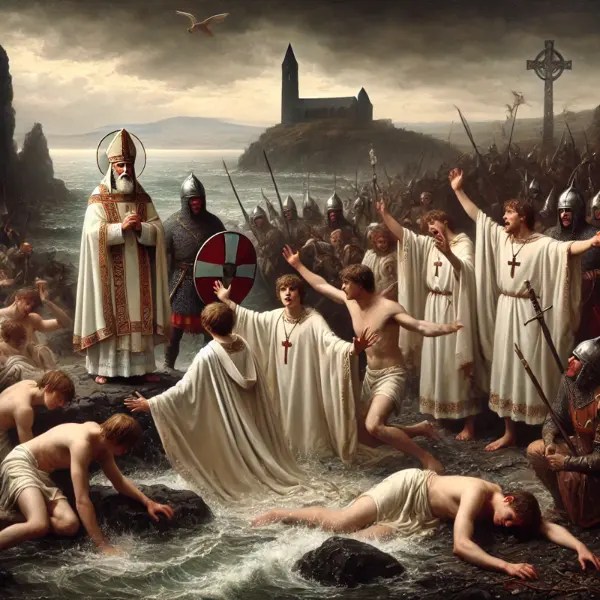
And we know about Patrick’s life because he wrote a spiritual autobiography which he called his Confession. Along with his autobiography, we have one other text written by St. Patrick and that is a letter that he wrote to a British King named Coroticus. According to this letter, Coroticus and his soldiers had brutally murdered several young men and women whom Patrick had recently baptized and confirmed. The chrism oil was still gleaming on their foreheads when they were cruelly cut down and killed. Those who were not killed were sold into slavery in northern Britain (Pictland). As someone who experienced slavery first-hand, Patrick had particularly harsh and impassioned words for Coroticus and his soldiers, whom he shamed and condemned and nearly excommunicated. Several times he refers to them as ravenous wolves who devoured God’s precious children like a loaf of bread. Because of this letter, Coroticus (who may have been hailed as great and powerful in his day) is permanently known throughout history as a violent monster and a pathetic pawn of Satan. And because of this letter, St. Patrick (who was once a slave himself) is now known as the first Christian in history (if not the first person in history!) that we know of to speak out against slavery.
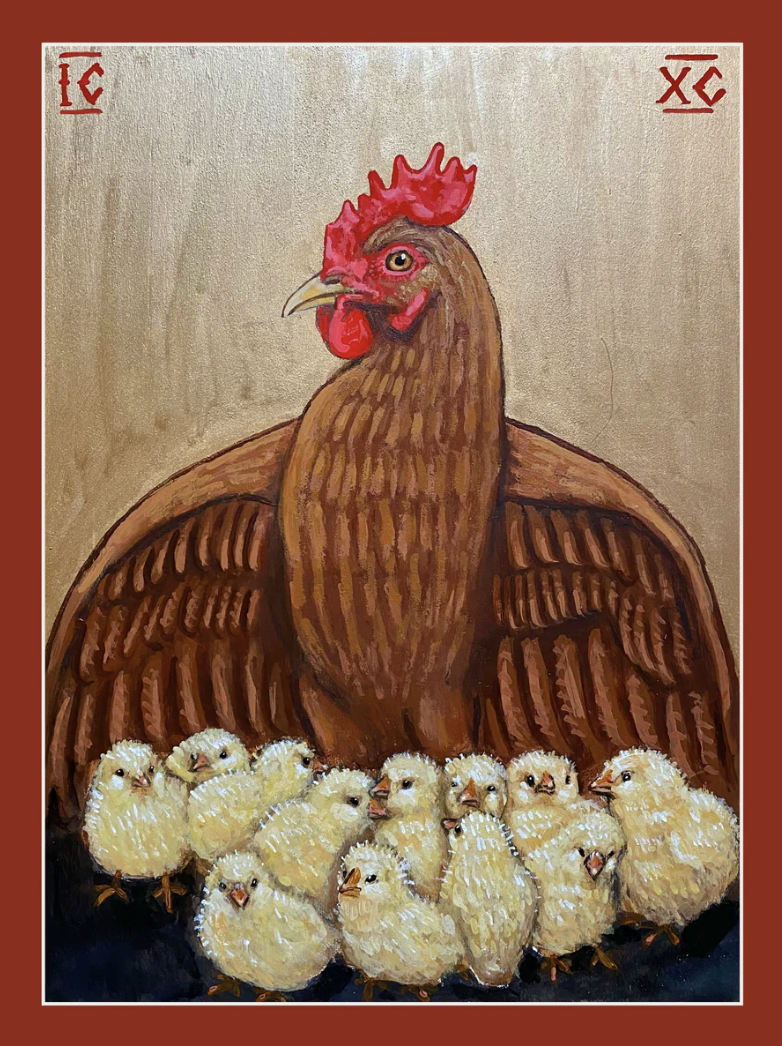
In our Gospel this morning, Jesus speaks out against one of the tyrants of his day: King Herod. Like St. Patrick, Jesus compares this bully to a predator. Some Pharisees (many of whom were Jesus’s friends and thus concerned for his safety) told Jesus to be careful and to not stay too long in his present location because Herod was eager to have him killed. Jesus says, “Go tell that fox that I’m a prophet and I’m not going to die until it’s God’s time and God’s place: Jerusalem. And in the meantime, I am going to stand up and protect all those who are vulnerable. I’m going to wrap my arms around the children of Israel like a mother hen wraps her baby chicks under her wings.” Jesus and St. Patrick both spoke truth to power. They both responded to violence and tyranny with healing and love and prophetic urgency. Notice they did not respond to violence with more violence. They knew what the Rev. Dr. Martin Luther King Jr. articulated so well when he said, “Darkness cannot drive out darkness; only light can do that. Hate cannot drive out hate; only love can do that.”
St. Patrick chose not to assemble a band of Irish warriors, who were known for their terrifying power and fierce bravery and who could have likely retaliated and perhaps defeated Coroticus and his soldiers. Instead, he made sure that his letter was read aloud all over Britain and Ireland so that all would know that Coroticus was a greedy and abusive monster. Likewise, Jesus chose not to call upon his angelic armies or even his band of eager disciples, who were at his beck and call. Instead, Jesus called Herod a predator: a fox. And then Jesus referred to himself as a healer and a prophet and a mother hen protecting her brood. Listen to what Jesus is doing here. He’s calling Herod a fox and calling himself a hen. We all know what happens when a fox gets in the henhouse: the hen is eaten alive. This is Jesus’s way of predicting and explaining his eventual death in Jerusalem. Herod and Pilate and Rome will eventually kill Jesus. But Jesus’s death will be on his terms, as an act of self-giving love and ultimate sacrifice like a mother hen giving her life to protect her brood. And Jesus makes it abundantly clear that the monster in this scenario is Herod, not God. God is not the bloodthirsty tyrant demanding Jesus’s death as some medieval theologians and many modern evangelicals suggest. Herod and Coroticus are the bloodthirsty tyrants and St. Patrick and Jesus are calling them out. Herod and Coroticus and all those who follow in their footsteps are those whom the Apostle Paul calls the “enemies of the cross of Christ” in our reading from Philippians. “Their end is destruction; their god is the belly; and their glory is in their shame.”
And we are reminded of the potentially predatory power of the state and the empire every time we read the Nicene Creed and those ancient words that declare the historical fact that “Jesus was crucified under Pontius Pilate.” This last Tuesday, we saw how these are among the most ancient words of the Creed, recited by 2nd century martyrs Ignatius of Antioch and Justin Martyr. Last Sunday, I said that the Creed provides a code for reading Scripture, to equip us against diabolical interpretations. This is such a crucial example because it provides a necessary corrective for all those who read the Gospels (especially John) and conclude that it was “the Jews” who crucified Jesus. This misreading has been used by the devil to fuel some of the worst anti-Jewish violence in history; and our Creed clearly rejects that reading. While some Jewish leaders worked in collusion with Rome (as the Gospels insist), it’s important to remember that the Jews had no power to crucify anyone. Only the Roman empire had that power. Pontius Pilate may have felt reluctant to condemn Jesus and may have repented about it later (as the Orthodox suggest), but it still does not change the historical fact that he condemned Jesus to a violent death while simultaneously releasing a violent murderer.
What broke St. Patrick’s heart the most was that Coroticus claimed to be a Christian. Patrick did not excommunicate Coroticus although he came close. He ultimately saw Coroticus as a slave himself: a slave to his own greed and sin. And he called for Coroticus to repent because he knew that forgiveness and liberation can be found through repentance. The bold and fearless words of Jesus and St. Patrick urge us, this Lent, to repent of the ways in which we ourselves are like Herod and Coroticus (and Pilate), the ways in which we ourselves might be bullies or morally obtuse. Their words also urge us to speak truth to power and to call for the repentance of all who abuse their authority and who prey on the vulnerable. Their words urge us to heal and protect others even at the risk of our own safety and reputation. They urge us to be the mother hen for all children. Their words also urge us to repent of the ways we have been silent in the face of oppression and complicit to violence. During this season of Lent, may we learn to repent as individuals, as a nation, and as Christians; and learn to walk the way of the cross, finding strength in the shadow of the wings of our mother hen, the Christ who is before us, behind us, beneath us, above us, and within us. Amen.

 DANIEL DeFOREST LONDON