
Readings for the First Sunday in Lent (Year C)
This sermon was preached at Christ Episcopal Church in Eureka CA on March 9, 2025.
So, our Lenten journey has begun once again; our Lenten fast in preparation for the great Feast of the Resurrection; our 40 days of delayed gratification. And here at Christ Church, we will be reflecting throughout this season of Lent on one of the chief cornerstones of our tradition: the Nicene Creed, which we confess together each Sunday, and which was adopted at the Council of Nicaea 1700 years ago, this year. We will be reading the book The Creed: What Christians Believe and Why it Matters by Luke Timothy Johnson; and our Scripture readings on this First Sunday in Lent offer their own wisdom on why our Creed matters.
The reading from Deuteronomy includes instructions on how the Israelites offer their first fruits to God, an offering that includes a kind of creedal statement that reminds the Israelites of their identity, their story, and their generous and liberating God: “A wandering Aramean was my ancestor…” (Deuteronomy 26:5). These few verses distill the story and the beliefs of the people of Israel. They are a slightly longer version of their most pithy Creed, the Shema. And then the declaration concludes with these words, “Now I bring the first of the fruit of the ground that you, O LORD, have given me” (Deuteronomy 26:10). We say something similar here as part of our offertory: “All things come of thee, O Lord; and of thine own have we given thee.”
In Paul’s letter to the Romans, he offers a most pithy creed by teaching the very simple path to salvation: if we confess with our lips that Jesus is Lord and believe in our hearts that God raised him from the dead, we will be saved (Romans 10:9). I love that this verse says nothing explicitly about our intellectual assent to theological ideas. The intellect certainly plays an important role but notice that Paul refers to our body by referring to our lips, our mouth, our stoma, the part of our body that receives the Eucharist. And then he refers to our heart, cardia. Our belief in the Resurrection is a belief and an abiding trust rooted in the heart. The word Creed comes from the Latin credo, which means “I believe” and this word comes from the Proto-Indo-European root kerd-dhe, which means “to put one’s heart into.” That’s where we get the Greek word cardia, heart. So, in the Nicene Creed, when we say, “we believe” (credimus), it’s not so much that we are forcing our minds to grasp baffling theological concepts. Rather, we are putting our heart into these long-held and time-honored truths about the God of Love revealed in Jesus Christ and expressing this heart-centered trust with our mouths (stomata) by saying the words of this unique species of poetry that we call the Nicene Creed.
Speaking of the heart, I must say that today’s Psalm (Psalm 91) touches my heart deeply since this is a Psalm I prayed by my father’s hospital bed during his bone marrow transplant. It’s the Psalm I prayed with Father Doug on his last day here on earth. It’s a Psalm I prayed many times during COVID and it’s one I have prayed with several parishioners who have been ill or near death. We know that in ancient Judaism, this Psalm was used in exorcisms. I am certainly no exorcist (and there is no office of exorcism in the Episcopal Church) but when asked to help people who are struggling with oppressive spirits, this Psalm is an important resource I offer. It is one that I encourage you all to become familiar with. But what does this Psalm have to do with the Creed?
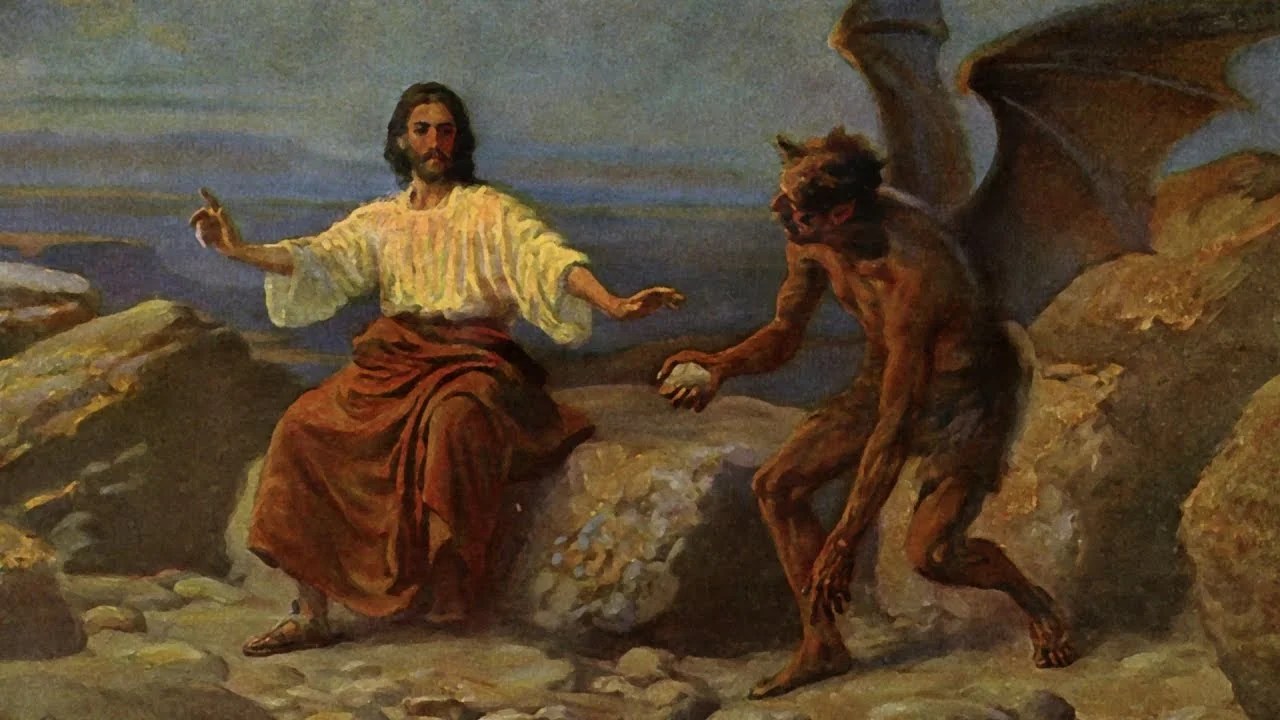
Well, to answer that question, we need to turn our attention to today’s Gospel, the Gospel always read on the First Sunday in Lent, the Gospel of our Lord’s 40 days of fasting in the wilderness, where he was tempted by the devil. Jesus responds to all three temptations by quoting Scripture (Torah), which he had clearly memorized. Perhaps God is inviting you to memorize a portion of Scripture throughout this Lenten season. Although we Episcopalians generally have a less-than-stellar reputation when it comes to biblical literacy, we are bucking that trend here thanks to Pastor Karen’s wildly successful Bible Study.[1] Biblical literacy is important, but there’s a reason why we Episcopalians and Anglicans never fully got on board with the Protestant Reformers’ rally cry of “Sola Scriptura,” which insists that the Bible is the only authority on matters of faith. For us, Scripture is the primary authority, but not the only one because we understand how dangerous the Scriptures can be and have been when read and even memorized by those who are not firmly rooted in the God of love revealed in Christ. In our Gospel today, we see that Jesus is not the only one quoting Scripture. The devil himself quotes twice from Psalm 91.[2] The devil uses the Bible for the purpose of temptation and evil and destruction.

So, you can go ahead and memorize all kinds of verses and even memorize the entire Bible, but that does automatically free you from the possibility that you are using Scripture in a diabolical way, as a weapon of mass discrimination and exclusion and hatred and bigotry and self-aggrandizement. Both Jesus and the devil know how to quote Scripture, but only one uses it to remain faithful to the way of self-giving love while the other uses it to obstruct and tear down and destroy. So, today’s Gospel compels us not so much to memorize Scripture, but to ask ourselves how does one read Scripture? How do we read Scripture like Jesus, and not abuse Scripture like the devil?
In the early church, there was a man named Marcion who knew the Bible probably better than anyone here, but unfortunately his reading resulted in extreme anti-Judaism as well as a rejection of the goodness of creation. That’s when St. Irenaeus of Lyons saw that the orthodox need[ed]…their own ‘code for reading,’ [for reading like Jesus]. This code is precisely the Rule of Faith [that we now call the Nicene Creed].”[3]
This is why we always include the Nicene Creed in our Liturgy of the Word, after we hear Scripture read and the preacher’s interpretation in the sermon. The Creed provides us with a code and lens for reading so that everything is understood and filtered through the revelation of a triune God revealed in the self-giving love of Jesus Christ who generously invites us into the circle dance of the Father and the Son and the Holy Spirit so that we might live forever with him in the life of the world to come.
So, I invite us now to give our hearts to the God of love revealed in Christ by confessing with our mouths the words of this 1700-year-old Creed, which provides us with the life-giving lens we need for interpreting Scripture as well as the lens we need for interpreting our crazy world, our busy lives, and our very selves.

[1] Bishop Alexander Stewart, former bishop of Massachusetts, said, “You can’t have a parish unless it’s got a Bible Study.”
[2] Some scholars like to joke that the reason the devil knew this psalm so well is because it was used so often against him in exorcisms. He heard it used against him so many times that he memorized it.
[3] Luke Timothy Johnson, The Creed: What Christians Believe and Why it Matters, 48.

 DANIEL DeFOREST LONDON