
Readings for the Seventh Sunday after the Epiphany – Year C
This sermon was preached at Christ Episcopal Church Eureka on Sunday February 23, 2025.

Over the last seven weeks, several of us have been gathering in the Pierson Room to discuss our reading of The Interior Castle, a spiritual classic written by 16th century Spanish mystic, Teresa of Avila. (When Bishop Megan visited us back in October to make seven new Episcopalians here around the feast of St. Teresa, each person received their own copy of this book.) In Spanish, the book is called Las Moradas del Castillo Interior: the mansions or dwelling places of the Interior Castle. Teresa invites us to go within through prayer and stillness to discover our souls as elaborate castles made of crystal with seven general vicinities or moradas.[1]
The first morada is the outer courtyard where we catch diffuse glimpses of the Light radiating from the innermost chamber, where God dwells. We move closer to the divine within by cultivating humility.[2] In the second morada, we enter the castle itself and start to feel peace and become at home within ourselves.[3] It is in the third morada that we face the same challenge posed to the rich young ruler in Mark’s Gospel who is told by Jesus to sell everything he has and give it all to the poor. We realize here that this inner journey will ultimately require us to let go of everything.[4] When we move into the fourth morada, we notice that although we are drawing closer and closer to the innermost chamber, the rooms of the castle are becoming larger and larger as the core of our being also dilates and expands in its capacity to experience the vastness of God.[5]
In describing the fifth morada, Teresa introduces another metaphor that could have easily become the basis of another spiritual classic: the metaphor of the silkworm who builds the cocoon where it will die only to reemerge as a white butterfly.[6] She uses this metaphor to describe the transformation of the soul in the Prayer of Union, which is experienced in the fifth morada, but this same metaphor could just as easily be used to help St. Paul make his point about the resurrected body in today’s reading from First Corinthians. In the epistle, Paul addresses a question about the resurrection that was troubling the early Christians and still confuses many Christians today: How do we make sense of the resurrection of the body when we know these bodies will decompose and decay? And how do we make sense of the resurrection of the body when our bodies are cremated? Paul’s analogy of the seed and the plant “are not an exact analogy for the old body and the new, but rather a way of demonstrating radical change within basic continuity.”[7] There is indeed something mind-boggling about a tiny acorn containing within itself the potential of a mighty oak tree. However, I find the metamorphosis of a butterfly even more fascinating and inspiring and helpful.
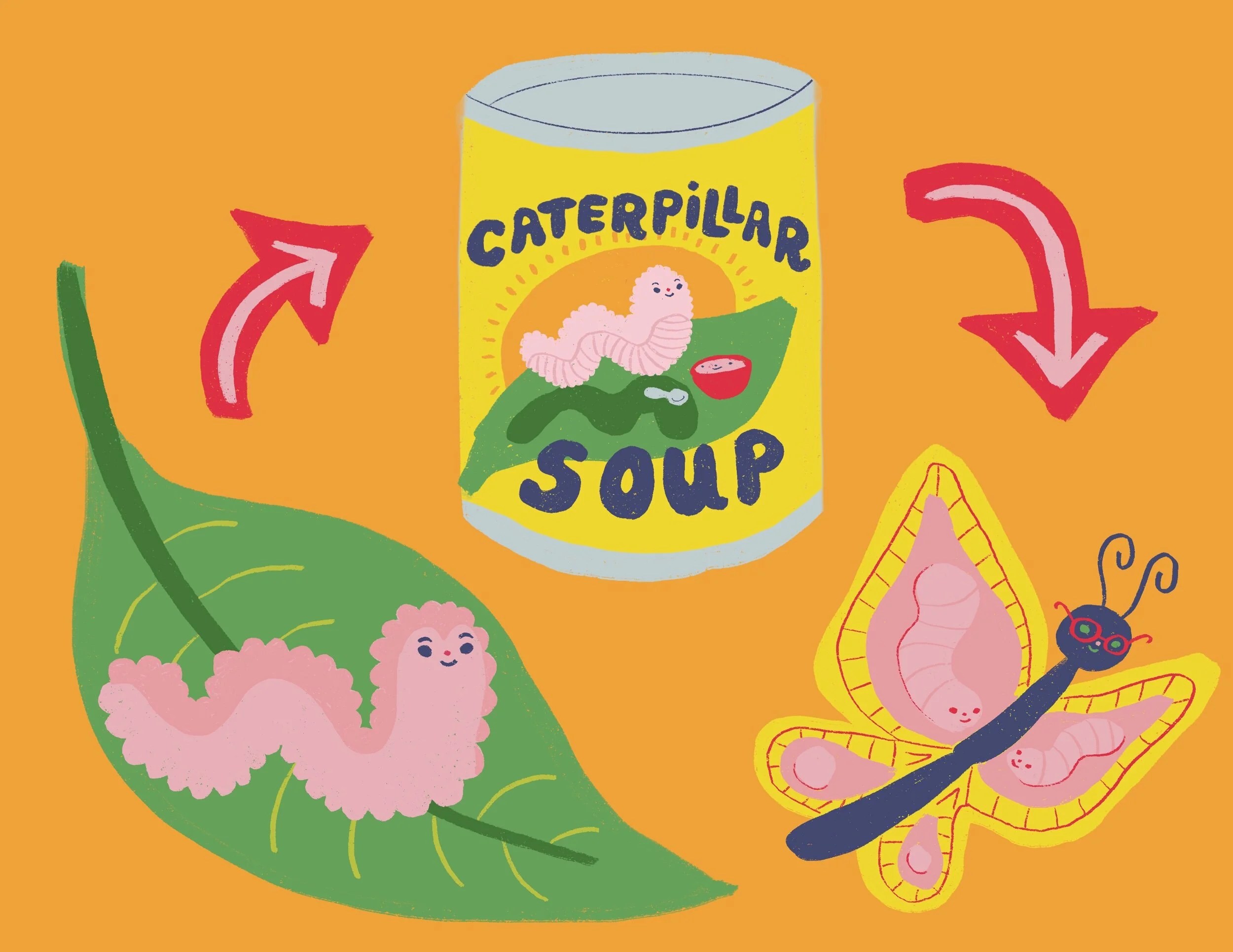
When a caterpillar enters the chrysalis, it sheds its skin and dissolves its muscles and organs. If you open the chrysalis during this time, all you will see is a messy goo that scientists call “caterpillar soup.” It looks likes the caterpillar is dead and gone but, in reality, that caterpillar is transitioning into a magnificent butterfly that will soon be dancing in the skies. And researchers have discovered that butterflies remember their lives as caterpillars. If the messy goo of caterpillar soup transforms into a butterfly through natural means, then why can’t the remains or cremains of our bodies be transformed into something heavenly through supernatural means?
Paul is promising us that we who are in Christ, will shuffle off this caterpillar-like clothing when we die and then emerge with more beauty and color than we can ever imagine. The Risen Christ revealed this to us by appearing to his friends in his resurrected body, by returning to us caterpillars as a butterfly.
Now Teresa of Avila does not emphasize the messy goo of the caterpillar soup (at least not explicitly), but she does seem to underscore the apparent messiness of the transformations that occur within our spiritual lives, which are not always linear but often circumambulatory, like a labyrinth. It seemed like each week at our book study group, at least one person would point out how difficult and disorganized and unsystematic Teresa’s writing could be. It was almost as if her writing style itself was embodying the sometimes-non-linear flow of the spiritual life and reminding us of its apparent messiness.
What to our eyes might look like the hot mess of a chaotic caterpillar soup could be, in reality, the sacred stirrings of a profound spiritual transformation. If your life feels like the hot mess of a chaotic caterpillar soup, then take heart. God may indeed be busy transforming you into a butterfly. But perhaps more importantly, this insight helps us to practice compassion for others, for those whose lives appear, to us, to be a chaotic mess. And this leads us to the sixth morada which is characterized by compassion for the messiest people among us, including those who spew out rumors and lies and venom against us.[8] Teresa, who devotes the most chapters describing the sixth dwelling, says, “Let’s love the ones who offend us. Has our great God ever stopped loving us? Not for one second! And we have certainly offended him plenty of times. He has very good reason for wanting us all to forgive anyone who has hurt us.”[9] So, if you want evidence that someone is dwelling in the sixth mansion of the interior castle, then just notice how compassionate and forgiving they are to those who offend them.[10] Notice how well they emulate Joseph who forgave the very same brothers who previously beat him, threw him in a well, and sold him off as a slave. Notice how well they obey the radical teachings of Jesus in his Sermon on the Plain, when he said: “Love your enemies, do good to those who hate you, bless those who curse you, pray for those who abuse you…. Do not judge, do not condemn…Forgive… be merciful, just as your Father is merciful.” Be compassionate because everyone you meet is fighting a hard battle. Be compassionate because everyone you meet is likely dealing with some kind of chaotic caterpillar soup in their life, everyone you meet is likely undergoing some form of transformation.
Be compassionate because this is the way of love, the way of the Cross, in which Christ calls each of us to walk; and Teresa reminds us, time and time again, that it is far from easy. But it is worth it because this way of compassion eventually leads us to the seventh and final morada, the innermost chamber of our souls, where we find ultimate rest and countless blessings and the greatest joy in the limitless love of the One whom Teresa addressed as “His Majesty.”[11] In this chamber, God gives you a love letter that he wrote with the purest love, composed in a secret code that only you can decipher; and in this chamber, your only job is to let that love pour over you like a mighty waterfall. May we enjoy a taste of that innermost chamber even today so that we might be strengthened to continue in our spiritual journey of compassion and transformation. Amen.
[1] “All we have to do is be still and go within,” echoing the invitation of today’s Psalm: “Be still before the Lord and wait patiently for him” (Ps. 37:7). St. Teresa of Avila, The Interior Castle, translated by Mirabai Starr (New York: Riverhead, 2004), 22.
[2] “Without humility, all is lost” (Starr, 46) and “There is nothing more essential than humility (Starr, 46). Humility corresponds with the spiritual meaning of the first letter in the Hebrew alphabet: Aleph (Humility). Since Teresa of Avila descends from Jewish Conversos, lived during a season of flowering of Jewish Mysticism, and was deeply influenced by Francisco de Osuna’s book titled The Third Spiritual Alphabet, I felt inspired to explore the connections between Teresa’s seven dwellings and the spiritual meaning of the first seven letters of the Hebrew alphabet. The correspondences have turned out to be striking. Also, in chapter 1 of the sixth dwelling, Teresa makes an explicit reference to letters of the alphabet: Starr, 162; Kavanaugh, 113. letras, (Las Moradas del Castillo Interior, 88). In chapter 3, she writes of her attentiveness to every word and even every syllable spoken by a genuine spiritual voice (Starr, 180). In the fourth dwelling, she quotes a verse from the fourth stanza (the Daleth stanza) of the acrostic Psalm 119; and in the final chapter (chapter 4 of the seventh dwelling) she quotes from yet another acrostic poem: Psalm 112 (Starr, 287).
[3] “Can there be an evil greater than that of being ill at ease in our own house?” (Kavanaugh, 53) and “If we don’t obtain peace and have peace in our own house, we’ll not find it outside” (Kavanaugh, 53). Teresa of Avila, The Interior Castle, translated by Kieran Kavanaugh OCD and Otilio Rodriguez OCD (Mahwah NJ: Paulist Press, 1979), 53. The “home” corresponds with the spiritual meaning of the Hebrew letter Beth (House).
[4] “Leave everything behind” (Starr, 77). In this dwelling, Teresa speaks of the rich young ruler in the Gospel of Mark: “Remember the young man who was told by the Beloved exactly what he had to do if he wished for perfection? Ever since I first began to speak of these dwellings, I have had this youth in mind because he is just like us” (Starr, 71). The wealth of the rich young ruler corresponds to the spiritual meaning of the third letter of the Hebrew alphabet: Gimel (Camel) which is a symbol of “wealth.”
[5] In this dwelling, Teresa explicitly quotes from the Daleth stanza of the acrostic Psalm 119: “As I write this, I’m thinking again of that verse I mentioned: Dilatasti cor meum, which says that the heart is expanded. But I still don’t think this is an experience of the heart. I think its source is much deeper inside. I think it must come from the very core of our being. I have seen secret things that have left me dumbfounded. And how many more than these must there be!” (Starr, 98). Dilatasti cor meum is Latin for “You have expanded my heart” Psalm 119:32. Daleth (Door). With this expansion of the heart, the doors of our perception are flung wide open: “Returning to the biblical passage, what is most useful here, I think, is the part about expansion. As the heavenly water begins to surge from the spring deep inside us, it spreads and expands our whole inner being and gives rise to ineffable blessings. The soul herself cannot even understand what is unfolding here” (Starr, 99).
[6] “Let the silkworm die. This is the natural outcome once it has done what it was created to do. Then we will see God and see ourselves nestled inside his greatness like the silkworm in her cocoon…The soul in this state of prayer dies to the world and emerges a little white butterfly. Oh, the greatness of God! How magnificent that the soul, having been hidden in the greatness of God and so closely joined with him, is so transformed…Think of the difference between an unsightly worm and a white butterfly. That’s how different the soul is after her transformation of union” (Starr, 129). This fifth dwelling corresponds to the Hebrew letter He – Window). Deepak Chopra and Michael Zapolin associate the Letter He with “transition and significant personal growth…moving from one phase of life into another, reaching a certain landmark age or accomplishment, or simply being in the process of maturation and deepening.” When the He letter appears, you know “you’ve gone as far as you can go according to your limited physical understanding of one phase, and you’re on the brink of developing your own sixth sense.” Deepak Chopra, Michael Zapolin, & Alys R. Yablon, Ask the Kabala: Oracle Cards (Carlsbad CA: Hay House 2006, 46). The image that is illustrated on the He oracle card in their collection is a butterfly!
[7] N. T. Wright, Twelve Months of Sundays: Biblical Meditations on Christian Years A, B & C (New York: Morehouse, 2012), 292.
[8] In this dwelling, Teresa begins by saying, “Here the soul is wounded with love” (Starr, 155). The sixth letter of the Hebrew alphabet is Waw, which is the nail or spear that also functions as a conjunction (“and”) that connects two subjects. The letter resembles a shooting star or thunderbolt: “His gesture is as swift as a shooting star and as resounding as a thunderbolt…she feels that she has been wounded in the sweetest way, but she can’t figure out how it happened or who inflicted it. All she knows is that the wound is something precious and she doesn’t ever want to recover!” (Starr, 167). See reference to streak of lighting in chapter 9 (Starr, 233). “The pain penetrates the very depths of the soul. And so, when he who has wounded her withdraws his arrow, it seems like God is drawing out her innermost depths, in proportion to the love she feels for him” (Starr, 168). Later in this dwelling, she writes about discerning spirits. The Waw can function like the Sword of Manjushri helping us to distinguish and discern. Thorns of the burning bush are referenced in chapter 4 (Starr, 187). “Have you ever noticed how a blade of grass is folded into a piece of amber? …Yes, the soul is like a straw, and it is no easier for a strong man to pick up a straw than it is for this great Giant of ours to carry away the spirit (Starr, 196). “She may feel like she is being pierced by a flaming arrow” (Starr, 249).
[9] Starr, 245. Also, “Since she has reaped the fruits of persecution, a special and very tender love for her detractors grows in her heart. She considers them to be friends and more helpful allies than those who speak well of her” (Starr, 159).
[10] Also, in chapter 1 of this sixth dwelling, Teresa makes an explicit reference to letters of the alphabet: Starr, 162; Kavanaugh, 113. letras, (Las Moradas del Castillo Interior, 88). In chapter 3, she writes of her attentiveness to every word and even every syllable spoken by a genuine spiritual voice (Starr, 180).
[11] The seventh letter of the Hebrew alphabet is Zayin, which represents the Sabbath and Rest. In chapter 6 of the sixth dwelling, Teresa says, “Our little butterfly cannot find any lasting rest” (Starr, 203). Traditionally, Jewish families light two candles on the Sabbath and Teresa makes a reference to “two softened candles” in chapter 2 of this dwelling (Starr, 270). Final rest: “This is the place where that little butterfly we’ve been talking about dies. And she dies with the greatest joy because Christ is now her life” (Starr, 270). “Now the little butterfly has died of happiness, we could say, filled with the living Christ. She has found her rest at last” (Starr, 276). “Here the wounded deer is given abundant water to drink. Here the soul delights beneath God’s holy tent. Here the dove Noah sent out to see if the storm was over finds the olive branch as a sign that firm ground exists amid the storms and floods of this world” (Starr, 283). “Once you have been shown how to enjoy the castle you will find rest in everything, even in the things that challenge you most” (Starr, 298).

 DANIEL DeFOREST LONDON