
This article was written for the January 2025 Chronicle newsletter for Christ Church Eureka.

Wise Men Still Seek Him: The Magi as Descendants of My Namesake
A couple years ago, parishioner Marty Vega gave me a sweatshirt that her late husband, Daniel, used to wear during this time of year, near Epiphany, when we celebrate the visit of the Magi. The sweatshirt features a traditional image of the wise men travelling on camels, with a bright star in the background, under the clever phrase, “Wise Men Still Seek Him.” Both the phrase and the image have taken on new meaning for me after reading an excellent book titled The Magi: Who They Were, How They’ve Been Remembered, and Why They Still Fascinate by Eric Vanden Eykel. In the book, I learned that the wise men were portrayed in the ancient catacombs as colorfully dressed figures wearing bright red Phrygian caps, that teenagers in Spain dress up as the wise men each year in the “Three Kings Parade,” and that James Taylor wrote a song about them titled “Home by Another Way,” which I now own on vinyl. I also learned that the wise men should actually be called the “magical ones” and that these magical ones may have been spiritual descendants of my biblical namesake and the namesake of the former owner of my sweatshirt, the prophet Daniel…
The Greek term in Matthew 2:1 that has traditionally been translated as “wise men” or “Magi” is magoi, which is where we get the English words “magic,” “magical,” “magician” and perhaps also “imagination.” The original Greek of Matthew’s Gospel never mentions three kings and even opens up the possibility that “wise women” may have been included in this caravan of visiting Magi. The author Eykel suggests that a more accurate translation of magoi is “magical people” or, as I prefer, the “magical ones”: After Jesus was born in Bethlehem in Judea, during the time of King Herod, the magical ones from the east came to Jerusalem (Matt 2:1).
Although the term magoi is not used often in Scripture, several ancient sources use the term to refer to the priests of Zoroastrianism, an ancient Persian religion which teaches that the spiritual realm is divided into two equally powerful forces of good and evil, in constant battle with each other. The term magoi is also used sparingly in the book of Daniel to refer to the spiritual advisors to the Babylonian and later Persian kings. [1]
Daniel himself, the author and protagonist of his book, was among this group of royal spiritual advisors. He was initially part of the Jewish nobility in 587 BCE when Jerusalem was conquered by the Babylonians, who took him captive and trained him to serve in the royal court. During his time in Babylon, Daniel was likely trained in the mystical arts and practices of Zoroastrianism, which meant that he learned how to read the stars and how to chant and preside at Zoroastrian sacrifices and offerings, rituals that supposedly stilled storms, placated spirits, and helped souls travel unencumbered to the afterlife. Pope Gregory the Great refers to this training in that beloved hymn that we sing every Lent, The Glory of These Forty Days: “So Daniel trained his mystic sight…”
However, since Daniel was Jewish and remained faithful to the Jewish God, his mystical sight exceeded that of all the other magoi. Not only was he able to interpret the king’s dreams, but he was also able to decipher the content of the king’s dreams without ever being told! Daniel attributed this special power to the Jewish God whom he insisted was the one true God. This same God delivered him from the lion’s den when jealous politicians tried to get him killed.
These stories arouse my imagination and make me wonder if the memory of this highly enlightened magos,[2] Daniel, continued to inspire future magoi to seek wisdom from this Jewish God in subsequent centuries.
I wonder if Daniel may have left some hints and clues and prophecies for his fellow Zoroastrian magoi about the coming Jewish Messiah. After all, Daniel prophesied about “the Son of Man,” which is the title Jesus uses most often to refer to himself in the Gospels (Daniel 7:13).
I also wonder if Daniel used his astrological knowledge and insight to predict when and where the Jewish Messiah would be born. After all, the name Zoroaster roughly translates to “pure star”; and the Zoroastrian magoi of the first century may have been following the very star that Daniel had shown them centuries before.
Letting my imagination continue to run wild, I recall the ancient icons of the prophet Daniel that portray him with a red cube upon his head, which is likely a Jewish phylactery.[3] However, I cannot help but notice its resemblance in color and shape to those red Phrygian caps that the magoi, in seen in the catacombs. Were the magoi trying to imitate Daniel with their red hats? Were they also trying to imitate Daniel in their eagerness to seek and worship the Jewish God?
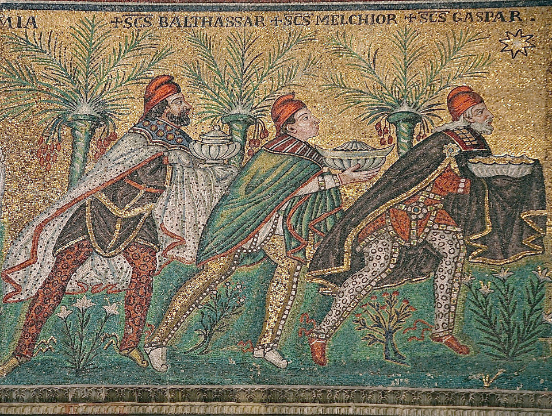

Now when I wear and appreciate Daniel’s sweatshirt that Marty gave me, I cannot help but see wise Zoroastrian priests seeking the Jewish God by following the “pure star” (zoro aster) which the Jewish Zoroastrian prophet Daniel may have initially shown them. And the phrase “Wise Men Still Seek Him” suggests that those today who seek insight from the stars (in astrology, horoscopes, etc.) or from Eastern religion and philosophies would also be wise to seek the Source of all wisdom in the Word made flesh, the Jewish Messiah, Jesus Christ our Lord.
[1] The term magoi is Greek and although the book of Daniel was originally written in Hebrew and Aramaic, the Greek translation (known as the Septuagint) uses the term magoi and this was the version that was widely read during the writing of Matthew’s Gospel.
[2] Magos is the singular form of the plural magoi.
[3] Jewish people continue to wear phylacteries, or tefillin, today. They are small leather boxes that contain parchments of Torah instructing them to keep the divine teachings always before them: Exodus 13:9, 16; Deuteronomy 6:8; 11:18.

 DANIEL DeFOREST LONDON