
Readings for the Fourth Sunday of Advent (Year C)
This sermon was preached at Christ Episcopal Church in Eureka CA on Sunday December 22, 2024.
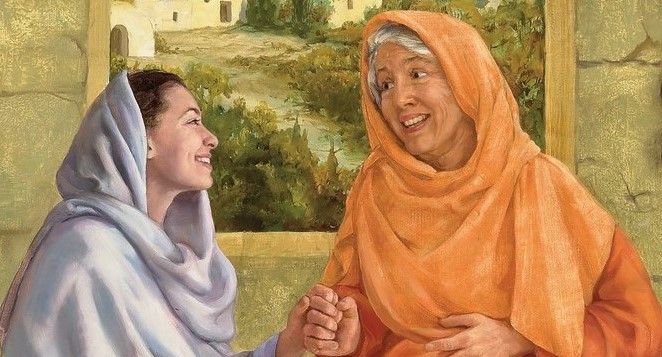
During my recent trip back East, I had the opportunity to sing Christmas Carols with Harvard students as well as visit my favorite Anglo-Catholic parish, St. Mary the Virgin at Times Square in New York City. Inspired by those experiences and the Scripture readings today, I would like to share with you a story about how St. Mary’s magnificent poem, the Magnificat, transformed the life of a young Harvard student and, in doing so, I invite us to let the power of this poem transform our lives.
The Harvard student was born in 1939 in Keene, New Hampshire and previously attended Virginia Military Institute, since his ancestors had served in the Revolutionary War and the Civil War, and his father, who was a medical doctor, served in WWII. After graduating from VMI as the valedictorian, he suffered from severe depression, which only deepened when he began his studies as a Harvard graduate student. While studying English literature at Harvard, he felt the enormous weight and grief of his father’s death, his family’s financial struggles, his sister’s emotional challenges, and his own profound identity crisis. The weight of all this anguish finally began to lift for him while he was attending a worship service at Church of the Advent in Boston. The student’s name was Jonathan Myrick Daniels and he described his experience at the Church of the Advent when he wrote, “I made a decision which radically changed my life. I decided to return to the church after having left her quite deliberately several years before. God followed that gift with another. As I felt his not-so-gentle nudge reminding me that I didn’t belong in the Graduate School where I was studying, I decided then to leave my program at the end of the year and in God’s good time to seek holy orders.” Jonathan left Harvard and returned to Keene to support his family; and then soon enrolled as a seminarian at the Episcopal Theological School back in Cambridge MA. During his second year as a seminarian, he heard the call of the Rev. Dr. Martin Luther King Jr. to clergy and seminarians to become more actively involved in the Civil Rights Movement. Daniels wrote, “There was trouble in Selma…and Dr. King had asked for Northern volunteers. Could I spare the time? Did I want to spare the time? Did God want?”
While asking himself these questions, Daniels attended Evening Prayer at the seminary and sang the words of the Magnificat. But he did not hear them as the quaint words of a mild-mannered Mary. Rather, he heard them as a fierce expression of tough-minded hope and as a call to follow Mary’s intrepid “Yes” to the Lord. He wrote the following:
“My soul doth magnify the Lord, and my spirit hath rejoiced in God my Saviour. I had come to Evening Prayer as usual that evening, and as usual I was singing the Magnificat with the special love and reverence I have always felt for Mary’s glad song. He hath showed strength with his arm. As the lovely hymn of the God-bearer continued, I found myself peculiarly alert, suddenly straining toward the decisive, luminous, Spirit-filled “moment” that would, in retrospect, remind me of others—particularly one at Easter three years ago. Then it came. He hath put down the mighty from their seat, and hath exalted the humble and meek. He hath filled the hungry with good things. I knew then that I must go to Selma. The Virgin’s song was to grow more and more dear in the weeks ahead.”
For several months in Alabama, he tutored children and invited young African Americans to attend the all-white St. Paul’s Episcopal Church in Selma; and developed deep relationships with people of color. One day, while he was engaged in this work of justice, he walked by a convenient store in Hayneville, Alabama, with a white Catholic priest and two black girls, Joyce Bailey and Ruby Sales. They had just come out of prison after being arrested on trumped-up charges for participating in a protest. So, they had just spent a week in a hot jail cell in Alabama with no food or water and they simply wanted to buy a soda at the convenient store called Varner’s Cash Store. As they were walking up the steps to the store, a man named Tom Coleman started yelling obscenities at them and cursing them. Tom Coleman them aimed a shotgun at sixteen-year-old Ruby Sales and pulled the trigger, but not before Jonathan Myrick Daniels jumped in front of Ruby and was instantly killed by the bullet in his abdomen. He was 26 years old. If he had not been shot, he would be 85 years old today. I had the privilege of meeting the woman whose life he saved: Ruby Sales, who is a nationally recognized social justice activist, scholar, and public theologian. She continues to work for social justice as well as voting rights for people of color, which was the primary objective that Jonathan Daniels and others were pursuing in the 1960s.

There is a sculpture of Jonathan Myrick Daniels alongside Mother Teresa, Rosa Parks, and Elie Wiesel at the National Cathedral in Washington DC; and Jonathan is one of the two American martyrs commemorated at Canterbury Cathedral’s Chapel of Martyrs, along with Dr. Martin Luther King Jr., who was still alive when Jonathan Daniels was shot and who said, “One of the most heroic Christian deeds of which I have [ever] heard in my entire ministry was performed by Jonathan Daniels.”
Every year, on August 14th, Episcopalians gather for a Jonathan Daniels pilgrimage which involves a walk to the convenient store, where he was shot, and the courthouse, where Tom Coleman was acquitted by an all-white and all-male jury. During one of these pilgrimages, Dr. Catherine Meeks, the Executive Director of the Absalom Jones Center for Racial Healing, reminded everyone that Jonathan Daniels did not seek to be a martyr. Rather, he sought to listen and be faithful and obedient to God’s call; and he sought to emulate the author of the Magnificat, St. Mary. He let the Virgin’s song grow more and more dear to him in and he let the power of the ancient poem compel him to give his life for the sake of another. Let us never dismiss the words of the Magnificat as simply quaint or pretty. May we remember how these words compelled Jonathan Daniels to leave the comfort of Cambridge and to help “put down the mighty from their seat, and exalt the humble and meek” in 1960s Alabama, even at the risk of his own life. May the fierce power of the Virgin’s song grow more and more dear to us so that we too can follow Jonathan’s and Mary’s intrepid “Yes” to the Lord. Amen.


 DANIEL DeFOREST LONDON