
Readings for the Second Sunday of Advent (Year C)
This sermon was preached at Christ Episcopal Church in Eureka CA on Sunday December 8, 2024.

This week, I was reading and reflecting on today’s Gospel, especially Luke’s words from the prophet Isaiah who says, “Every valley shall be exalted and every mountain and hill made low” (Luke 3:5; Isaiah 40:4). These tectonic words of Scripture became more real and palpable to me when we were hit hard on Thursday by an earthquake that felt particularly long, rolling, and turbulent, almost as if valleys were rising and mountains were contracting. This last week, the unsettling and unnerving aspects of Advent hit home in an unexpected way, forcing us all to wake up and pay attention.
Today, the Second Sunday of Advent, has traditionally been a time when we face the unsettling and unnerving aspects of the Advent season, the shadow side of Advent, which is indeed about anticipating the coming of Christ at Christmas, but which is also about anticipating the Second Coming of Christ at the end of the world, the Apocalypse, Judgement Day, the dreadful Day of the Lord, which the prophets so frequently foretell and warn us about, with fear and trembling. In our first reading today, the prophet Malachi asks, “Who can endure the Day of the Lord’s coming, and who can stand when he appears?”
The first biographer of St. Francis of Assisi was a Franciscan friar named Thomas of Celano who understood this shadow side of Advent and who wrote what has been called “the greatest judgment hymn of all time.”[1] The hymn is called the Dies Irae, which is Latin for “Day of Wrath,” and some say it was written specifically for the Second Sunday of Advent, today. This hymn is not found in our hymnals because fire-and-brimstone songs and sermons have not been in fashion for Episcopalians over the last several decades. However, for many centuries the hymn was used at virtually every Mass for All Souls as well as during Requiems and Funerals; and you can hear its opening four notes in popular films, during scenes of suspense or death, as in Star Wars, The Lion King, The Lord of the Rings, Jurassic Park, and even It’s a Wonderful Life. I’m going to ask our organist Avery to play the opening four notes on the organ for us right now if she doesn’t mind. The opening words of this Latin hymn translate to English as:
Day of wrath and doom impending,
David’s word with Sibyl blending!
Heaven and earth in ashes ending
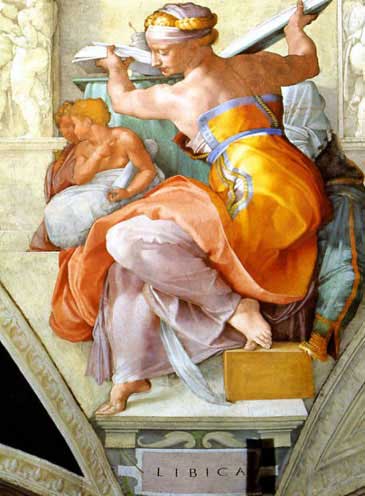
The reference to “David’s word” refers to the words of the Hebrew prophets who have foretold this Day of Wrath while the reference to “the Sibyl” refers to the words of the Ancient Greek female prophets who also foretold a Day of Judgement. The Sibyl, by the way, is the subject of my wife’s first book as well as the class she’s been teaching at Harvard Divinity School this year. If you ever visit the Sistine Chapel at the Vatican, you will see seven Hebrew prophets on the vault of the Chapel interspersed with five Sibyls: the Persian Sibyl, the Erythraean Sibyl, the Delphic Sibyl, the Cumaean Sibyl, and the Libyan Sibyl. These Sibyls were immensely popular during the Middle Ages and the Renaissance; and the Dies Irae contributed to their popularity. The Dies Irae concludes with these words:
Low I kneel, with heart submission.
Crushed to ashes in contrition;
Help me in my last condition!
Ah! that day of tears and mourning!
From the dust of earth returning,
Man for judgment must prepare him;
Spare, O God, in mercy spare him!
Lord all-pitying, Jesu Blest,
Grant them Thine eternal rest.
We do not know the day or time of the Second Coming, the Day of the Lord. Jesus himself said even he did not know, so let’s not claim to know more than Christ. In fact, that’s the main point repeated throughout Scripture about the Day of the Lord. We don’t know when it will come. Like an earthquake, it can arrive at any time, unexpected.
St. Paul believed that the Day of the Lord was imminent, bound to arrive in his lifetime. In our reading from Philippians, Paul refers twice to the coming Day of Jesus Christ (Philippians 1:6, 10). Now since the Second Coming of Christ did not occur in the first century and here we are now in the 21st century, we might be inclined to take these biblical teachings about the Day of the Lord very lightly. However, we ought not dismiss these teachings entirely because you and I will indeed stand before the judgment seat of Christ at an unexpected hour. Most of us do not know the day or the hour when we will die. And I say this out of love and a hope for long and healthy life, but you and I might die, even during this Advent season. You and I could die this week or even this day. I hope that that sobering truth wakes us up and keeps us awake spiritually, which is the main point of this biblical teaching, because for us, that will be the end of the world and that will be the Day of the Lord.
This day, for some, will be a Day of Wrath and Doom Impending, but for others that same day might be a day of great joy and delight, depending on how we orient our lives right now. If we are selfish and narcissistic and hateful and unjust, the Day of the Lord will feel like a Day of Doom. If we are selfless, compassionate, and loving, then the Day of Lord will feel like pure sunshine.
At the end of his book on Spiritual Friendship, St. Aelred of Rievaulx talks about the love of God that will be poured out upon everyone on the last day. He said, “For some this will feel like the sun and for others it will feel like the rain,” like pure sunshine or like a brutal storm. In his letter to the Philippians, Paul is filled with joy as he anticipates the Day of the Lord, that same day that the prophets and sibyls described as a Day of Wrath. Paul believes that the one who began a good work in us will bring that work to completion by the day of Jesus Christ. And Paul prays that our love may overflow more and more with knowledge and full insight to help us to determine what is best, so that in the day of Christ we may be pure and blameless, having produced the harvest of righteousness that comes through Jesus Christ for the glory and praise of God.
So, whether it be the Second Coming of Christ in this world or the Day of the Lord in our own personal lives and deaths, may we orient our hearts today and fill them to overflowing with love and knowledge and full insight, so that the inevitable Day of the Lord, which may arrive like an unexpected earthquake, may be for us, not a Day of Wrath, but a day of joy and refreshment and rest. Amen.
[1] Philip Schaff, Christ in Song (New York: Anson D. F. Randolph and Co., 1869), p. 372.

 DANIEL DeFOREST LONDON