
Readings for the First Sunday of Advent (Year C)
This sermon was preached at Christ Episcopal Church in Eureka CA on Sunday December 1, 2024.
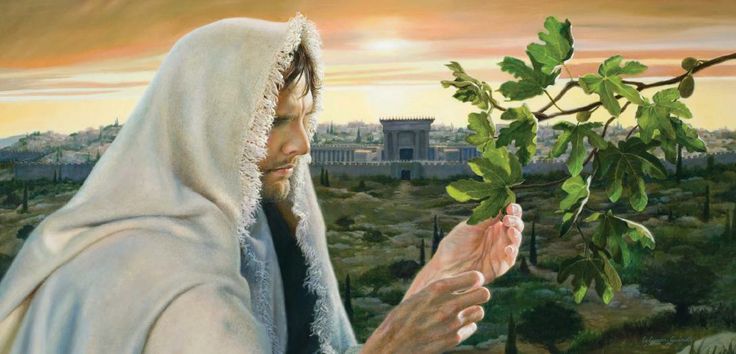
Today marks the beginning of a new liturgical year and the first day of the Advent season when we eagerly await and silently anticipate the coming, the Adventus, of the Christ. Tis the season to slow down enough to notice the signs of God’s coming Kingdom all around us. In the Gospel of Luke, which will anchor our Sundays throughout this year, Jesus today invites us to notice the signs of God’s kingdom and of our own redemption in the shining of the sun, in the gleam of the moon, in the glistening of the stars, and in the roaring waves of the sea. Jesus loves preaching about the natural world. He would have loved visiting Humboldt County. And then, just in case you’re doubting that Jesus was a Nature Mystic, he says, “Look at all the trees!”[1] So, during this season when many of us are putting up Christmas trees and perhaps even Jesse Trees in our homes, may we heed Christ’s call to indeed “Look at all the trees!” and may we receive the Christ-infused wisdom of the trees with open hearts.

After the Thanksgiving Eve Eucharist when Jesus in Matthew’s Gospel invited us to look at the birds of the air and the lilies of the field, a parishioner shared with me a poem written by E. E. Cummings, a Unitarian poet whose words resonate with today’s Scripture readings:
i thank You God for most this amazing
day: for the leaping greenly spirits of trees
and a blue true dream of sky; and for everything
which is natural which is infinite which is yes
(i who have died am alive again today,
and this is the sun’s birthday; this is the birth
day of life and of love and wings; and of the gay
great happening illimitably earth)
how should tasting touching hearing seeing
breathing any – lifted from the no
of all nothing—human merely being
doubt unimaginable You?
(now the ears of my ears awake and
now the eyes of my eyes are opened)
May God awaken our ears and open our eyes as we look at all the trees and thank God for their leaping greenly spirits this Advent season.
Another poem that resonates with today’s readings is one written by a German author whom I have recently been rediscovering: Herman Hesse, who wrote a book on St. Francis of Assisi as well as the Buddha, and whom our own Mary McNelis met when her husband was writing a book about him at Oxford, titled Hermann Hesse as Humanist by John Christopher Middleton. Hesee wrote a poem titled “Trees” and it goes like this:

Trees, for me, have always been the most compelling preachers… The world rustles in their uppermost branches, their roots rest in the infinite, but they do not lose themselves in either, they work with all the strength of their lives toward just one thing: fulfilling their own law that lives within them, shaping their own form, becoming their own selves. Nothing is more sacred, nothing more exemplary, than a strong and beautiful tree.
When a tree is cut down and shows its fatal wound naked to the sunlight, we can read its whole history in the bright disk of its trunk and gravestone: in its annual rings and deformities are faithfully recorded all the struggle, all the suffering and illness, all the joy and flourishing, the lean years and rich years, attacks withstood and storms outlasted. And every farm boy knows that the hardest, noblest wood has the narrowest rings, and that the most indestructible, strong, and most exemplary trunks grow high in the mountains, in constant danger.
These words remind me of the words of Jesus who says today, “When these fearful and foreboding things begin to take place, stand up and raise your heads high, because your redemption is drawing near” (Luke 21:28). Hesse’s poem continues,
Trees are holy. If you know how to talk to them, how to listen to them, you will learn the truth. They preach not doctrines and rules: they preach, with no concern for details, the primal law of life. A tree says: Hidden in me is a seed, a spark, a thought. I am life from eternal Life…My task is to give shape to the eternal, and to show that shape in its unique, distinctive particularity. A tree says: My power is trust…I live out the mystery of my seed to the very end…I trust that God is within me. I trust that my task is a holy one. I live from this trust.
When we’re sad and have difficulty enduring our life any longer, a tree can say to us: Be quiet! Be at peace! Look at me! Life is not easy, nor is it hard. Those are childish thoughts. Let God speak within you while you stay silent. You are scared because your path seems to be leading you away from your mother and your home. But home is not here or there. Home is inside you, or else it is nowhere.
Remember Jesus said, also in Luke’s Gospel, “The coming of the kingdom of God is not something that can be observed, nor will people say, ‘Here it is,’ or ‘There it is,’ because the kingdom of God is within you” (Luke 17:21). The poem continues:
A fierce desire to wander and roam tugs at my heart when I hear the trees rustling in the evening wind. If you listen long and closely, this longing to travel, too, reveals its seed, its meaning. It is not, as it seems, a longing to run away from your sorrows. It is a longing for home, for the memory of your mother, for new images and parables for life. It leads you back home. Every path leads home, every step is a birth, every step is a death, every grave is the mother. That is how the tree rustles in the evening, when our own childish thoughts are scaring us. Trees have long thoughts—drawn out, calm, long of breath—the same way they have longer lives than we do. They are wiser than we are, at least than we are when we do not heed them. But once we’ve learned how to listen to the trees, the brevity and speed and childish haste of our thoughts attain a gladness without equal. Those who have learned to listen to trees no longer want to be a tree. They do not yearn to be anything but what they are. That is home. And that is happiness. [2]
In today’s Gospel, Jesus uses apocalyptic imagery to prophesy the destruction of the Jewish temple, which will be the tragic loss of the center of the Jewish world, but then he says, “When you lose these things that can so easily become idols, that’s when you know the kingdom of God is near, because when we lose all our false identities (which will all fade away in the end), we enter the process of discovering and claiming our true and ultimate identity as God’s beloved.” The kingdom of God is near because we are giving God’s voice of love supremacy over all other voices. Sometimes, it’s when we are forced to let go of all those other sources of identity and value and self-worth that we learn to rest in who we truly are. Like the trees, we do not yearn to be anything but what we already are: God’s beloved. That is home. And that is happiness. This Advent, I invite us all to obey Jesus by looking at the trees, listen to their wisdom, and coming home. Amen.
[1] In Matthew and Mark, he says, “Learn your lesson from the fig tree” (Matthew 24:32; Mark 13:28), but in Luke, Jesus says, “Look at the fig tree and all the trees!” (Luke 21:29).
[2] Herman Hesse, Trees: An Anthology of Writings and Paintings by Herman Hesse, translated by Damion Searls (Kales Press: San Diego, 2024), 1 – 3.

 DANIEL DeFOREST LONDON