
Readings for the Twentieth Sunday after Pentecost (Year B – Track 1 – Proper 22)
Job 38:1-7, (34-41)
Psalm 104:1-9, 25, 37b
Hebrews 5:1-10
Mark 10:35-45
This sermon was preached at Christ Episcopal Church in Eureka CA on Sunday October 6, 2024.
Happy St. Francis weekend! The saint’s feast day was Friday October 4th, but we Episcopalians like to celebrate him all weekend since he is the most beloved and admired saint in the entire church; probably the least imitated, but the most celebrated. It was a joy to celebrate his feast day with Bishop Megan and a throng of people and pets from all over the deanery at Sequoia Park yesterday for the Blessing of the Animals and our Sacred Saunter. I realize I have probably preached on St. Francis more than any other saint and I feel invited to preach on him again today, trusting that he can help illumine today’s Gospel.
Over the last couple weeks, I’ve been translating a German novel by one of my favorite authors, Herman Hesse, who wrote books such as Siddhartha and Demian and Steppenwolf, books that have been tremendously formative for me. I recently learned that Hesse wrote a novel on St. Francis titled Franz von Assisi, which has not been translated to English as far as I know. So, I’ve been trying to translate it myself out of eager curiosity. I shared a portion of the translation yesterday at the Saunter; and today I want to share a phrase from the novel that grabbed my attention. The phrase is die Gewalt seiner demütigen Liebe, which translates literally to “the violence of humble love.” A tamer translation would be “the power of humble love,” but Gewalt means “violence.” The evocative phrase “the violence of love” was also used by Oscar Romero, an archbishop who was martyred for standing up vehemently for the poor and vulnerable in El Salvador; and Pope Francis recently canonized Romero as a saint. Herman Hesse uses the phrase in a similar context, saying, “The violence of humble love compelled Francis to embrace the lowest, the most despised, and the most vulnerable.” Francis embraced and even kissed the lepers who previously disgusted him. He stood up for the weak and the vulnerable by becoming poor and vulnerable himself. His passion compelled him to pray for and protect the last, the lost, the least.
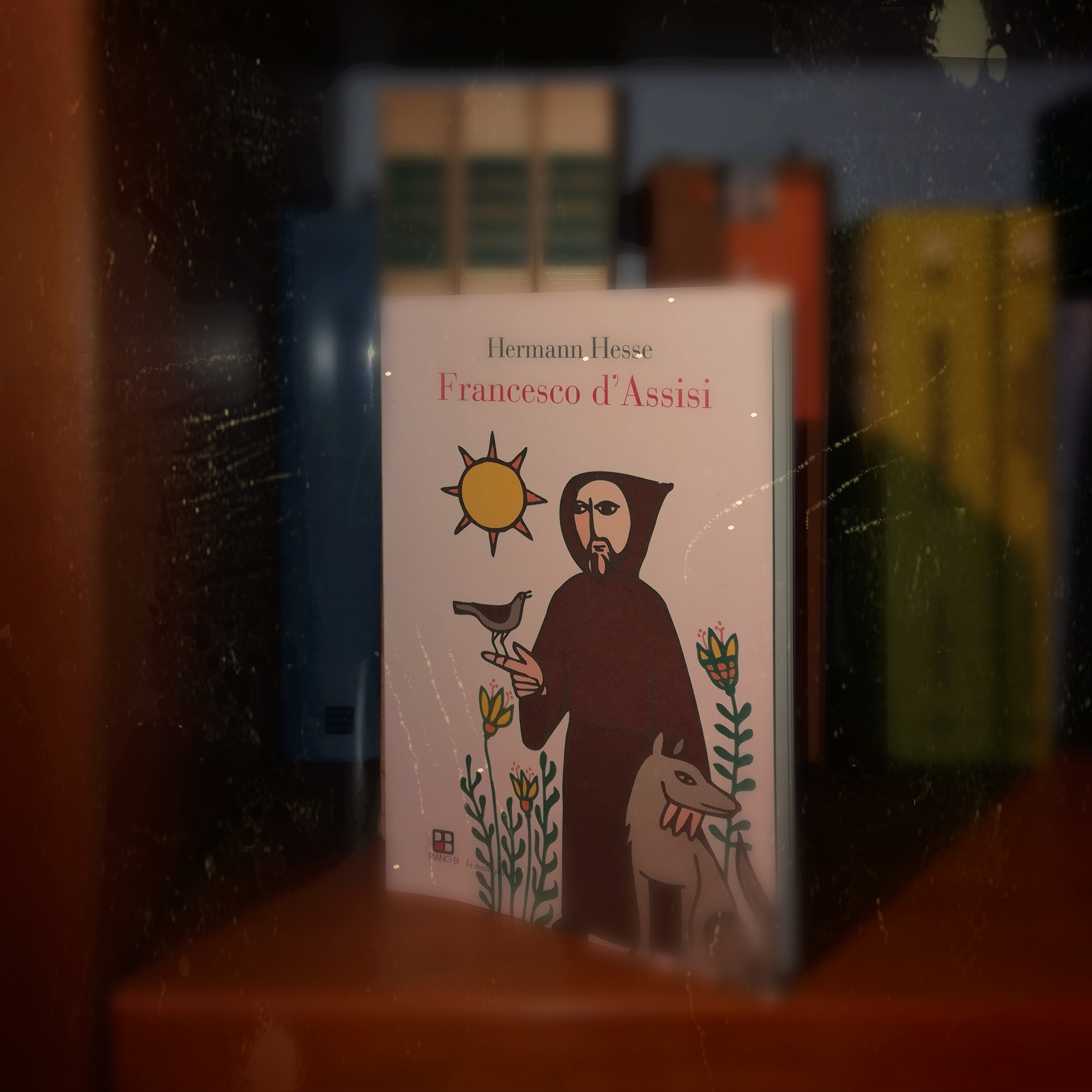
Now of course Francis and Romero certainly did not advocate any forms of physical violence, but Herman Hesse and Romero both believed that the force of humble love was so potent that the word “violence” was the only one that could do it justice.
It is this passion for helping the vulnerable, this “violence of humble love,” that can help us understand Christ’s teachings today as well as this series of challenging teachings from Mark’s Gospel. Two Sundays ago, while the disciples were arguing about who was the greatest, Jesus took a child in his arms and said, “Let me tell you about true greatness: Whoever welcome child like this in my name welcomes me.” And then last Sunday, Jesus used undeniably violent language to condemn those who put children and other vulnerable people at risk. He was still holding the child in his arms as he said these words. In today’s Gospel, Jesus has moved to a different location, “into the region of Judea and beyond the Jordan” (Mark 10:1), but his message remains consistent. He continues to stand up vehemently for the poor and vulnerable. This is how we ought to understand his teachings on divorce.
Jesus said, “Whoever divorces his wife and marries another commits adultery against her.” Our former bishop was twice divorced; and I have officiated weddings between people who have been previously divorced. Does that mean our diocese and I sanction adultery? No. It’s important to look at the context of Christ’s teachings. Once again, he is speaking up vehemently for the most vulnerable people. During Jesus’s day, there were two major rabbinic schools: the school of Rabbi Shammai and the school of Rabbi Hillel. Shammai was generally the conservative rabbi while Hillel was the liberal, with whom we often associate Jesus. But in this case, Jesus agrees with Rabbi Shammai. Shammai insisted that the only grounds for a man to divorce his wife was infidelity while Hillel said that a man could divorce his wife “for any cause whatsoever.” During this time, wives generally could not divorce their husbands, but if a man could divorce his wife for whatever reason he wanted (even overcooking dinner or just losing interest in her), then the woman would be always vulnerable to divorce, which would lead to social ostracism and economic destitution. So, here Jesus is interpreting the Torah in a way that helps protect women and their rights.
Jesus is compelled by the power of humble love to stand up for the vulnerable. That is what Jesus is doing all throughout the Gospels. So, when Christians use passages like this to attack and condemn and exclude traditionally vulnerable communities, such as those who have been divorced and/or those who are part of the LGBTQ community, they are working against the consistent mission of Jesus Christ.
Sadly, followers of Christ have been doing this since day one. In fact, we see Jesus’s very disciples doing this: completing missing the point by speaking sternly against the people who simply wanted to bring their vulnerable children to Jesus for a blessing, much like those who were blessed by the bishop yesterday. When Jesus saw this, he was eganaktesen (ἠγανάκτησεν from the word aganakteo), which means deeply vexed. Compelled by the vehemence of his love for the vulnerable, he said, “Let the little children come to me; do not stop them. When you try to stop them, you are working against the kingdom of God.” And Jesus took the children in his arms and blessed them.
How are you being called and compelled by the gewalt of humble love to protect and bless the vulnerable? One way to answer this question and to make ourselves more fully available to the power of humble of love is to pray the prayer attributed to St. Francis. Although Francis was indeed a poet whose beloved Canticle of the Sun will be enjoying its 800-year anniversary next year, the prayer known as the Prayer of St. Francis was not written by him, yet it captures his spirit beautifully.
This is one of those prayers that you need to be careful about praying because God will answer your prayer when you pray the Prayer of St. Francis. God will seize you with the gewalt of his humble love. The prayer is written on the cover of your bulletin on the image of a plaque that hangs in the sacristy here at Christ Church. So, if you dare, pray aloud with me these words:
“Lord, make me an instrument of thy peace. Where there is hatred, let me sow love; where there is injury, pardon; where there is doubt, faith; where there is despair, hope; where there is darkness, light; and where there is sadness, joy. O Divine Master, grant that I may not so much seek to be consoled as to console; to be understood as to understand; to be loved as to love; for it is in giving that we received, it is in pardoning that we are pardoned, and it is in dying that we are born to eternal life. Amen.”


 DANIEL DeFOREST LONDON