
This article was written for the October 2024 Chronicle newsletter for Christ Church Eureka.
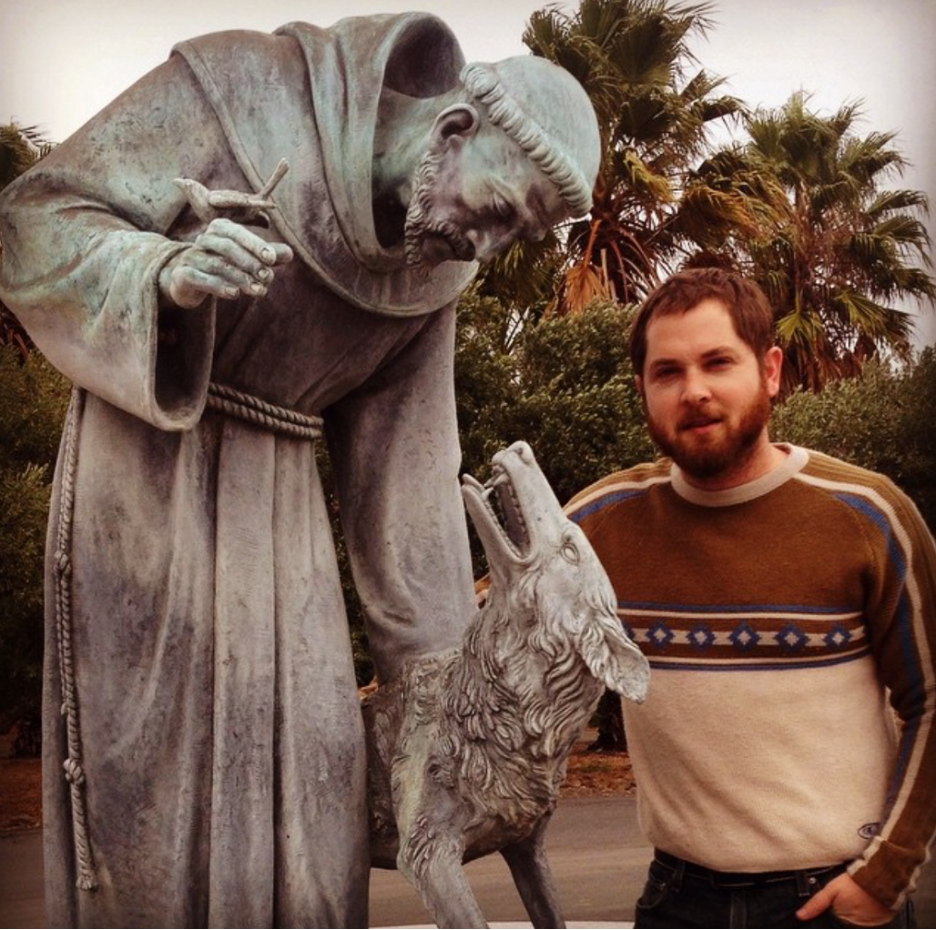
St. Francis and Forest Therapy
In the first biography of St. Francis written by Thomas of Celano in 1230, four years after Francis died, we see evidence of the saint’s love for the forest. Along with reporting the saint’s famous sermon to the birds, Celano also recounts a dream that Francis had of a mighty tree whose beauty inspired awe and wonder. Through his interaction with the tree in the dream, Francis felt deeply affirmed him in his vocation and in the vocation of his fellow friars. In the 14th century anthology known as The Little Flowers of St. Francis, we see how intimately connected the forest was to prayer for Francis and the friars. Francis and his brothers were frequently described as praying and contemplating in the woods, sometimes pouring out their tears, sometimes sighing and crying aloud, sometimes rapt in ecstasy with an army of saints and angels, and sometimes celebrating Mass as we do during our Sacred Saunters.
In Francis’s own words from his poem The Canticle of Brother Sun, we learn about his appreciation for Brother Sun whose beams radiate through the forest, and Brother Wind who sings through the rustling of the tree’s branches, and Sister Mother Earth who nourishes and sustains the trees, fruits, and flowers. Francis saw all of these as expressions of his fellow creatures’ praise for their Creator and they each deepened his love and gratitude for “the Most High, all powerful, good Lord.”
Francis’s first modern biographer Paul Sabatier (1854 – 1941) wrote that the “pure air of the forest must have been good for his physical well- being.” Although Francis was not preoccupied with his physical wellbeing and the health benefits of being in the forest, I imagine he still would have appreciated the modern-day practice of Forest Bathing since it has been shown to deepen our sense of gratitude and empathy.
The first invitation in Forest Therapy is to give thanks for the land and the caretakers of the land, including the indigenous tribes who may have tended the land centuries ago. Francis concludes his Canticle of Brother Sun, which is considered the first poem written in the Italian vernacular, by saying, “Praise and bless the Lord, and give Him thanks, and serve Him with great humility.” Gratitude was an essential practice for St. Francis as it is in Forest Therapy. While Francis may not have been concerned with physical health benefits, it’s worth acknowledging that trees release phyton chemicals called phytoncides[1] that not only protect them from rotting, but also provide health benefits for us. Scientists have discovered that when we breathe in these phytoncides which the trees release, our bodies respond by increasing the number and activity of the white blood cells called natural killer cells, which kill tumor-infected and virus-infected cells. Phytoncides also reduce our cortisol levels,[2] temper inflammation, improve cognition, enhance sleep, relieve anxiety and depression, help regulate blood pressure, and even boost empathy. In the 1980s, Japanese scientists found that exposure to trees and their phytoncides served as an effective eco-antidote to urban and technological burnout. Rooted in their Shinto and Buddhist practices, they began encouraging a practice called shinrin-yoku,[3] which means “forest bathing,” bathing in the phytoncides. According to the early accounts of St. Francis and the friars, they were forest bathing. Or perhaps more appropriately, they were forest praying.
The second invitation in Forest Therapy is to be present to the forest by engaging all five senses in what Forest Therapy Guides call “Pleasures of Presence” or “Embodied Awareness.” We are invited to smell the aromas of the forest and hear its music in the birds and trees, to notice what the forest air feels like as it touches our skin, and to taste the air by drinking it in, perhaps through an imaginary straw. We are then invited to close our eyes and turn in a direction that our hearts prompt us, only to open our eyes again slowly to receive all that we see as if it were a painting made especially for us by someone who loves us very, very much. In this process, we are invited to get in touch with our sixth sense, our heart sense. We get in touch with this sense simply by placing our hands on our hearts and noticing what emerges within us. In his book St. Francis and the Song of Brotherhood, Eric Doyle writes about Francis and the heart sense, saying “Francis found himself endowed with the sixth sense of heartsight, or what he himself described as ‘the eyes of the spirit.’”[4]
One of the intentions of The Pleasures of Presence invitation is to help participants reconnect with the heart and body. In his pursuit of spiritual perfection, Francis had become fairly detached from his body, which he referred to as “Brother Ass.” In the Italian town of Greccio, Francis reflected on the Christmas mystery of the Word becoming flesh, a holy event that elevates the human flesh as a vehicle for divine glory. Though he was only 41 years old, his body was in decline because of severe fasting and self-denial. It was around this time in his life that he began to finally listen lovingly to his body. Inspired by the affirmation of the human flesh revealed in the Incarnation, he spoke to his body and said these words: “Rejoice, brother body, and forgive me for all the ways I have ignored you. I now give you my loving attention and hasten to heed to your complaints.”[5] Unfortunately, the damage had already been done and he died only a few years later, but not after leaving his legacy in the town of Greccio, a legacy that remains alive today, a legacy that invites us all to be in our bodies and to discover God’s presence with us here and now, even in “Brother Ass.”
This Italian deacon’s legacy is a deeply Anglican one, as Anglican author C. S. Lewis affirmed when he later elaborated on the deacon’s name for his body. Lewis said, “Ass is exquisitely right because no one in his senses can either revere or hate a donkey. It is a useful, sturdy, lazy, obstinate, patient, lovable and infuriating beast; deserving now a stick and now a carrot; both pathetically and absurdly beautiful. So [too] the body.”[6] The experience of being in a human body is one that God Himself wanted to experience and enjoy; and in so doing, God made it possible for us to experience union with him right here and right now, in these vessels
Anglicans call this “incarnational piety,” a piety based on the Gospel of John which affirms that the Word became flesh. Towards the end of his life, St. Francis wanted the people of Greccio to appreciate the gift of the Incarnation, to experience God in their bodies in the present moment, by creating the first Nativity scene ever, which was a live Nativity scene, and which has become perhaps the most popular Christmas tradition in the world. If you go to Greccio today and visit what is called the Chapel of the Crib, you will see a fresco of the first Nativity scene, with St. Francis kneeling beside an Italian baby who played the role of Jesus. St. Francis the deacon is appropriately dressed in a dalmatic. This Anglican and Franciscan emphasis on the Incarnation invites us to experience God’s loving presence in our bodies, in our breath, in our heartbeat, and in all the pathetic and absurd beauty of this human flesh.
I invite you to join us for the St. Francis Sacred Saunter this weekend with Bishop Megan; and I invite you to spend time among the trees, praying, practicing gratitude, and being present to the forest and your own body by engaging all your senses: smell, sight, hearing, touch, taste, as well as your heart sense. Try to spend at least a half hour in the forest or beside a tree and then prayerfully read Francis’s Canticle of Brother Sun, which I’ve included below. This poem, the first written in Italian, was composed in 1225, so it is approaching its 800-year anniversary! After spending some time in the forest, you may want to write your own verse or verses, inspired by your personal experience in the forest. You don’t need any previous experience in writing poetry to do this. Just write whatever emerges from your experience of practicing presence, gratitude, and prayer in the forest, like St. Francis and his fellow friars.

[1] Volatiles organic compounds (VOCs) or “essential oils” that have antimicrobial and insecticidal qualities that protect the tree from germs and parasites.
[2] Cortisol is the body’s main stress hormone.
[3] In the word Shinrin (forest)the “r” is pronounced like our “d.”
[4] Eric Doyle, St. Francis and the Song of Brotherhood, 45.
[5] James Wiseman, “The Body in Spiritual Practice: Some Historical Points of Reference” in Reclaiming the Body in Christian Spirituality, edited by Thomas Ryan (Mahwah NJ: Paulist Press, 2004), 7.
[6] C. S. Lewis, The Four Loves, 93.

 DANIEL DeFOREST LONDON