
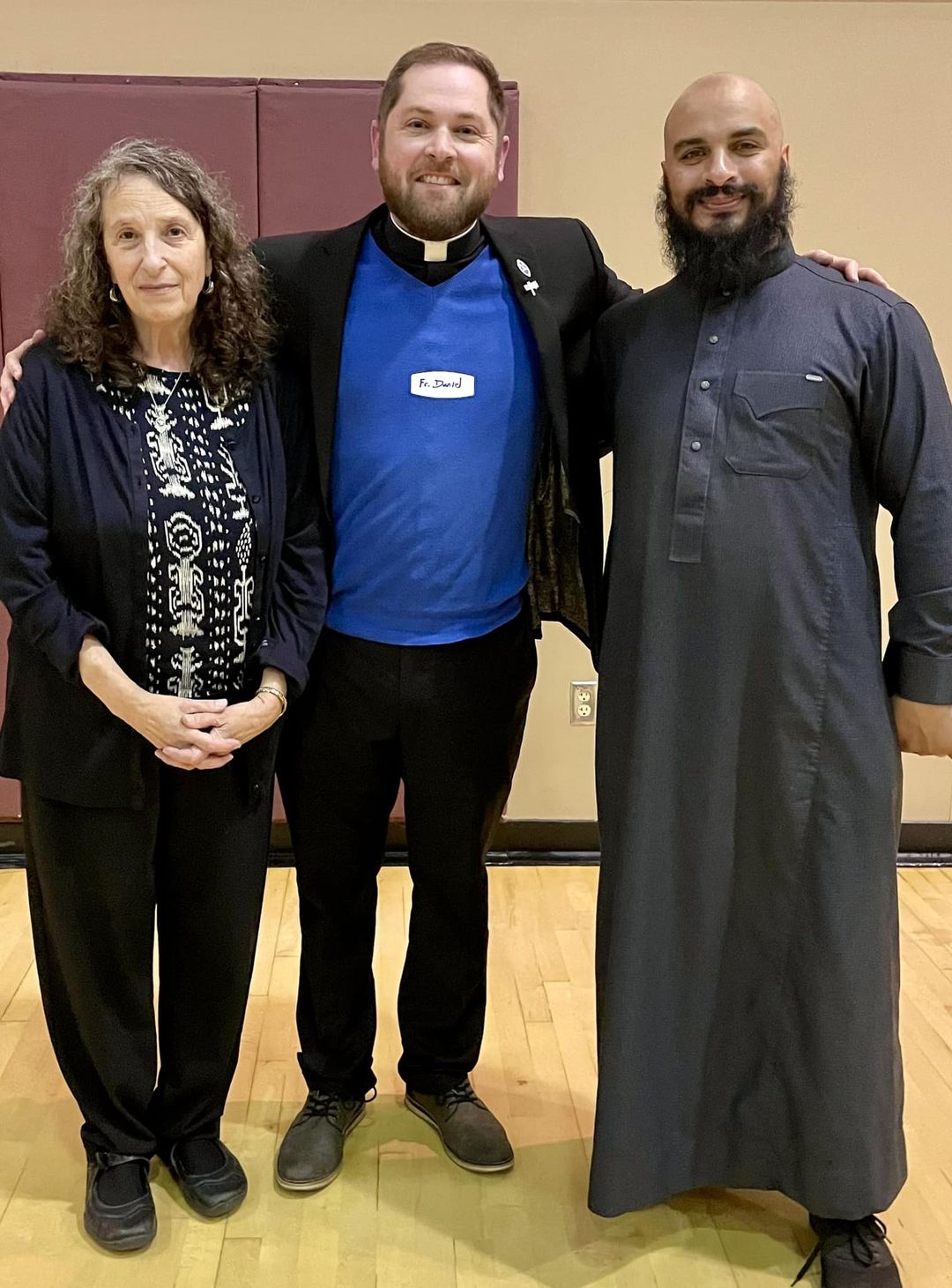
These remarks were written for “Let’s Talk About Palestine and Israel: A Community Conversation” at the Arcata Community Center as part of a panel with Rabbi Naomi Steinberg and Imam Abubakr Elgarguri. They are primarily responses to two questions: Whose Holy Land? and What Would Peace Look Like?
Opening Remarks
Thank you, Imam.
Thank you, Rabbi.
Thank you all.
I’m going to share my experience; and I do speak on my own behalf.
I am the rector of Christ Episcopal Church in Eureka and a follower of Jesus Christ, a rabbi who is honored in Islam and who was a very good Jew.
I want to say that I’m going to share two experiences, my two experiences of visiting the Holy Land; and just say that I’ve been going through transformations in my understanding, the layers of the onion to peel; and I’m going through transformation right now.
I appreciate everything that has been shared and it’s also driven home the difficult reality that this is very hard to talk about in a respectful and civil way.
Thank you for listening.
I believe that’s the first step….
Whose Holy Land?
With over 2 billion members worldwide, the global Christian community also has a broad diversity of opinion and belief when it comes to the Holy Land. I had the experience of visiting the Holy Land with Christian Zionists and then later with Palestinian Christians, two groups that represent opposite ends of the diverse spectrum of Christian beliefs regarding the region.
I first visited Israel twenty years ago with a group of Christian Zionists who call themselves Messianic Jews, Jews who believe that Jesus is the promised Messiah.[1] Although there is variation of beliefs among Messianic Jews, they generally understand the formation of the state of Israel[2] and the return of the Jewish people to the land as a fulfillment of biblical prophecy.[3] For them, the existence of Israel not only confirms the divine truth of the Bible, it also energizes them with a sense that God’s hand is at work in modern-day politics and that they can be a part of God’s plan by supporting Israel. Messianic Jews and Christian Zionists are deeply invested in Jewish people resettling the land because many see this as a necessary step that must take place before the Jewish people accept Jesus as their Messiah and thus fulfil their interpretation of St. Paul’s words in the Book of Romans when he says, “A hardening has come upon Israel until the full number of Gentiles have come in; and then all Israel will be saved” (Romans 11:26 – 27). Christian Zionists, of course, understand this “salvation” for Israel as salvation through the death and resurrection of Jesus Christ. Since a great deal of anti-Jewish violence throughout history has been instigated and fueled by the church in the Name of Christ, this prophecy of Jews eventually accepting Jesus as the Messiah is problematic to say the least and frankly offensive. However, although they may have very different goals in sight, many Jewish Zionists (not all) have accepted the support of Christian Zionists in the Jewish resettlement of the Holy Land. So, in answering the question “Whose Holy Land?” Christian Zionists and Messianic Jews would say it belongs to the Jews.
Six years later, I visited the Holy Land again, but this time (as an Episcopalian and Anglican) with a Christian ecumenical non-violent liberation theology organization called Sabeel, founded by a Palestinian Anglican priest.[4] In answering the question “Whose Holy Land?” these Christians would say it belongs to the Palestinians, who had already been living there for centuries.[5] With Sabeel, I learned the perspective of Palestinian Christians, whose story begins in the biblical book of Acts at the Council of Jerusalem (about 50 CE), when Jewish Christian leaders decided to allow non-Jews into the Church, without having to convert to Judaism. Many of these non-Jewish Christians remained in Judea after Rome destroyed the second temple in 70 CE and they stayed in the land when it was renamed Palestine.[6] These Palestinian Christians lived in relative peace, even when Islam took over the territory in the seventh century.[7] Under tolerant Muslim rule, the Palestinian Christians, Jews, and Muslims lived harmoniously together, for the most part. After World War I, the British took over the land,[8] eventually promising independence to Palestinians while also promising a homeland for Jews on the same land of the Palestinians. The British and then the US equipped the state of Israel with enough military strength to fight the neighboring Arab countries and to treat the Palestinian Christians and Muslims as “less than human.” As more Jews moved in, many Palestinian homes were bulldozed, and neighborhoods were destroyed. And, after learning how to farm from the Palestinians, the Israelis seized the fertile plots of the land, leaving Palestinians with the barren territories.[9] Many Palestinian territories now lack sufficient water supply, medical access, and other necessary resources for adequate living. From their perspective, Israel practices “apartheid” by constructing walls of separation in the name of “security,” herding Palestinians through humiliating and dehumanizing checkpoints and then branding them as “terrorists” whenever they attempt to stand up for their rights.[10] Also, any expression of sympathy for Palestinians is often condemned as antisemitism. Palestinian Christians, who experience oppression from Israel, emphasize the fact that Jesus also lived in that same region when it was occupied by the oppressive Roman empire, an empire that had him crucified for the crime of rebellion and sedition.
What would peace look like?
I see peace in the Holy Land being rooted in the recovery and the reclaiming of the Jewish prophetic tradition, a tradition in which Jesus clearly saw himself, a tradition that emphasizes care for the poor and the vulnerable and that condemns idolatry, a tradition that is not afraid to speak truth to power and to criticize political leaders when they prioritize their own selfish and idolatrous greed over the health and wellbeing of other vulnerable human beings. Many Israelis are already involved in this prophetic work (Jewish Voice for Peace, Rabbis for Human Rights, etc.), voicing their criticism of Netanyahu and his policies. I believe followers of Christ can support Israel’s right to exist and defend itself while also calling Israel out on their flagrant denial of human rights for Palestinians. In fact, I’m inclined to believe Jesus the prophet would be doing just that.
Authentic peace requires a willingness to listen to another’s perspective, to tell the truth, to refrain from all forms of scapegoating and demonizing and dehumanizing, and to acknowledge the ways that we have failed to live up to our ideals. For me, as a Christian, this involves acknowledging and repenting of the horrific forms of Christian antisemitism and Islamophobia that have plagued and still plague our church. As an Anglican, this involves acknowledging the colonial history of the British empire, which played a significant role in creating the modern Middle East conflict in the first place. As a US citizen of European descent, this involves acknowledging and repenting of my ancestor’s involvement in the removal and genocide of indigenous tribes on this land in the name of Manifest Destiny. Whenever anyone in the US points their finger at Israel, they should always be aware that they’re pointing three fingers back at themselves.
Anglican archbishop Desmond Tutu said, “There can be no healing without truth” and another Episcopal bishop recently said, “You have to tell the whole story before you can write a new story.” I don’t know exactly what peace in the Middle East would look like, but I believe it must include the freedom and safety to tell the whole truth even when it’s very difficult.
[1] My father grew up Jewish and became a Christian through a Messianic Jewish group known as Jews for Jesus.
[2] Yom HaAtzmaut (May 14, 1948) Israel’s Independence Day
[3] “For I will take you from the nations, gather you from all the lands and bring you into your own land.” Ezekiel 36:24; The Valley of Dry Bones – Ezekiel 37 :1-14; “For I will restore them to their own land which I gave to their fathers” Jeremiah 16:15
[4] The Reverend Naim Ateek.
[5] Although Jerusalem has been and remains the premiere pilgrimage destination for Christians (featuring the Church of the Holy Sepulcher, the Via Dolorosa, the Garden of Gethsemane, the Garden Tomb, the Church of the Nativity in Bethlehem, the Basilica of the Annunciation, Capernaum in Galilee, Mount of Beatitudes, Mount of Olives, etc.), Christians generally do not attach the same level of significance or sense of ownership to the land itself as much as Israelis and Palestinians. Holy sites remain important; however, one of the Christian holy sites is the Church of Jacob’s Well, which is where Jesus spoke with a Samaritan woman about sacred religious sites and told her that “True worshippers will worship the Father in spirit and truth…God is spirit, and those who worship him must worship in spirit and truth” (John 4:23). This teaching of Jesus invites Christians to focus more on the spiritual presence of God which can be accessed anywhere rather than on specific geographic locations, including the Holy Land. One of the ancient Desert Fathers Abba Sisoes said, “Seek God, and not where God lives.”
[6] After the second temple was destroyed, Rome renamed Jerusalem “Aelia Capitolina” and renamed Judea “Palestine” after the Jews’ long-lasting enemy, the Philistines.
[7] It is worth mentioning that the most sacred site of all for Christians is the Church of the Holy Sepulcher, the traditional site of the passion, death, and resurrection of Christ. The family that has held and continues to hold the keys to the Church is a Sunni Muslim family, a neutral guardian for a site that is sacred to so many Christian denominations.
[8] The land was previously ruled by the Ottoman Empire.
[9] Palestinian families who have been living on the land for centuries were treated like foreigners who should starve to death or “get the hell out.”
[10] Because of their military superiority, the Israelis have taken over more and more territory, kicking out and often slaughtering unarmed Palestinian women and children in the process. Whenever Palestinians attempt to fight back or stand up for their rights, they are branded as “terrorists” by Israel and by the rest of the world. The US, in particular, staunchly supports Israel fiscally and militarily, even when the Israeli government continues to violate the basic human rights of Palestinians. Because Jews and Israelis have the power and money to influence the world media, the truth of Palestinian oppression under Israeli occupation remains cloaked under the guise of Israeli security from Palestinian terrorism.

 DANIEL DeFOREST LONDON