
Readings for the Fifteenth Sunday after Pentecost (Year B – Track 1 – Proper 17)
Song of Solomon 2:8-13
Psalm 45:1-2, 7-10
James 1:17-27
Mark 7:1-8, 14-15, 21-23
This sermon was preached at Christ Episcopal Church in Eureka CA on Sunday September 1, 2024.

“There is nothing outside a person that by going in can defile, but the things that come out are what defile.” Mark 7:15
This morning, I’d like to begin by inviting us to take some breaths together: to inhale through our noses and exhale through our mouths. Notice what it’s like to be alive this morning, to be in your body, to be able to breathe and hear and see and smell. Now I invite you to breathe in the comfort of God’s love and breathe out compassion. Inhale God’s love and forgiveness and exhale whatever you need to release and forgive this morning. The readings today invite us to breathe mindfully and prayerfully insofar as they invite us to sing and to smell the flowers and to be aware of what we are putting out into the world.
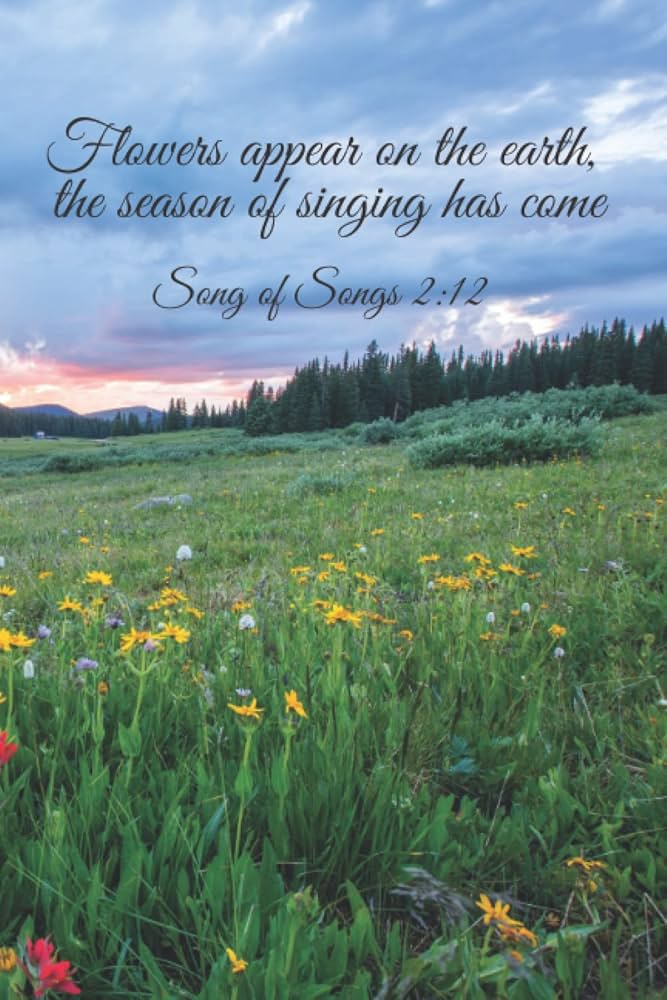
The reading from the Hebrew Scriptures is a portion of the Song of Solomon, which I mentioned a couple Sundays ago when we read of King Solomon, the traditional author of this book, asking God for wisdom, which is personified in the Bible as a woman singing and dancing with the Lord. Our Sunday lectionary includes only one or sometimes two selections from this book every three years, which is unfortunate because the Christian monks and mystics and Jewish mystics consider this book to be the Bible’s Holy of Holies, the poetic expression of our soul’s union with the divine. On the surface, the Song of Solomon is a poem celebrating erotic love, but the mystics read it allegorically. My wife and I had a portion of the book read at our wedding and I thought of today’s reading at Natalie and Chance’s wedding last Saturday, which was a day that began with heavy rains that subsided just in time for the ceremony when the clouds parted and the sun came out: “The rain is over and gone…the time of singing has come.” Because we so rarely spend time with this book, I felt inspired this week to read and translate today’s portion from the original Hebrew and I’d love to share the Hebrew and translation with you. And as I do, I invite you to let these ancient words of poetry wash over you as you breathe them in:
Shir HaShirim, Asher LiShlomo
The Song of Songs, which is Solomon’s Chapter 2:8-13
Qol dodi, Hineh-ze ba (8a)
The voice of my beloved, behold! he comes
M’daleg al heharim m’qafetz al hagbaoth (8b)
Leaping over the mountains towards me, skipping across the hills
Domeh dodi litzvi o l’opher ha’ayalim (9a)
Resembling, my beloved, the beauty of a gazelle or a stag
Hineh-ze omed (9b)
Behold! Now he has arrived
Acher catlenu mashgiach min hachalonoth metzitz min hacharakim (9c)
Now leaning on the wall of my house, peeping through my window
Anah dodi, v’amar li (10a)
Crooning, my beloved coos and cries out
Qoomi lak rayati yafati, oolki lak (10b)
Arise, my beautiful lover, and come away with me!
Ki-hineh hastan avar (11a)
Look, the winter is over
Hageshem chalaph halak lo (11b)
And the rains have stopped for good
Hanitsanim niroo baaretz (12a)
The wildflowers are longing for our appreciation
Et hazmir higia (12b)
And they seem to be singing
V’qol hator nishma bartzenu (12c)
Singing in harmony with the voice of the turtledove
Hatenu chantah fagenah (13a)
The fig tree wants us to pluck and eat her delicious flowers
V’hagfanim smadar natnu reyach (13b)
And the grape vines are just asking to be smelled and caressed
Qoomi lak rayati yafati oolki lak (13c)
Arise, my beautiful lover, and come away with me!
In today’s reading, the lover urges his beloved to get outside, and smell the flowers, and eat the figs, and caress the grapes on the vine, and breathe in the fresh air. It’s an invitation to forest bathing. One of the greatest interpreters of the Song of Songs is St. Bernard of Clairvaux, the 12th century Cistercian abbot who inspired Aelred of Rievaulx to write his books, including his book on spiritual friendship (which I recommend). In one of his sermons on the Song of Songs, Bernard refers to today’s passage and interprets the flowers as symbols of the Risen Christ and all the saints. Bernard says, “Christ is the first and chief Flower of the human race…the Rose of Sharon and the Lily of the valleys [Song 2:1]… appearing as the first-fruit of the Resurrection, but not alone; also with the saints who appear as bright and shining flowers, producing the fruits of faith, which prevail against the cold and frost.”[1] This idea of Christ and the saints as the fragrant wildflowers reminds me of the following quote attributed to Pope Francis: “Rivers do not drink their own water; trees do not eat their own fruit; the sun does not shine on itself, and flowers do not spread fragrance for themselves. Living for others is a rule of nature. We are all born to help each other. Life is good when you are happy; but much better when others are happy because of you.” Flowers do not spread fragrance for themselves. So, what fragrance are you sharing with others? What are you spreading out into the world?



It is this question that leads me to today’s Gospel, in which Jesus says, “There is nothing outside a person that by going in can defile, but the things that come out are what defile” (7:15). Although there are many layers of meaning to this complex Gospel passage,[2] I hear Jesus teaching us to be much more concerned about what we are putting out into the world as opposed to what we are taking in. Jesus is more concerned about us speaking evil than he is about us seeing or hearing evil. Jesus wants us to be releasing a spiritually fragrant aroma rather than a spiritually foul stench. Jesus himself absorbed the most spiritually toxic energies in the universe while on the Cross, but, in the process, he released compassion and forgiveness, saying, “Father, forgive them; they know not what they do.” On the Cross, Jesus breathes in the stench of our sin and breathes out the fragrance of his forgiveness so that we too might be spiritually fragrant flowers in a world that so desperately needs our grace and compassion, especially right now in our nation as we approach an election. I invite us to breathe in comfort and breathe out compassion, and I also challenge us to be like Christ on the Cross, that first and chief flower, who absorbs the nastiness without becoming nasty himself and who transforms sin into compassion that is released like a spiritually fragrant aroma. May we arise with the One who calls each of us his beautiful beloved (rayati yafati) as he taps on our window and invites us to go outside to not only smell the flowers but to become spiritual flowers ourselves that breathe out compassion and spread it all over the world. Amen.
[1] Bernard of Clairvaux, The Song of Songs: Selections form the Sermons of S. Bernard with Notes and Introduction by Bruce Blaxland MA Vicar of Lilleshall (New York: Edwin S. Gorham, 1954), Sermon 58 (142 – 147), 145.
[2] I’ll admit this is a difficult Gospel passage, far more difficult than we might initially imagine. Part of what makes today’s Gospel so difficult is the fact that several verses have been omitted in our lectionary reading: verses 9-13 and verses 16 -20. And the disturbing irony is the fact that if you read these verses, you learn that Jesus is criticizing the Pharisees for nullifying God’s word through human tradition. As Tom Wright humorously says, “The main bit missing from Mark 7 is about nullifying God’s word through human tradition. Hmmm.” N. T. Wright, Twelve Months of Sundays: Biblical Meditations on Christian Years A, B, & C (New York: Morehouse, 2012), 230. Our lectionary made by religious leaders omits the parts of the Bible in which Jesus criticizes religious leaders for omitting parts of the Bible. I love the lectionary, and I hate it. This is why I’m so grateful for Pastor Karen’s Bible Studies, where we can spend time with the verses that the lectionary omits.

 DANIEL DeFOREST LONDON