
Readings for the Eighth Sunday after Pentecost (Year B – Track 1 – Proper 10)
This sermon was preached at Christ Episcopal Church in Eureka CA on Sunday July 14, 2024.
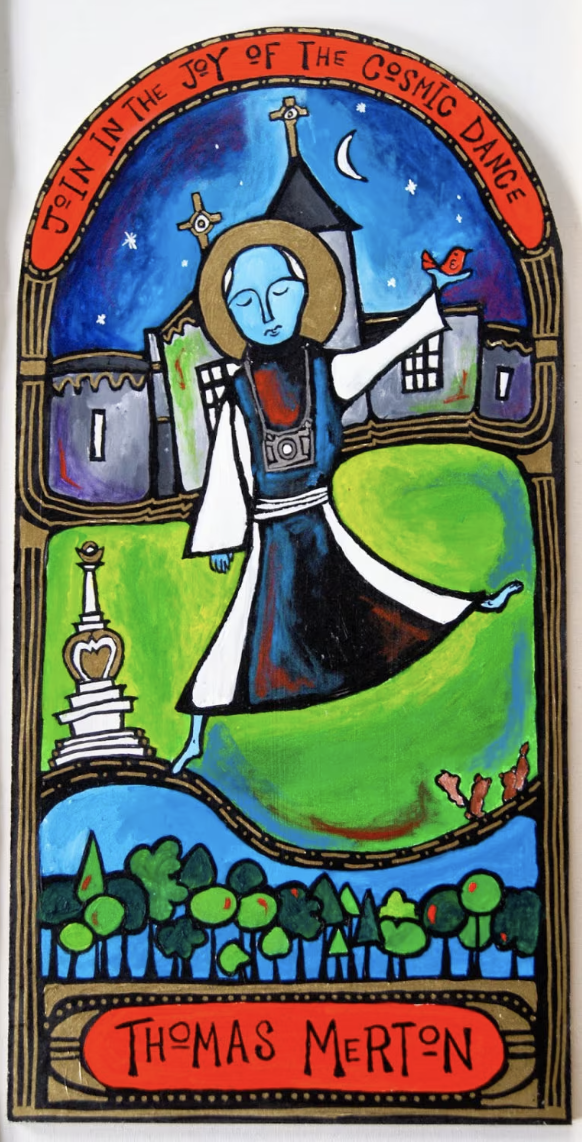
“God destined us for adoption as his children through Jesus Christ, according to the good pleasure of his will, to the praise of his glorious grace that he freely bestowed on us in the Beloved.” (Ephesians 1:5).
I was very excited to preach my sermon today. I wrote it several days ago and it was all about dancing, dancing like King David as portrayed delightfully on the cover of your bulletin. I was going to talk about my own experience dancing with other deputies at the “Episco-disco,” a silent disco party in the Episcopal cathedral in Louisville KY, the same cathedral where the bishops elected our new presiding bishop elect Sean Rowe. I was going to quote Thomas Merton who was referenced frequently at General Convention. In fact, he was quoted by Sean Rowe in his opening remarks, moments after he was elected. (So, for those who think Merton is just some random author whom Fr. Daniel is obsessed with, think again. He’s a big deal in the Episcopal Church.) The Merton quote I was going to share with you is one referenced in the Betty Chinn biography, in which Merton says, “We are invited to forget ourselves on purpose, cast our awful solemnity to the winds and join in the general dance.”[1] And I was going to talk about how dancing helps me take myself less seriously and let go of my false self and relax into my true, ultimate identity, which is a beloved child of God. That is also your true, ultimate identity. Every other identity you have is temporary. I believe that is the identity that King David was relaxing into when he was dancing, dancing so freely and wildly and casting off, for a moment, the awful solemnities of being king, even to the chagrin of his wife. I was excited to preach today on dancing and on our true identity as beloved children of God.
Yesterday, after the vestry retreat in which we read aloud Spiritual Friendship Distilled and talked about praying for the health and wellbeing of others, including those with whom we strongly disagree; after that retreat, we all went home and we learned of the shooting at the Trump rally in Pennsylvania. And it just no longer felt ok for me to preach on dancing today.
We still have some songs about dancing; and we’ll still sing them because the main message of my sermon was about relaxing into our identity as beloved children of God, who invites us all into his cosmic dance of love. And that message still stands. But last night, when I read Presiding Michael Curry’s statement on the shooting, I realized that his words conveyed the message of my sermon in a more suitable way, in the light of recent events. Bishop Curry said, “The way of love—not the way of violence—is the way we bind up our nation’s wounds. We decry political violence in any form, and our call as followers of Jesus of Nazareth is always to love. We pray for the families of those who were killed. We pray for former President Trump and his family and for all who were harmed or impacted by this incident. We pray that as a nation and a world, we may see each other [and see ourselves] as the beloved children of God.”
God, we come before you today, asking for the healing and wellbeing of all those who have been impacted by gun violence and political violence, including everyone at the rally yesterday. Deal graciously with the families of those who were killed and surround them with your love. Heal all those who were injured, including former president Trump; and heal the wounds of this deeply divided nation. Help us to let go of our false selves and give us eyes to see ourselves and others as we truly are, all of us, each one of us, as your dearly beloved children. Amen.

[1] Thomas Merton, New Seeds of Contemplation, 296 – 297.

This sermon was originally written to be preached at Christ Episcopal Church in Eureka CA on Sunday July 14, 2024.
The words of the epigraph in the final chapter of Betty Chinn’s biography are also the concluding words of the spiritual classic New Seeds of Contemplation, written by the one and only Thomas Merton, Trappist monk and mystic who was frequently quoted at the Episcopal Church’s General Convention in Louisville a few weeks ago.[1] In fact, our presiding bishop elect Sean Rowe concluded his opening remarks with a quote from Thomas Merton, just moments after he was elected. Merton said, “We are invited to forget ourselves on purpose, cast our awful solemnity to the winds and join in the general dance.”[2]
On June 26th, all the bishops of the Episcopal Church gathered in Christ Church Cathedral Louisville to elect our new presiding bishop Sean Rowe. Not only did I have the privilege of serving in the House of Deputies, which voted to confirm the election of Sean Rowe, I also had the joy of “preparing the way” for the Spirit’s presence in the cathedral where the bishops held their election. Two nights prior to the election, I joined two lay deputies from our diocese (CeeCee Coleman from St. Matthew’s Sacramento and Amy Nykamp from Incarnation Santa Rosa) in an event sponsored by the Diocese of Kentucky called “Episco-Disco,” which was a silent disco dance party where participants listened to music through wireless headphones. The event was partly a tribute to Louisville as the only city in the US where disco balls are manufactured,[3] but it was also an opportunity for us to take ourselves less seriously for a few moments, and, in the words of Merton, “to forget ourselves on purpose, cast our awful solemnity to the winds and join in the general dance.”

Now I don’t consider myself a skilled dancer by any stretch of the imagination; and, for me, that’s exactly what makes the activity so spiritually edifying—it might not be edifying for those watching me, but it is for me—because it helps me let go of any sense of self-importance. It helps me let go for a bit of what Thomas Merton calls “the false self” and to move into a deeper rhythm with my true self, my ultimate identity as a beloved child of God. One reason we call Jesus the “only begotten Son of God” is because he is the only one who lived his life in perfect alignment with his true self, with his sonhood, with his eternal belovedness in God’s eyes. All our roles and identities are important to some degree—whether we be parents, priests, painters, professors, presidents or presiding bishops, but these all are temporary identities and roles, and they can potentially become “false selves” if they prevent us from relaxing into our true, ultimate identity as beloved children of God. That’s who we truly are underneath all the other personas.
On one level, I was dancing as an Episcopal priest in the cathedral, but the real person who was dancing there was simply Daniel, a beloved child of God. If anyone happened to feel scandalized by the fact that a priest was dancing in the cathedral, I would invite them to read today’s Scripture from Second Samuel in which King David “danced before the Lord with all his might,” even to the apparent chagrin of his wife, Queen Michal. This biblical event is portrayed delightfully on the cover of your bulletin, which is the image of a stained-glass window at a church in Illinois. Not only do I love the dirty look that the Queen is giving David, but I also love that David’s crown is flying off his head as he dances wildly. Although David is indeed king, here that identity becomes subsumed or even falls away as he embraces his true self, his ultimate identity as a beloved child of God, a man after God’s own heart.
What the lectionary leaves out is the heated conversation between King David and his wife Michal after the dance is over. She told him that he had made a fool of himself and was also dressed very inappropriately. David responded by saying that he was happy to make himself look like a fool in the process of praising God and he will make himself look like even more of a fool in the future in casting off the awful solemnities of being king to join in the general dance.
I preach on dancing today because it’s in our Scripture readings and I’ve personally found it to be an effective way of letting go of my own “awful solemnities” for a bit. However, dancing might not be everyone’s cup of tea; and our reading from the New Testament reminds us that, like all activities, there can also be a shadow side to dancing. It can be used as a tool for violence and manipulation, as was the case for Queen Herodias and King Herod, who had John the Baptist beheaded. The invitation is for us to discover that which helps us to let go of our false selves and relax into our true identity as beloved children of God. This is why Jesus speaks hyperbolically about even “hating” certain relationships and roles in our lives insofar as they distract us from our true self. What is it that helps you cast off your false selves and rest in your belovedness as a child of God?
I’d like to conclude with a story I read in Louisville from a book titled Merton’s Palace of Nowhere written by one of Merton’s students, James Finley. This book happens to be all about Merton’s spirituality of the true self and the false self and in the preface to the 40th anniversary edition, Finley writes about a vivid dream he had while struggling to write the book.
In the dream, he was invited to a large university to present a formal paper on Thomas Merton’s principles of folk dancing. When he approached the lectern, he became nervous because of the massive size of the audience; and as he began to read his paper, all the lights suddenly went out and everything became pitch dark except for the small brass lamp on the lectern. And then, miraculously, Thomas Merton appeared standing right next to him on the stage, luminous so that everyone could see him, even in the darkened room. James was thinking, “What are you doing here? You’re dead!” And then he saw Merton smile mischievously as he was wont to do, but James didn’t want to keep looking at him because he was afraid that he would lose his place in his carefully prepared paper.
Merton then began to do a folk dance in front of everyone, which made James resentful because he could tell that the audience was much more taken by watching Merton dance than by listening to James talk about dancing. Then someone in the front row stood up and began to dance with Merton; and then another and another until “everyone in the room was folk dancing with Merton in a communal sense of joy and abandonment,” except for James, who stood there determined not to let all the contagious joy interrupt his dogged determination to continue reading his carefully prepared paper on Merton’s principles of folk dancing.[4]
When he woke from the dream, he realized that Merton was inviting him to get out of his own way in writing the book; and then he wrote this: “I hope this dream helps you as it helped me to see the surprisingly intimate ways that Merton invites us to discover that God is all about us and within us, dancing away in and as the primordial rhythms of our breathing…God is dancing away, inviting us. As Merton has it, ‘We are invited to forget ourselves on purpose, cast our awful solemnity to the wind[s], and join in the general Dance.’ Then, we unexpectedly awaken to our true self, one with God, in the midst of our fragility and all our wayward ways.”[5] May we awaken to our true self today and relax into our ultimate identity as the beloved children of the One who dances in the very rhythms of our breathing. Amen.
[1] Revival, Bishop Sean Rowe’s Opening Remarks, General Convention worship, etc.
[2] Thomas Merton, New Seeds of Contemplation, 296 – 297.
[3] Over 90% of all disco balls in the world are made in Louisville. https://www.nbcnews.com/news/us-news/disco-dead-ball-still-spins-louisville-n603441
[4] James Finley, Merton’s Palace of Nowhere, xii.
[5] James Finley, Merton’s Palace of Nowhere, xii.

 DANIEL DeFOREST LONDON