
Readings for the Seventh Sunday of Easter (Year B)
This sermon was preached at Christ Episcopal Church in Eureka CA on Sunday May 12, 2024.
Happy Mother’s Day! On this day, we give thanks for the divine gifts of motherhood in all its diverse forms. And on this Seventh Sunday of Easter (also known as Ascension Sunday) when we read Christ’s prayer that we all may be one as Christ and the Father are one, may we give thanks for those maternal figures in our church who have helped us live into and fulfill this high priestly prayer for unity. In the seventh-century, English Abbess Mother Hilda was able to hold together as one the opposing Celtic and Roman expressions of Christianity at the infamous Synod of Whitby, even when she was partial to the Celtic Christian communities who ultimately deferred to Rome. In the seventeenth-century, Queen Elizabeth was able to hold together as one the opposing Protestant and Roman Catholic expressions of Christianity in the Church of England, thus becoming the founding mother of the modern Anglican Church, a founder whose legacy we like to celebrate much more than that of her reckless father, Henry VIII. And today, we also give thanks for our mother dean, Mother Lesley McCloghrie, who holds together as one the low-church Evangelical and the high-church Anglo-Catholic expressions of Anglicanism in our diocese and deanery, even when she is certainly partial to the Anglo-Catholic traditions. Thanks to church leaders like these who have exemplified maternal grace, we Episcopalians can celebrate a rich and robust legacy of unity and communion across differences, of fulfilling Christ’s prayer that we all may be one. Our Anglican heritage and Christ’s high priestly prayer invite us today to hold together differences and variety –including differences in piety, politics, and musical preference—with maternal grace. Christ’s prayer and our Anglican heritage also help guide us as we move forward in our ecumenical work of sharing ministry and mission with other denominations.
As an alternate deputy to General Convention, I have been attending the Legislative Committee Meetings for Ecumenical and Interreligious Relations since March. Inspired by our Gospel reading today, I’d like to take this opportunity to briefly share with you a few of the exciting ways that the Episcopal Church is moving deeper into the unity for which Christ prayed. This year, along with discussing resolutions that will provide helpful guidelines for interreligious relations with our Jewish and Muslim siblings,[1] we are also discussing resolutions that will move us into fuller communion with our Lutheran and Presbyterian and Methodist siblings in Christ.
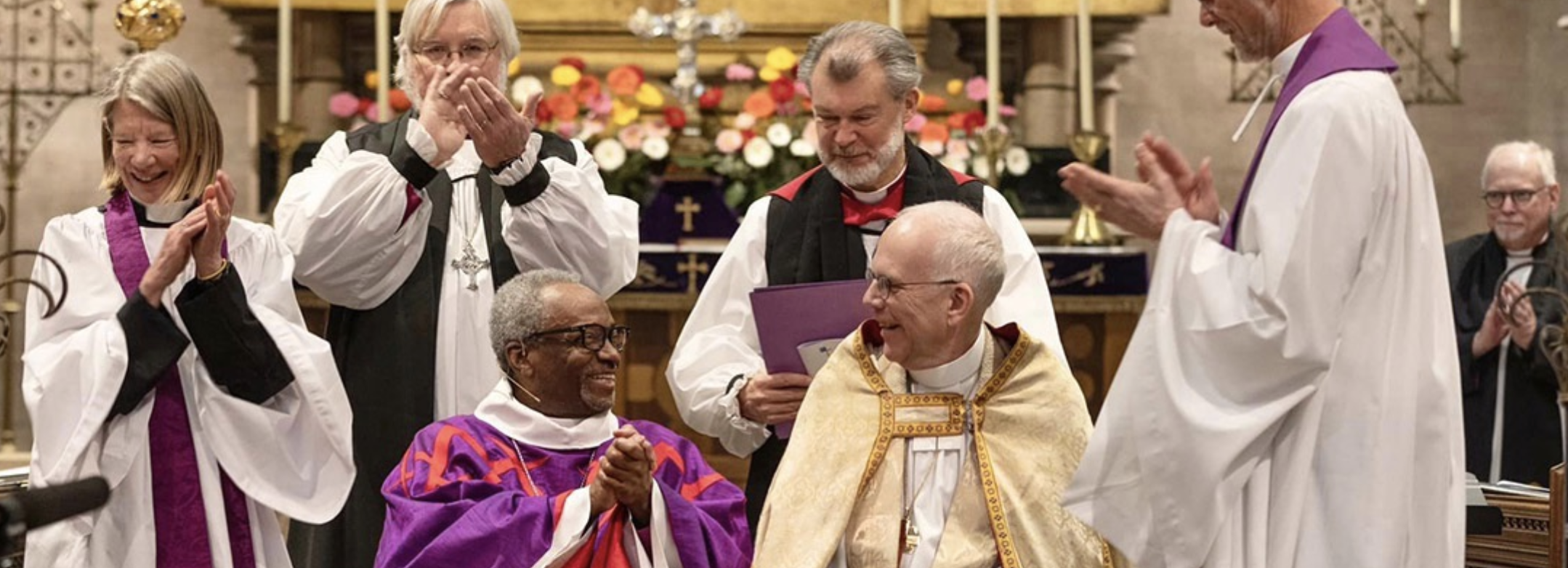
Although we are already in full communion with the Evangelical Lutheran Church in America (a communion embodied in our very own Pastor Jeri Gray-Reneberg), we had not yet established the exchangeability of deacons across the denominations. When the full-communion agreement was adopted in 2000,[2] the deacons in the ELCA were lay people who had not been ordained by bishops for a ministry of word and service like our deacons. Since then, the ELCA decided that we Episcopalians might be onto something when it comes to ordaining deacons, so they established ordination as the necessary entrance rite for the diaconate. Although there are still liturgical differences between the two denominations, this resolution on the exchangeability of deacons would strengthen our communion with our Lutheran friends in Christ.[3]
Another way that we may strengthen our unity with our Lutheran friends would be through passing a resolution that would establish full communion between the Episcopal Church and the Evangelical Lutheran Church of Bavaria (Evangelisch-Lutherische Kirche in Bayern),[4] which is composed of 2.6 million members in the largest state in Germany (basically, the Texas of Germany in terms of size), where ecumenical partnerships have already been at work among the Episcopal Churches in the area, especially at Church of the Ascension in Munich, where my colleague Pastor Dan Morrow serves.[5] This resolution will likely pass and, although we might not feel the immediate impact of it here in Eureka, this full communion would be very significant and certainly worth celebrating.

We are not yet in full communion with the Presbyterians of the PCUSA, which is composed of almost 2 million members in more than 10,000 congregations; and honestly, “full communion may not be feasible for some time.”[6] However, we are considering a resolution that would allow more “local ecumenical partnerships” between the two denominations, especially in places where clergy are in short supply. Such partnerships already exist in the Church of England, the Scottish Episcopal Church, the Anglican Church of Canada, and one Episcopal priest in Waukesha Wisconsin serves as the minister for an Episcopal and Presbyterian congregation that both meet in the same building.[7] We here at Christ Church have already been in ecumenical partnership with Presbyterian ministers, such as Pastor Dan Price and Pastor Deborah Hubbard who have served as guest preachers here.
Finally, the United Methodists: Some of our most beloved Anglican priests were Methodist ministers: John Wesley, who was ordained in the Anglican Church and then became Methodist in the process of launching the Methodist movement; and Absalom Jones, who began as a Methodist lay minister and then was ordained as the first African-American Episcopal priest (while his friend Richard Allen went on to found the African-Methodist-Episcopal church). The Episcopal Church and the United Methodist Church have been in formal dialogue for over 20 years about full communion; and just two weeks ago, the United Methodist Church made sweeping changes to their Book of Discipline regarding the ordination and marriage of homosexual persons, thus advancing towards our shared goals of an open and inclusive church for all of God’s people. Moreover, on April 30th, the United Methodist Church approved a proposal for full communion with The Episcopal Church.[8] So now, the ball is in our court. Yesterday, I spent over an hour listening to testimonies from Episcopalians and Methodists regarding a resolution to prayerfully consider this proposal. Although it seems unlikely that we will enter full communion with the Methodists this summer, I trust that the resolution that we discussed will indeed pass, a resolution that “encourages all Episcopalians to…understand the substance of the dialogue and its goal of full communion.”[9] And between now and 2027 (when we will likely vote on full communion), we are encouraged to spend time prayerfully considering “this significant step forward in response to our Lord’s fervent wish ‘that we all may be one.’”[10]

As we have been moving forward in response to Christ’s prayer in our Gospel today, the Episcopal Church has been encouraged and supported by the maternal presence of the Rev. Margaret Rose, the Deputy to the Presiding Bishop for Ecumenical and Interreligious Relations, who has gently reminded that unity is not uniformity but rather communion across differences, held together not only by bonds of affection but also by loving, patient, and maternal grace. May we live for more fully into this unity for which our Lord and Savior prayed. Amen.
[1] The resource is called “Holding Difference Together: Episcopal Theological and Practical Guidelines for Interreligious Relations”: https://extranet.generalconvention.org/staff/files/download/32366. Also, see “Christian-Jewish Relations: Theological and Practical Guidance for Episcopalians”: https://extranet.generalconvention.org/staff/files/download/32369
[2] The full communion agreement, “Called to Common Mission”, can be read here: https://www.episcopalchurch.org/ministries/ecumenical-interreligious/agreement-of-full-communion-called-to-common-mission/
[3] There are about 4 million members in 10,000 congregations in the ELCA.
[4] Abbreviated as ELKB, pronounced “E – L – Kah – Bay.”
[5] I met Pastor Dan Morrow when we served as the youth minister at St. Johns’ Episcopal Church in La Verne, CA. https://www.ascension-munich.org/our-rector
[6] Quote by the Rev. Elise Johnston, co-chair of https://episcopalnewsservice.org/2024/05/06/proposed-resolution-would-allow-local-ecumenical-partnerships-between-episcopal-presbyterian-churches/
[7] The Rev. David Simmons of St. Matthias Episcopal Church and First Presbyterian Church in Waukesha WI.
[8] https://www.umnews.org/en/news/full-communion-with-episcopalians-gets-closer
[9] Resources on the United Methodist – Episcopal dialogue can be found here: https://www.episcopalchurch.org/ministries/ecumenical-interreligious/united-methodist-episcopal-dialogue/
[10] Resolution 2024 – A049 https://www.vbinder.net/resolutions/495

 DANIEL DeFOREST LONDON