
Readings for the Fourth Sunday in Lent
This sermon was preached at Christ Episcopal Church Eureka on Sunday March 10, 2024.
“Just as Moses lifted up the serpent in the wilderness, so must the Son of Man be lifted up, that whoever believes in him may have eternal life.”
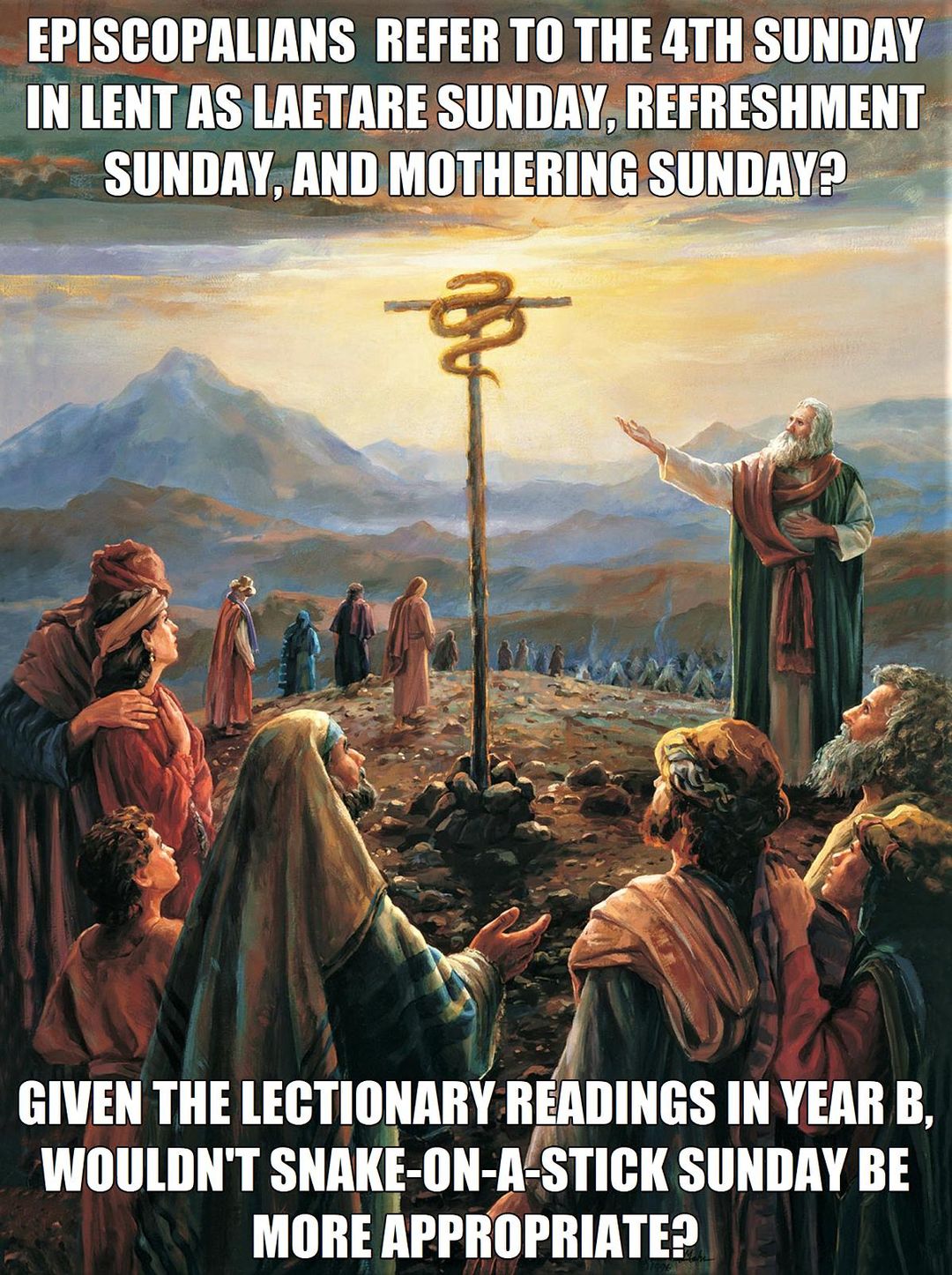
There’s a Facebook meme that comes around during this time in the Lenten season that says “Episcopalians refer to the 4th Sunday in Lent as Laetare Sunday, Refreshment Sunday, and Mothering Sunday. Given the lectionary readings in Year B, wouldn’t Snake-on-a-Stick Sunday be more appropriate?” So, Happy Laetare, Refreshment, Mothering, and Snake-on-a-Stick Sunday to you all! Allow me to briefly unpack these names: Laetare Sunday refers to the ancient introit spoken by the priest in Latin, which begins with the word “Laetare” that translates to “rejoice.” Rejoice! We are now halfway through Lent and Easter is not too far away. So, we wear our rose-colored vestments rather than the purple ones. Although all the Sundays in the season of Lent are feast days, times when we can break our Lenten fast, this Sunday is a special time of rest and respite and relaxing Lenten discipline, which is why it is also called Refreshment Sunday. Today is also Mothering Sunday, a day when we honor our “mother churches.” And what is our “mother church”? It is the church where you were baptized. So, if that is Christ Church Eureka you might want to offer a special gift today or if your mother church is another parish, you may want to send them a gift or a letter expressing your gratitude. We celebrate these Sundays each year, but Snake-on-a-Stick Sunday comes around only once every three years, so let’s dive into this bizarre story from the Book of Numbers that Jesus then references in John.
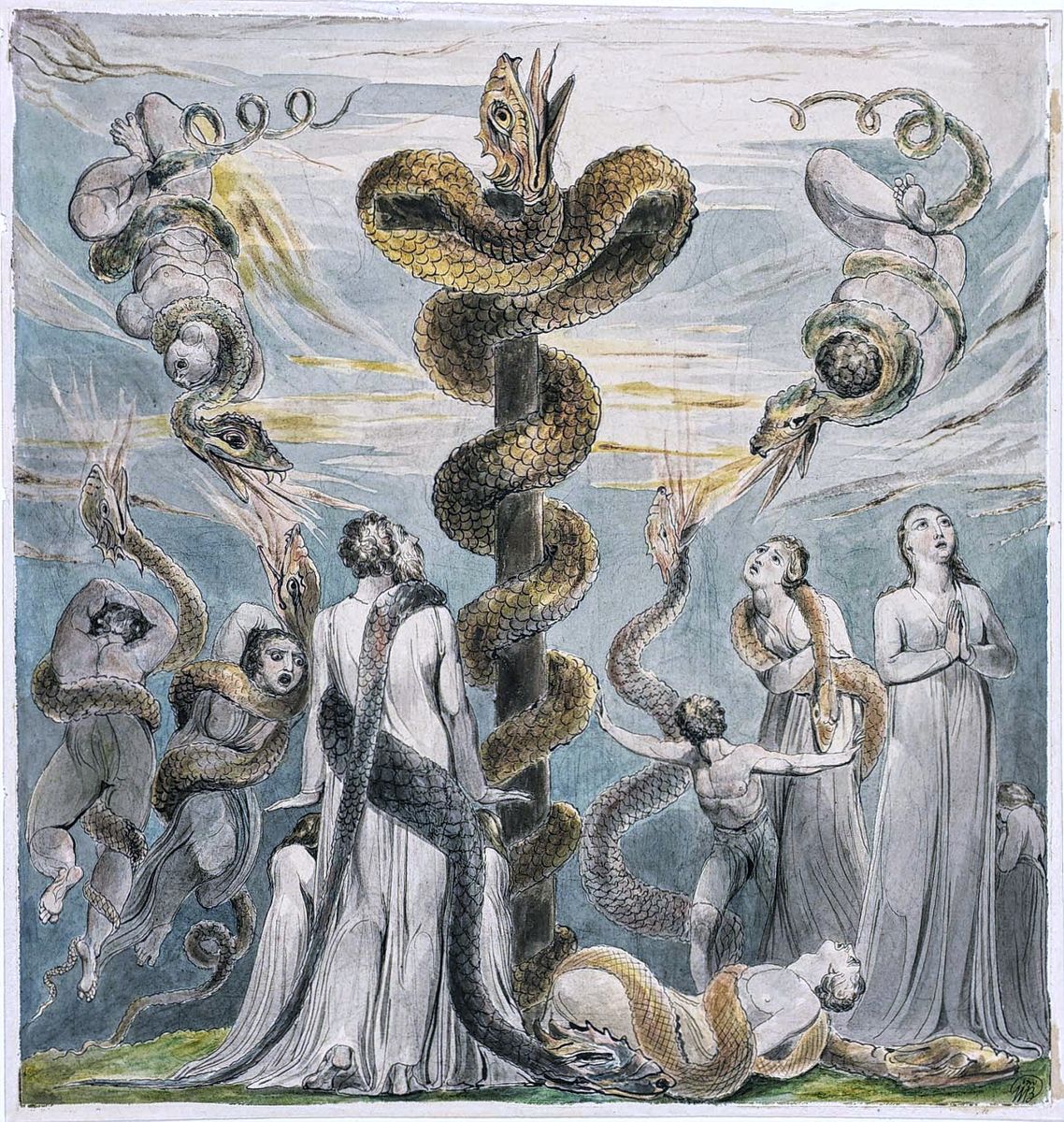
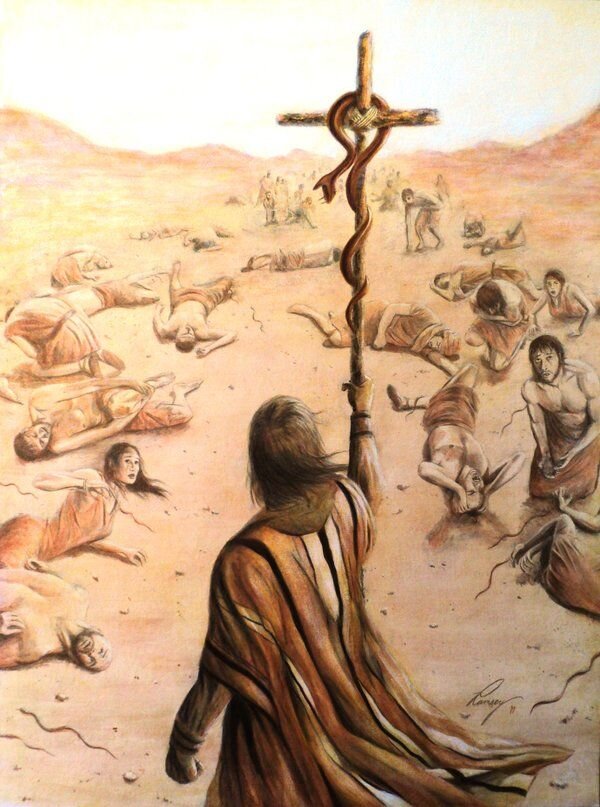
The Israelites are frustrated and impatient, hungry, and thirsty and fed up with their “miserable food,” which they say they detest.[1] Then, snakes show up and poison many Israelites to death with their fatal venom. The Israelites then ask their leader Moses for help, saying, “We have sinned by speaking against the Lord and against you; please pray to God so that God will send these snakes away.” But God does not send the snakes away. Instead, God uses this as an opportunity not only to heal but also to reveal something profound about Himself to His people.
According to the text, the LORD is the one responsible for sending the poisonous snakes. The Israelites blame God (and Moses) for the miserable food, the lack of water and their apparent circumambulations throughout the desert. So, when poisonous snakes arrive on the scene, God is blamed for these as well, as the text declares: “The LORD sent poisonous snakes among the people.” So, for the Israelites, the serpent became a symbol of God’s violent punishment and wrath against His people for their ingratitude and complaining. However, God responds to their prayer by turning that symbol on its head; by making the symbol of the serpent into a sign of God’s healing and new life. By lifting up the serpent in the wilderness, God is saying to God’s people, “My dear children, I am not a God of wrath. I am not a God who will poison you to death because of your complaining. I am a God of love and forgiveness and healing. I want you to stop projecting your violence and wrath onto me. I will teach you this by taking the symbol that you see as representative of my wrath; and I will transform it into a symbol of healing and new life. By looking at this life-giving snake, may your understanding of me be transformed from a God of violent wrath to a God of healing and life.”

Now it seems that this profound insight about God was lost hundreds of years later when King Hezekiah, the King of Judah, broke this bronze snake into pieces. However, Jesus sought to reclaim and embody this insight and this symbol. Jesus essentially says in our Gospel, “Just as the serpent revealed God as a source of healing and love, not violence and wrath, so will I reveal God to you as a God of love and eternal life not condemnation and death.” And he once again uses a symbol associated with punishment, the Cross, to make this point. Jesus makes this very clear. We all know the famous verse John 3:16 which beautifully sums up the entire Gospel: “For God so loved the world that he gave his only-begotten Son that whosoever believes in him shall not perish but have everlasting life.” But the following verse is just as important: “God did not send the Son into the world to condemn the world, but in order that the world might be saved through him.” Jesus revealed God as a God of healing and salvation, not condemnation.
There is indeed a time for judgment when the Light of God shines upon us and exposes the many ways that we are caught up in sin and we are complicit in violence and oppression in very insidious and subtle ways. But that judgment always includes an invitation to be healed and transformed by the life-giving and liberating love of God.
Throughout church history, many theologians have understood the cross of Christ primarily as a symbol of God’s wrathful punishment of sin, which Jesus bore on our behalf. There may be some truth to that; however, by understanding the cross primarily in this way, we end up making the same mistake that the Israelites did: we project our own violence onto God.[2] At the cross, God reveals his love and forgiveness in response to our wrath and violence. At the cross, God transforms a symbol of human violence into a symbol of healing and new life, even eternal life, just as God did with the serpent in the wilderness.
May we each find deep rest on this Laetare Sunday and be refreshed by the Gospel truth of God’s healing and liberating and maternal love, which transforms symbols of suffering and wrath into symbols of new and abundant and everlasting life. Amen.
[1] This food is the manna, the bread of angels, the bread of the heavens, which according to Jewish Midrash, had any taste desired by the person eating it. There seems to be a little problem of ingratitude or perhaps being a little spoiled. Can we relate to this in any way? I know I can.
[2] When the great English theologian and mystic Julian of Norwich received her Revelations of Divine Love, she learned that there is no wrath in God.


 DANIEL DeFOREST LONDON