
Readings for the First Sunday after the Epiphany
This sermon was preached at Christ Episcopal Church Eureka on Sunday January 7, 2024.
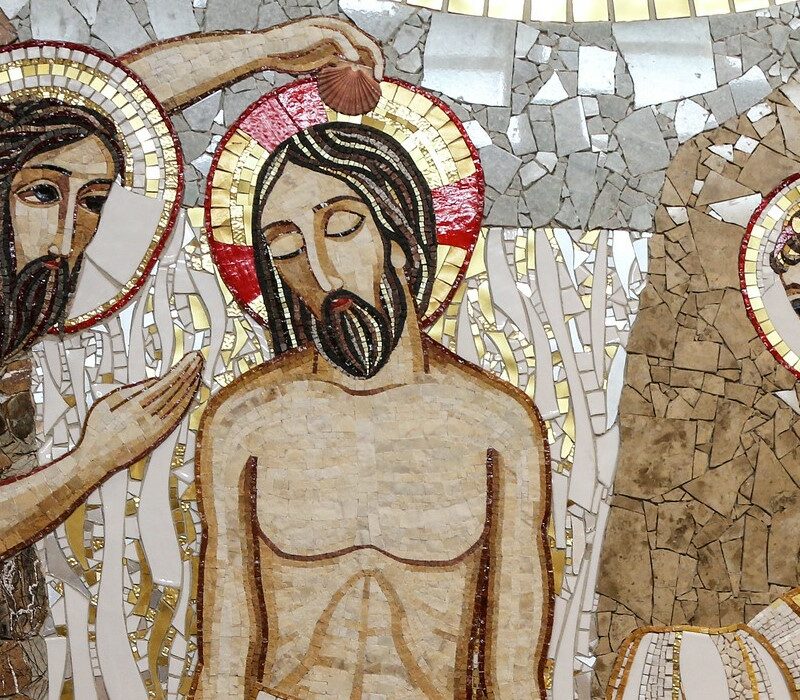
Today we celebrate the Feast of the Baptism of our Lord, when we read again portions from the Gospel of Mark that we heard back on the Second Sunday of Advent, when the camel-haired beast known as John the Baptist invited us all to re-wild our prayer lives. We revisit John’s Baptism of Jesus today because traditionally the Feast of the Epiphany (which was yesterday) commemorates three significant events in the life of Christ: the visit of the Magi, Jesus’s first miracle at Cana, and Jesus’s baptism.
“John the baptizer,” Mark says, “appeared in the wilderness, proclaiming a baptism of repentance for the forgiveness of sins.” John’s ritual likely involved full immersion in water, much like the Jewish practice of immersing in a miqveh. However, the miqveh was a Jewish bath used not for the forgiveness of sins, but for ritual purity, so John is repurposing the ritual here. (So Epiphany celebrates the Magi, the Miracle, and the makeshift miqveh.) This emphasis on a watery immersion that forgives sins creates a conundrum for Christians who claim that Jesus was without sin. The early church fathers solved this puzzle by explaining that Jesus’s baptism was not only his way of setting an example for us to be baptized but also Jesus’s way of representing all of humanity, which is sinful and in need of forgiveness, not unlike the way Jesus represents sinful humanity on the cross, bearing the punishment for all our sins. As Jesus emerged from John’s wild makeshift miqveh, the Holy Spirit descended as the heavenly Father affirmed the love and delight that he has for his Son. So, in the baptism of Jesus, we see the revelation and manifestation (Epiphany) of the Triune God, the affirmation of the faith community and its ritual practices (as they began to emerge under the leadership of the wild Baptist), and Jesus’s solidarity and identification with humanity in all our sinful brokenness.
Now we Episcopalians believe that Baptism is the outward and visible sign of an inward and spiritual grace, specifically the grace that grants us the forgiveness of our sins as well as union with Christ in his death and resurrection.[1] Holy Baptism remains so central and foundational to our tradition that the Episcopal Church canons state, “No unbaptized person shall be eligible to receive Holy Communion in this Church.”[2] A few years ago, our diocese caused a stir within the wider Episcopal Church when we passed a resolution requesting that this canon be repealed in the interest of welcoming everyone to the table.[3] The resolution was denied and the canon remains in effect. In fact, our diocese just tried to pass a similar resolution again this last November at diocesan convention, but this time, it failed to gain sufficient votes to go beyond our diocese.
Now here at Christ Church, all are indeed welcome to receive Holy Communion so technically we are in violation of the canon, but as a student of Christian spirituality and mysticism, I can understand why the bishops and other leaders of the church prefer to keep this canon in effect as it upholds the crucial importance of Holy Baptism and Holy Eucharist. Many of the Christian saints and mystics throughout history have understood Holy Communion as the divine wedding chamber, as deep and unitive intimacy with the Body of Christ. I find the mystics’ marriage analogy helpful because although the church’s teachings on human sexuality are varied and have caused their own massive controversy across the communion, the church still upholds sexual intimacy within marriage as the ideal; generally discouraging such intimacy between individuals who have not yet made some level of significant commitment to each other. Ideally, that intimacy is reserved for those who have already made their marriage vows. Similarly, the church seeks to safeguard the sanctity of Holy Communion, the divine wedding chamber, by reserving it for those who have been baptized and who have made their baptismal vows. In other words, just as the Episcopal Church generally discourages casual pre-marital sex so too does it discourage casual pre-baptismal communion. And this leads me to our baptismal covenant…
Former Bishop of Minnesota and later Bishop of Los Angeles Robert Anderson told me that all his sermons could be summed in three words: “The Baptismal Covenant.” Just as the vows of the marriage covenant are made before consummation, so too are the vows of the baptismal covenant made before communion. These vows, which begin on page 292 of your prayer book and page 11 of your bulletin, make up our foundational identity as Christians and Episcopalians. If you want to know what we believe and what we are called to do in the world, look here. Now, notice that they include the three elements that we saw in Mark’s account of the Baptism of Jesus: the Holy Trinity, a commitment to the faith community, and compassionate solidarity with humanity.
The first question I will ask when we renew our baptismal vows today is “Do you reaffirm your renunciation of evil and renew your commitment to Jesus Christ?” This one question sums up several questions that are asked before a baptism, questions known collectively as the “minor exorcism” in which the candidate renounces Satan, all spiritual forces of wickedness, all evil powers, and all sinful desires. (In the Eastern Orthodox Church, candidates turn away from the altar and literally spit as a symbol of their renunciation and spitting upon Satan.) The word exorcism comes from the Greek exorkizo which literally means to “swear an oath,” a horkos. In ancient Greece, swearing an oath meant invoking a deity to punish the oath-taker if he or she failed to keep the oath and it is this meaning that lies at the root of the term’s use in Christianity today.[4]
We then confess our belief in the Triune God as expressed in the ancient words of the Apostle’s Creed, followed by our commitment to the faith community and our solidarity with humanity as we strive for justice and peace among all people and respect the dignity of every human being. And three key words in our response are “with God’s help.”
Just last Sunday morning before worship, I was reading a book that I bought as a sending-off gift for Pastor Dan Price, a book that includes teachings on Baptism from the greatest Protestant theologian of the 20th century Karl Barth, who said, “Constantly the baptized will be shockingly unfaithful to the community, and the community to the baptized, and hence both to their Lord…In the shadow of these doubts baptism itself seems to be an irresponsible venture which finally, perhaps, should not be ventured at all. The hope in which we baptize and are baptized, however, is not quite the untenable hope in the goodness of our own action subsequent to baptism…Hope in Jesus Christ is the hope in which the community and its candidates do their common work…Jesus Christ is the goal, the future….The Christian life which begins with baptism can thus be a life in which we are not alone and left to our own devices with all the very dubious things which are certainly to be expected on our side. It is a life in which, whether we realize and experience it or not, God is with us and among us every day and every hour, always waiting for us and moving towards us.”[5] So, with those hope-filled words in mind, let’s stand together and recommit ourselves to Christ and renew our baptismal vows…
[1] Book of Common Prayer, 858.
[2] Episcopal Church Canon I.17.7
[3] https://www.norcalepiscopal.org/wp-content/uploads/2021/10/Resolution-R4-2021.pdf
[4] Francis Young, A History of Anglican Exorcism: Deliverance and Demonology in Church Ritual, (New York: I.B. Tauris & Co., 2018), 2.
[5] Karl Barth, Church Dogmatics: The Doctrine of Reconciliation, vol. IV, part 4, ed. G. W. Bromiley and T. F. Torrance (Edinburgh: T & T Clark, 1969), 202 – 10.


 DANIEL DeFOREST LONDON