
https://en.italiani.it/the-nativity-scene-of-san-francesco-that-illuminate-greccio/
Readings for the First Sunday after Christmas Day
This sermon was preached at Christ Episcopal Church Eureka on Sunday December 31, 2023.
800 years ago, a 41-year-old deacon travelled to the Italian town of Greccio, where he pondered the mystery of Christmas expressed in the words of the Gospel we just heard read. Although his younger years were marked by worldly licentiousness, he had become engrossed with the spiritual realm throughout his adulthood and his extreme commitment to the spiritual life had attracted thousands of followers. However, in his pursuit for spiritual perfection, he had become detached from his body, which he referred to as “Brother Ass.”[1] In Greccio, he reflected on the Christmas mystery of the Word becoming flesh, a holy event that elevates the human flesh as a vehicle for divine glory. Though he was only 41 years old, his body was in decline because of severe fasting and self-denial. It was around this time in his life that he began to finally listen lovingly to his body. Inspired by the affirmation of the human flesh revealed in the Incarnation, he spoke to his body and said these words: “Rejoice, brother body, and forgive me for all the ways I have ignored you. I now give you my loving attention and hasten to heed to your complaints.”[2] Unfortunately, the damage had already been done and he died only a few years later, but not after leaving his legacy in the town of Greccio, a legacy that remains alive today, a legacy that invites us all to be in our bodies and to discover God’s presence with us here and now, even in “Brother Ass.”

https://brotherassbrewing.com/
This Italian deacon’s legacy is a deeply Anglican one, as Anglican author C. S. Lewis affirmed when he later elaborated on the deacon’s name for his body. Lewis said, “Ass is exquisitely right because no one in his senses can either revere or hate a donkey. It is a useful, sturdy, lazy, obstinate, patient, lovable and infuriating beast; deserving now a stick and now a carrot; both pathetically and absurdly beautiful. So the body.”[3]
This message speaks to me and even convicts me, not because I’m a self-denying ascetic like the Italian deacon but rather because I often live too much in my head (and my head can often be in the clouds), detached from my body. I spend a lot of time thinking and dreaming about the spiritual realm, reading about encounters with the supernatural, near-death experiences, and out-of-body experiences. And that makes sense. I’m a priest and I love that about myself. However, my enthusiasm for the spiritual realm can sometimes prevent me from being here now in this body with other bodies, all “pathetically and absurdly beautiful.” The experience of being in a human body is one that God Himself wanted to enjoy; and in so doing, God made it possible for us to experience union with him right here and right now, in these vessels.[4]
Anglicans call this “incarnational piety,” a piety based on the Gospel of John which affirms that the Word became flesh. Franciscan Richard Rohr describes this incarnational piety when he says, “If incarnation is the big thing, then Christmas is bigger than Easter (which it actually is in most Western Christian countries). If God became a human being, then it’s good to be human and incarnation is already redemption. St. Francis and the Franciscans were the first to popularize Christmas. For the first 1,000 years of the church, there was greater celebration and emphasis on Easter. For Francis, if the Incarnation was true, then Easter took care of itself. Resurrection is simply incarnation coming to its logical conclusion: we are returning to our original union with God. If God is already in everything, then everything is unto glory!”[5] In becoming human, God made it possible for humanity to become one with God.[6]
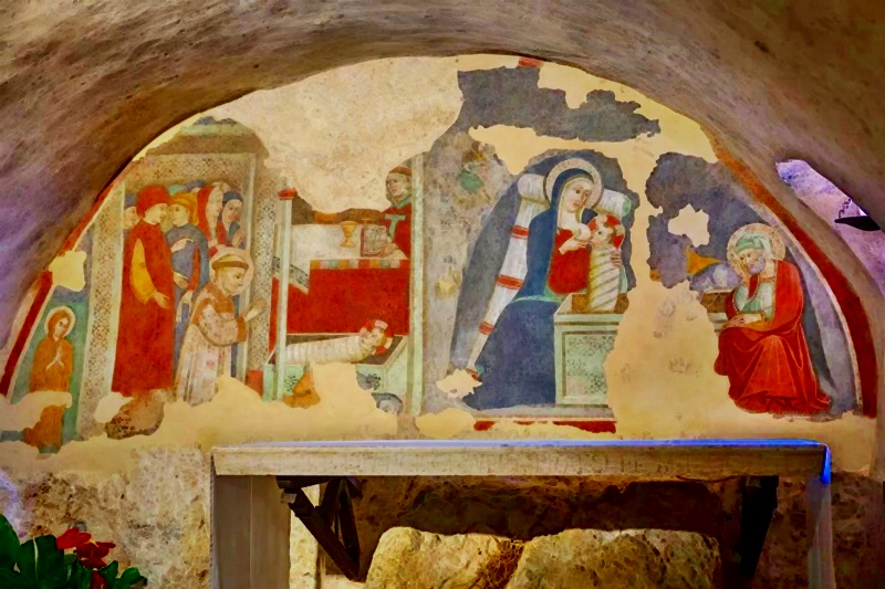
And it’s with this Franciscan quote that we return to the 41-year-old deacon in Greccio who was none other than St. Francis himself who wanted the people of Greccio to appreciate the gift of the Incarnation, to experience God in their bodies in the present moment, by creating the first Nativity scene ever, which was a live Nativity scene, and which has become perhaps the most popular Christmas tradition in the world. We would not have this creche here if it were not for St. Francis, who introduced this practice in Greccio in the year 1223, exactly 800 years ago today. This Christmas in the year 2023, is the 800-year anniversary, the octocentenary, of the first Nativity scene. If you go to Greccio today and visit what is called the Chapel of the Crib, you will see a fresco of the first Nativity scene, with St. Francis kneeling beside an Italian baby who played the role of Jesus. St. Francis the deacon is appropriately dressed in a dalmatic which looks remarkably like the dalmatic Pam is wearing today. This Anglican and Franciscan emphasis on the Incarnation not only compels us all to the diaconal work of pursuing peace and justice for all people here and now, but it also invites us to experience God’s loving presence in our bodies, in our breath, in our heartbeat, in all the pathetic and absurd beauty of this human flesh. Amen.
[1] C. S. Lewis later commented on this name, saying, “Ass is exquisitely right because no one in his senses can either revere or hate a donkey. It is a useful, sturdy, lazy, obstinate, patient, lovable and infuriating beast; deserving now a stick and now a carrot; both pathetically and absurdly beautiful. So the body.” C. S. Lewis, The Four Loves, 93.
[2] James Wiseman, “The Body in Spiritual Practice: Some Historical Points of Reference” in Reclaiming the Body in Christian Spirituality, edited by Thomas Ryan (Mahwah NJ: Paulist Press, 2004), 7.
[3] C. S. Lewis, The Four Loves, 93.
[4] Karl Barth was “convinced that God does not come to us, nor do we come to God, except through the mediation of Christ, who is the Word of God made flesh. The incarnate Word, crucified and risen, does not encounter us today apart from the secondary means of Scripture and proclamation.”
[5] https://cac.org/daily-meditations/incarnation-already-redemption-2015-06-05/
[6] St. Athanasius, the Father of Christian Orthodoxy, wrote, “The Word was made flesh in order that we might be made gods…Just as the Lord, putting on the body, became a man, so also we men are both deified through his flesh, and henceforth inherit everlasting life. Athanasius, Against the Arians 1.39, 3.34. He summed up this teaching when he said, “For the Son of God became man so that we might become God.”

 DANIEL DeFOREST LONDON