
This article was written for the December 2023 Chronicle newsletter for Christ Church Eureka.
On my last day in Aotearoa New Zealand, I preached at the historic St. Stephen’s Chapel in Auckland, beside a wooden altar upon which the first constitution of the Anglican Church in Aotearoa was signed. I preached on the gift of Anglican openness and shared the following phrase that I learned after reading a book titled The Shape of Anglican Theology: “Anglicans are not always angels, but we are good at looking at things from different angles.”[1]
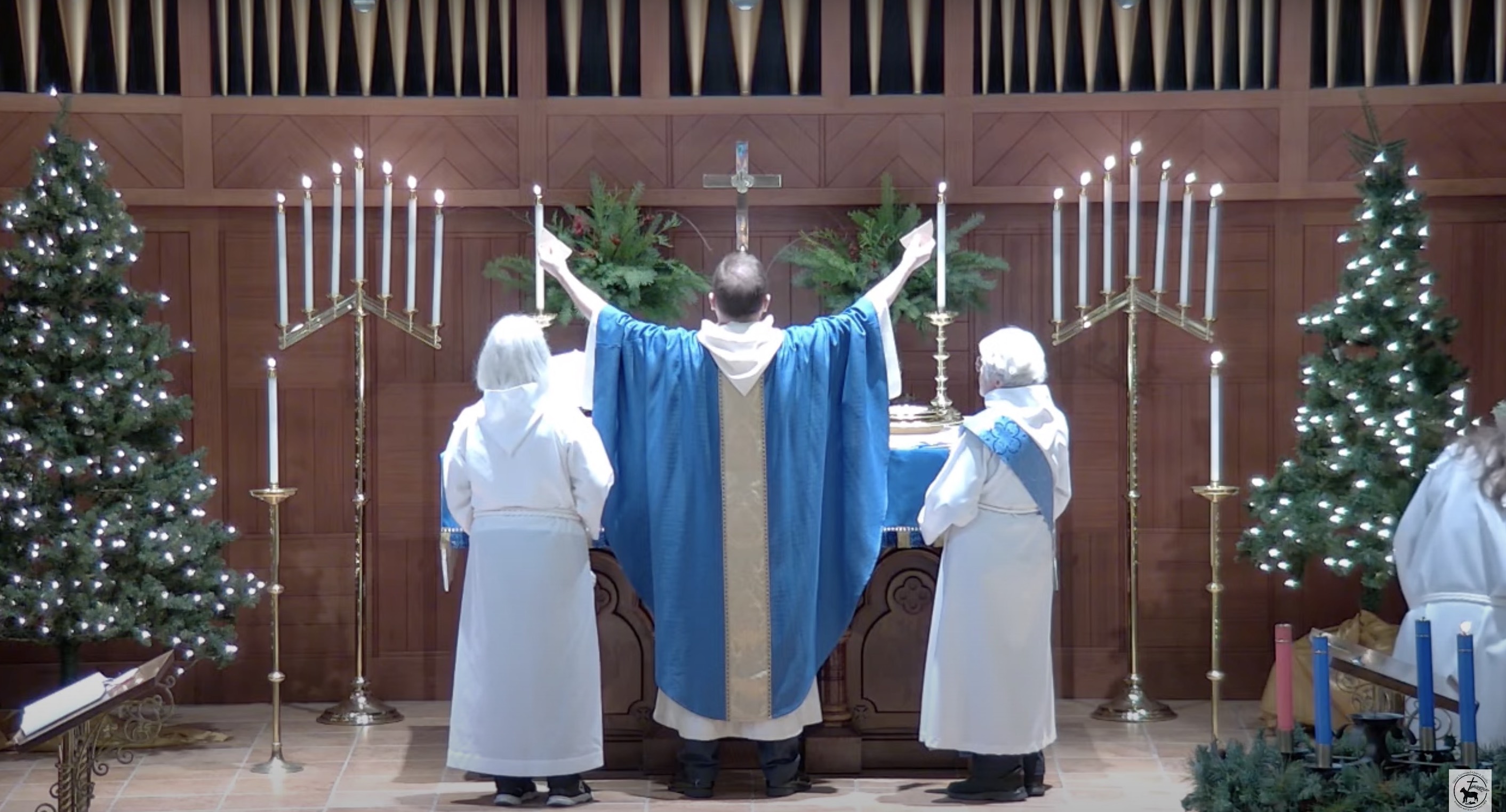
I then proceeded to co-celebrate Eucharist with the cathedral precentor Fr. Ivica Gregurec, who consecrated the elements with his back to the congregation so that we were all facing the same direction together. This way of celebrating Eucharist is called ad orientem, which means “towards the East,” and it is the way priests have been celebrating Eucharist for most of church history.[2] I celebrated this way a couple times at my field education parish in Berkeley (St. Clement’s) as well as at my previous parish in San Rafael (Redeemer); and some of you may remember priests at Christ Church Eureka celebrating this way many decades ago. Although my experience with this orientation has been relatively limited, I found it to be powerful and transformative and especially appropriate during the season of Advent.


When I returned from my Sabbatical, several of you expressed interest and curiosity about how my experiences in other Anglican provinces may influence the way I lead and design worship here at Christ Church. Let me first say that, as an Episcopal priest, I am bound by the rubrics of the Book of Common Prayer and would need to request special permission from my bishop before making any significant changes to the established liturgy. However, this Advent, I will be celebrating Eucharist ad orientem, which one can argue is more faithful to the rubrics of the Book of Common Prayer than the way we have been doing it.[3]
I am only planning to celebrate Eucharist ad orientem during Advent, which is essentially only three weeks this year.[4] Advent is a perfect time to worship in this way as we look together towards the coming (the Adventus) of the Son. Christians have traditionally faced East to await the rising of the sun which symbolizes the dawn of a new era and the arrival of eternal light and life in Christ Jesus our Lord. Although we will technically be facing south due to the architectural orientation of Christ Church, we will symbolically be looking together towards Christ and his arrival.
Advocates for ad orientem often point out that this way of celebrating limits the performance aspect of worship as if the priest and the altar party are putting on a show for the congregation. They also point out that this formation brings the focus back to God, as the meme below demonstrates:
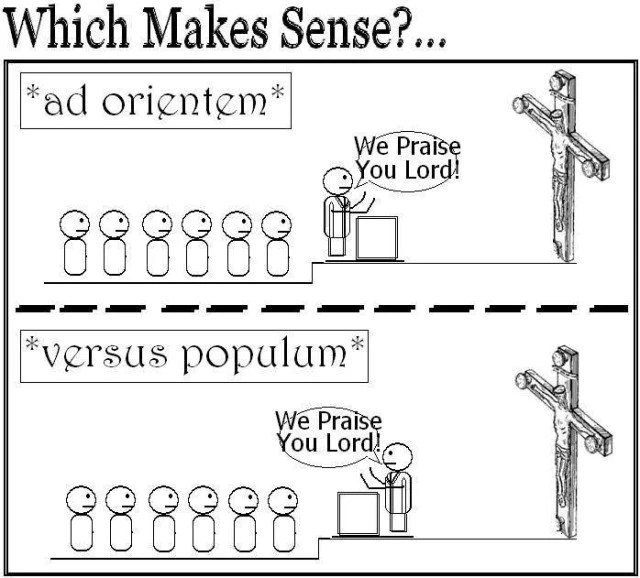
Of course, we also believe that Christ is present among us, which is why I most frequently celebrate Eucharist facing the congregation, versus populum. This regular formation can be a very powerful way of recognizing the immanence of Christ among us. However, there also times when it is important for us to remember the radical transcendence of God, the unknowable mystery of the divine who is the “wholly Other.” And the season of Advent is such a time.
Last Sunday, we celebrated the Feast of Christ the King, acknowledging that Christ is the ultimate ruler of all things in heaven and earth. However, we do not need to look very far to see that Christ’s Reign of Love and Compassion has not yet been fully realized in our world. Advent is a season to remember that we are in a time of “not yet”; and Advent invites us to look together towards the coming Son and pray, “Come, Lord Jesus!” (Rev 22:20). And it is hard for me to imagine a better way of embodying this practice than by facing the Cross together during Holy Communion.
My friends, I am looking forward to celebrating another Advent with you by literally looking forward together to the Adventus of Christ. When we celebrate Christmas on December 24 and 25, we will return to the versus populum formation since that is a season to celebrate the Incarnation of Christ among us. However, we are not quite there yet.
If this new (or should I say “ancient”?) way of celebrating Eucharist is not your cup of tea, then I would humbly appeal to that Anglican openness I preached about in New Zealand and invite us all to try looking at things together, as faithful Anglicans,from a different angle, since Advent is also a season of openness to something new…
[1] This aphorism is not included in The Shape of Anglican Theology but is rather one that I gleaned from reading the book. The Shape of Anglican Theology: Faith Seeking Wisdom (Boston: Brill, 2022), 30, 84. The aphorism is also a nod to Pope Gregory the Great’s famous pun, Non Angli Sed Angeli. You can read my sermon “Anglican Openness” here: https://deforestlondon.wordpress.com/2023/08/20/anglican-openness/
[2] The name for the orientation that we use regularly is versus populum, which means “towards the people” or more literally, “against the people.”
[3] If we look at page 361 in the Book of Common Prayer, we will see that the rubric says, “The people remain standing. The Celebrant, whether bishop or priest, faces them and sings or says: ‘The Lord be with you.’” This part of the Eucharistic prayer is called the Sursum Corda and even priests who celebrate ad orientem say this part while facing the congregation, since the words are being addressed to them. However, look at the rubric that follows the Sursum Corda: “Then, facing the Holy Table, the Celebrant proceeds.” Why would this rubric be included if the Celebrant is already facing the Holy Table? Also, look at the bottom of page 364 where the rubric says, “Facing the people, the Celebrant says the following Invitation: ‘The Gifts of God for the People of God.’” Why would this rubric be included if the Celebrant is already facing the people? The rubrics seem to assume that the priest is celebrating ad orientem, consecrating the elements with his back to the congregation.
[4] This year, the fourth Sunday of Advent falls on Christmas Eve so we will only be celebrating the fourth Sunday of Advent at the 8 AM Contemplative Eucharist and the 9:30 AM Joy Mass. The 10:30 AM Eucharist will be our family Christingle service.

 DANIEL DeFOREST LONDON