
Readings for the Twenty Third Sunday after Pentecost (Year A) Proper 26 – Track 2
This sermon was preached at Christ Episcopal Church in Eureka CA on Sunday November 5, 2023.

“You’ll never enjoy the world aright, until you wake up every day as if you were in Heaven, until you look upon the skies with celestial joy as if you were among the angels, and the sea flows in your veins, and you’re crowned with the stars, and you realize that you are the sole heir of the whole world because you are a uniquely chosen and beloved child of God for whom the world was made.”[1] These are the words of 17th century Anglican priest and poet Thomas Traherne who is now considered the first great Anglican mystic. Even though he was mostly ignored during his lifetime and his poetry wasn’t published until the early 20th century, Traherne lived his life as if he were in the Garden of Eden because he found all his self-worth and all his happiness (“felicity”) in his identity as a beloved child of God for whom the world was made. He did not seem at all disappointed by a lack of personal fame or admiration from others. He discovered all the joy in the world in his identity as a beloved child of God. And that’s what today’s sermon is all about: our ultimate and foundational identity as chosen and beloved children of God and the spiritual danger of seeking self-worth apart from that identity. You will never enjoy the world aright until you make your belovedness in God’s eyes central and primary to your identity and your happiness.
This is what Jesus is teaching in today’s Gospel, albeit in his own extreme, attention-grabbing, and frankly jarring way. This is a tricky passage that, like all biblical passages, must be read in its proper Jewish context. Jesus acknowledges and respects the office and authority of the Pharisees, who, he says, “sit on Moses’s seat.” There’s nothing more authoritative in Judaism than to sit on Moses’s seat. This is not an anti-Jewish or even anti-Pharisee tirade of Jesus. Some biblical scholars even think that Jesus himself was a Pharisee; however, we only know the name of one Pharisee and that happens to be the same person who wrote the majority of the New Testament: the Apostle Paul.[2] Jesus respects the office of the Pharisees; however, he has some harsh critiques against the fallible human beings who currently occupy that office.
The Pharisees developed practices and traditions based on their reading of the Torah which were intended to help them and help others remember their primary identity as chosen and beloved children of God. Jesus is not condemning these practices at all. In fact, he likely engaged in the practices himself. Rather he is condemning their misuse and abuse. Instead of using the practices to root themselves in their divinely beloved “chosenness,” the Pharisees transformed them into spiritual gimmicks meant to attract other people’s admiration. And when we need other people to admire us in order for us to like and accept ourselves, we end up placing heavy psychological burdens on others and that is exactly what the Pharisees are doing.
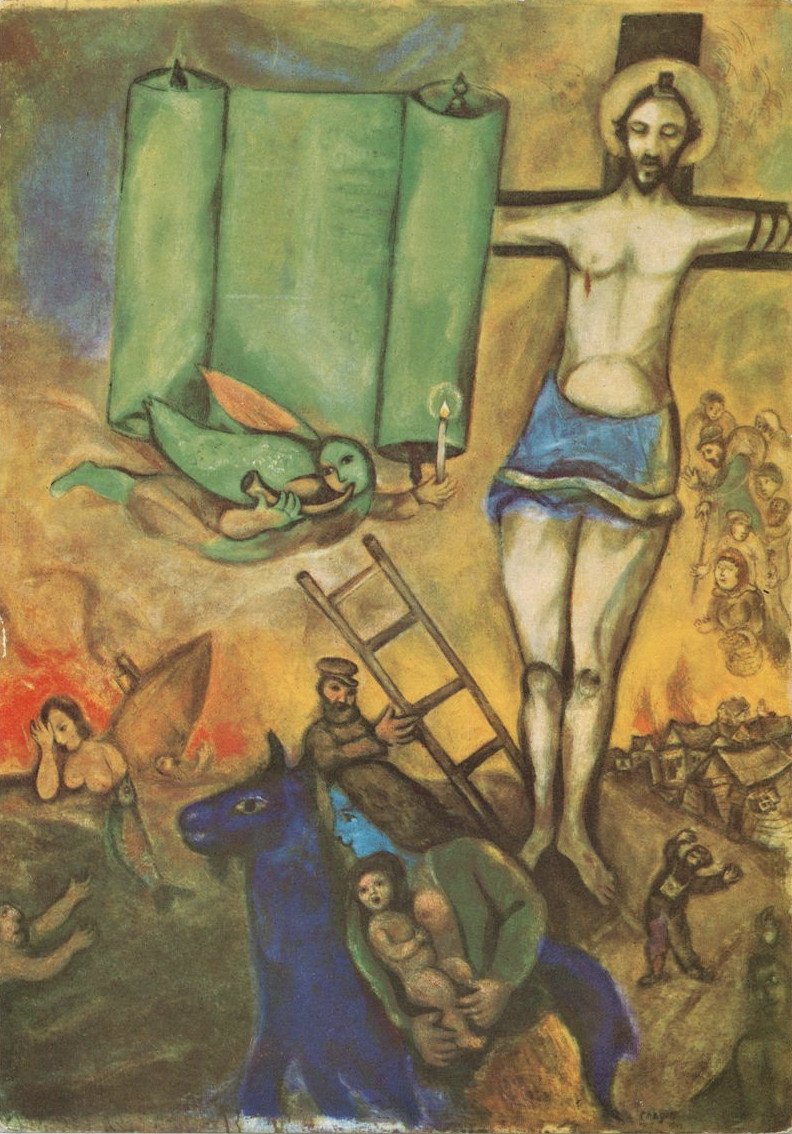
Jesus says, “They do all their deeds to be seen by others; for they make their phylacteries broad and their fringes long” (Matt 23:5). Here he is describing two Jewish practices and symbols known as tefillin and tzitzit (or tassels). These were both meant to serve as tangible reminders of their identity as beloved children of God. The phylacteries, or tefillin, are small leather boxes that contain verses of the Torah written in Hebrew on kosher parchment.[3] These boxes are strapped with leather bands to the head and the arm of the practitioner. The box on the arm points to the heart so that the person wearing the tefllin is reminded to love God with their all heart and mind as they rest prayerfully in their belovedness. If you look at the cover of your bulletin, you will see a Marc Chagall painting which portrays Jesus wearing tefillin even while on the Cross. It’s not hard to imagine Jesus wearing tefillin because we know that Jesus wore the other sartorial symbol that he describes in today’s Gospels: the tassles or tzitzit. In the Book of Numbers, God tells Moses that the Israelites are to make tassels on the corner of their garments, as a tangible reminder of their identity as beloved children of God.[4] Here is a prayer shawl (tallit) that I bought in Jerusalem and you can see the tassels on the corners. We know that Jesus wore these tassels because earlier in Matthew’s Gospel, a sick woman is healed by touching not the hem of his garment (which we usually hear) but the tassel (tzitzit or kraspedou) of his garment.[5] So again, Jesus is not criticizing the symbols (which are meant to serve as reminders of God’s love), but rather their misuse by those who turn them into props for their own self-aggrandizement, by those who make the phylacteries extra-large and the tassels extra-long to be seen and admired by others.
It is in this context that we can begin to understand Jesus’s extreme teaching on certain titles like “rabbi” and “father.” He says, “Call no one on earth your father…or teacher” (Matt 23:9-10). Does this mean that Jesus is upset with us every time we refer to a priest as father? Or when we refer to our own biological dads or stepdads as father? Or our instructors as teachers? No. First of all, we need to remember that Jesus, like most Jewish rabbis of the time, loved to use hyperbole, exaggeration to grab our attention and to wake us up. Second, we also need to remember that taking Jesus utterly seriously (which we must do if we claim him to be our Lord and Savior) is not the same as taking him literally. In Matthew’s Gospel, Jesus also says, “If you’re right eye causes you to sin, gouge it out and throw it away…[and] If you’re right hand causes you to sin, cut it off and throw it away” (Matthew 5:29 – 30). We take this teaching seriously, but please do not take it literally.[6] We know that Jesus’s disciples took him seriously but not always literally. We know this not only because they abstained from mutilating themselves (thank God!), but also because they continued using the titles “father” and “rabbi” without any compunction.[7] In our reading this morning from Paul’s letter to the Thessalonians, he says, “We dealt with each one of you like a father with his children” (1 Thessalonians 2:11) and in 1 Corinthians, he says, “In Christ Jesus I became your father through the Gospel” (1 Cor 4:15). They had no trouble using the title “father” during the Apostolic Age, and no trouble during the subsequent period, which is known as the time of the Church Fathers. We take Jesus seriously but not always literally. As Anglicans, we take Jesus seriously by understanding him in his Jewish context and in the larger context of Scripture, Tradition, and Reason.[8]
Jesus is not condemning the Jewish symbols of tefillin and tassels. Likewise, Jesus is not condemning titles such as “father” and “teacher.” It’s only when these symbols and titles become used as props for self-aggrandizement that they can become a problem and that’s when it’s probably wise to let them go. Just as tefillin and tassels are meant to remind us of our identity as beloved children of God so too can titles like “teacher” or “father” or even “the reverend doctor” remind us of the gifts we have received from God (gifts including our education and particular training and gifts of the Spirit), gifts given not for our own personal glory but to humbly serve others and to help others, in the words of Thomas Traherne, enjoy the world aright by waking up each day as if in heaven, by looking at the sky with celestial joy because we are all God’s chosen and beloved children for whom the whole world was made and it is in this foundational identity that we discover our ultimate felicity and freedom.
[1] Thomas Traherne, “The House of God” in Centuries, Poems, and Thanksgivings, edited by H. M. Margoliuth (Oxford: Clarendon Press, 1958) as cited in Teachings of the Christian Mystics, edited by Andrew Harvey (Boulder CO: Shambhala, 2019), 127 – 128.
[2] “Then Paul….called out in the Sanhedrin, ‘My brothers, I am a Pharisee, descended from Pharisees.’” Acts 23:6
[3] Usually the verses include Deuteronomy 6:6-8, which says, “You shall bind these commands on your heart…bind them on your foreheads.”
[4] “The LORD said to Moses: ‘Speak to the Israelites, and tell them to make fringes on the corners of their garments throughout their generations and to put a blue cord on the fringe at each corner. You have the fringe so that, when you see it, you will remember all the commandments of the LORD and do them, and not follow the lust of your own heart and your own eyes.’” (Numbers 15:37 – 39). There is a story of a Jewish man paying for a prostitute and then as he was removing his clothes he saw the tassles (tzitzit) and remembered his true identity and decided not to sleep with her. His decision then inspired the prostitute to live a godly life.
[5] kraspedou tou himatiou autou Matthew 9:20
[6] In Luke 14:26, Jesus also says, “Whoever comes to me and does not hate father and mother, wife and children, brothers and sisters, yes, and even life itself cannot be my disciple.”
[7] 1 John 2:1; Acts 7:2; John 20:16
[8] If someone ever criticizes you for not taking Jesus literally, ask them if they have sold all their possessions and given them to the poor (Luke 19:21) because that might be one of the times when we would be wise to take Jesus literally, as did St. Anthony of Egypt and St. Francis of Assisi.

 DANIEL DeFOREST LONDON